- Plants
- ›Vascular Plants
- ›flowering plants
- ›Dicots
- ›Sunflowers, Bellflowers, Fanflowers, and Allies
- ›Sunflowers, Daisies, Asters, and Allies
- ›Gymnarrhenoideae
- ›Gymnarrheneae
- ›Cavea
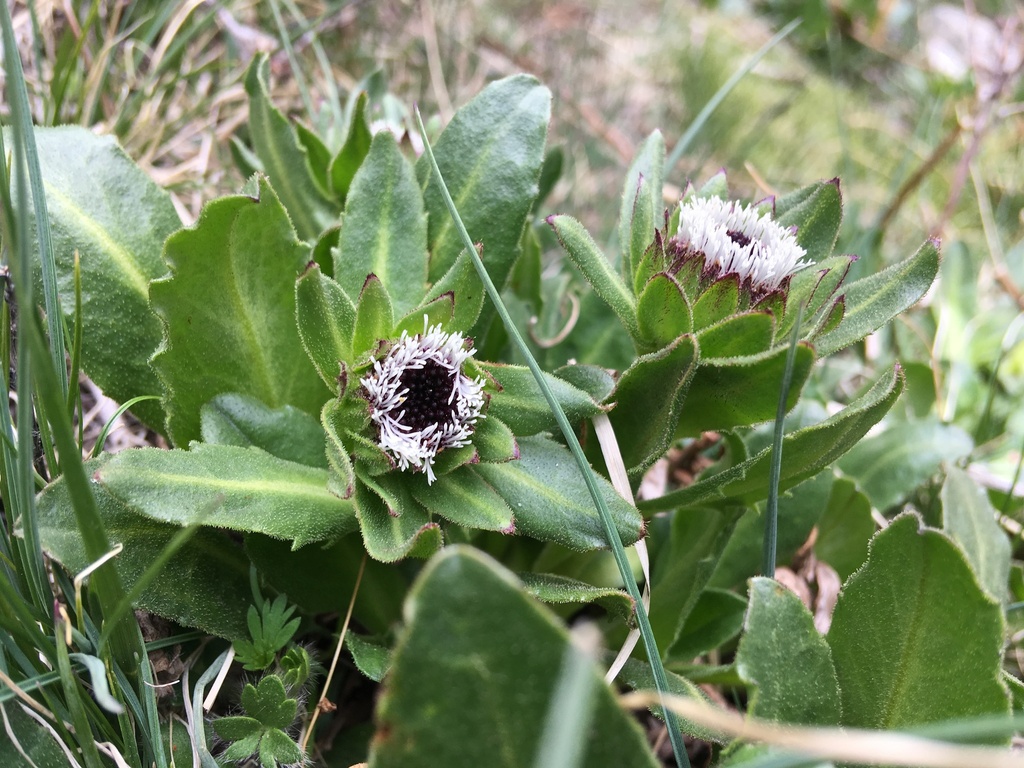
Cavea tanguensis
Cavea is a low perennial herbaceous plant that is assigned to the family Asteraceae. Cavea tanguensis is currently the only species assigned to this genus. It has a basal rosette of entire, slightly leathery leaves, and stems of 5–25 cm high, topped by bowl-shaped flower heads with many slender florets with long pappus and purplish corollas. The vernacular name in Chinese is 葶菊 (ting ju). It grows high in the mountains of Bhutan, China (Sichuan), India (Sikkim), Nepal and Tibet, and flowers in July and August.
From the article Cavea tanguensis on Wikipedia (CC BY-SA), quoted section by section
Description
Cavea is a perennial herb with stout, woody and mostly branched rootstocks of 10–30 cm long, which carry a basal leaf rosette and unbranching stems that carry some smaller leaves, bracts and flower heads.
Stems and leaves. The erect unbranching stems are stout and 5–25 cm high. The leaves in the basal rosette are somewhat leathery or even fleshy, the underside with many or few brownish glandular hairs, elongated spoon-shaped, 1+1⁄2–6 or exceptionally 12 cm long and 1⁄2–1 cm wide, at the base gradually narrowing to the main vein, the edge with some teeth far apart, and a blunt tip or almost pointy. The leaves on the stem have brownish glandular hairs, with some saw-like teeth and a blunt tip. The lower leaves on the stem are 3–6 cm long and 1⁄2–1¼ cm wide. Leaves become smaller and less leathery or fleshy further up, with the highest bract-like, up to 1+1⁄2 cm, almost vertically oriented and enveloping the base of the flower heads.
Inflorescence. Flower heads mostly contain relatively few male florets at the centre, encircled by many more female florets. However solely female flower heads also occur, and individual plants may even produce only female flower heads. The flower heads are individually set at the end of the branches, bowl-shaped and mostly 3–3+1⁄2 cm across. …
Range & habitat
This plant can be found in Bhutan, Nepal, southwestern Sichuan, Sikkim, and Tibet.
Wikipedia: “Distribution”
In human culture
Cavea is named after George Cave, who was the curator of the Lloyd's Botanical Garden in Darjeeling, and who collected many new plants from all over Sikkim.
Wikipedia: “Etymology”
Where it lives
Recorded sightings
—
geo-referenced records in GBIF, from museums, herbaria and field observers.
Drag the globe to turn it. Dots are where records exist, not a range map; darker means more records.
In the stacks
Searching the stacks…
Every page naming Cavea tanguensis in the Biodiversity Heritage Library →
This page is assembled live from iNaturalist, GBIF, Wikipedia, the Source Library and the Internet Archive. It is not yet part of the hand-edited codex. iNaturalist taxon 793916.