- Plants
- ›Vascular Plants
- ›flowering plants
- ›Dicots
- ›Mustards, Capers, and Allies
- ›mustard family
- ›Brassicoideae
- ›Camelinodae
- ›Turritideae
- ›Turritis
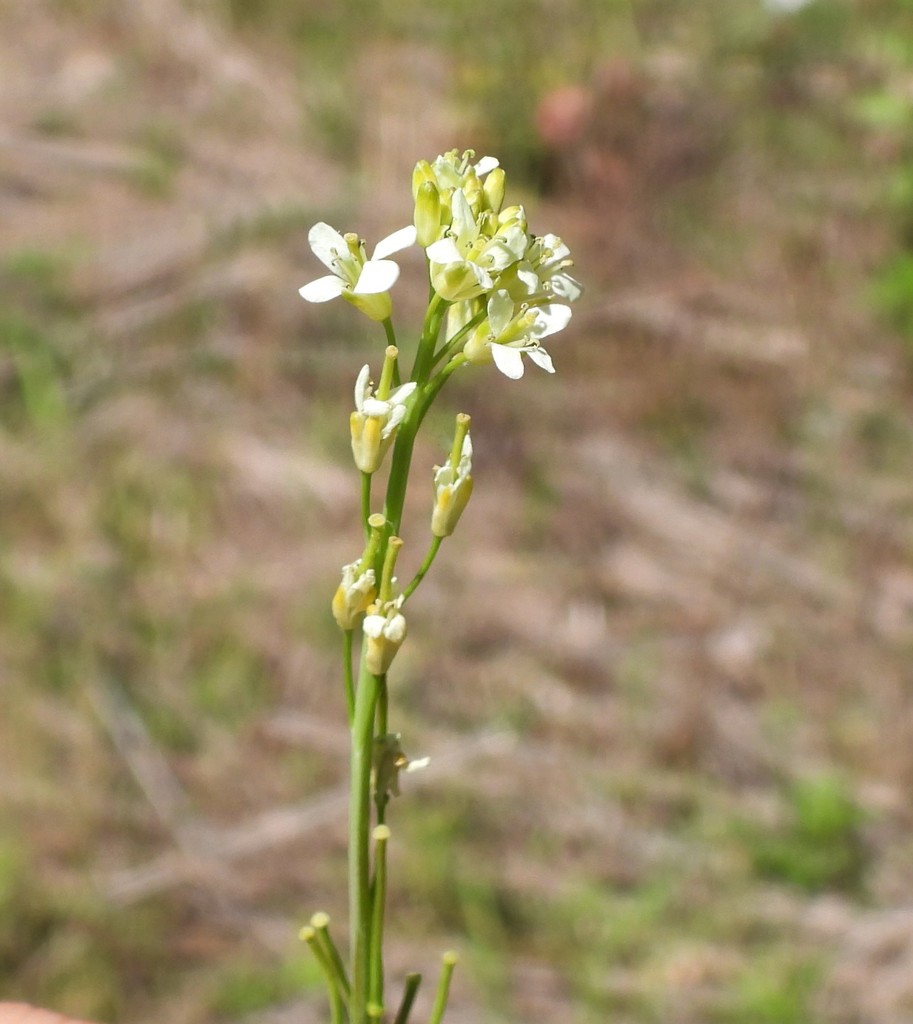
Tower Mustard
Turritis glabra
Turritis glabra, commonly known as tower rockcress or tower mustard, is a tall, slim, grey-green plant with small creamy flowers at the top of the stem. It usually grows on poor chalky or sandy soils, in open situations. It is native to Europe, Asia, and North Africa, and it is widespread in North America where it is also probably native. It can be found in many other parts of the world as an introduced species.
From the article Turritis glabra on Wikipedia (CC BY-SA), quoted section by section
Description
Tower mustard typically reaches 40 to 120 centimeters in height at full growth, but may be stunted to just 30 centimeters or might reach 1.5 meters in height in exceptional circumstances. It is typically a biennial herb, but may occasionally be a short lived perennial. Plants have a tap-root and fibrous side-roots. Plants usually have several erect, usually unbranched stems which are grey in the lower parts with a covering of simple hairs, but green and glabrous (hairless) above. The leaves occur in a basal rosette initially, and later grow alternately on the main stem and branches. The basal leaves are blunt and toothed or pinnatifid and up to 15 cm long, whereas the stem and branch leaves become progressively smaller, less divided and more pointed, clasping the stem. The basal leaves are usually covered in hairs (pubescent) on the upper surface, but in rare cases they may be hairless. They vary in shape from spoon shape with a narrow base and wide at the end (spatulate), to being a narrow spear point with the widest point in the middle (oblanceolate), or a rounded rectangle longer than wide (oblong) with a broad point. They are typically 5 to 12 centimeters long, but may be only 4 cm or as much as 15 cm in length. …
Range & habitat
The native distribution of tower mustard is moderately uncertain with sources having some details of its range different. POWO lists it as native to all parts of Europe with the exceptions of Ireland, Sardinia, and Corsica. They list it as growing in much of the northwest of Temperate Asia from Turkey and Iran northwards into central Asia and from Chita Oblast, Irkutsk Oblast, and Krasnoyarsk Krai westwards in Siberia. In the more southerly parts of Asia POWO lists it as native to Korea, Japan, Mongolia, Manchuria, north-central China, southeast China, Xinjiang, Nepal, and the western Himalayas. In addition they list it as introduced to Primorsky Krai, Sakhalin Island, and the Kuril Islands. In Africa POWO lists it as native to Algeria, Kenya, Morocco, Rwanda, Tanzania, Uganda, and the Democratic Republic of the Congo, with it being introduced to Lesotho and two parts of South Africa, KwaZulu-Natal, the Cape Provinces, and the Northern Provinces. In North America POWO lists it as native to all parts of Canada with the exceptions of Newfoundland and Labrador, Nova Scotia, Prince Edward Island, and Nunavut. …
Wikipedia: “Distribution and status”
Where it lives
Recorded sightings
—
geo-referenced records in GBIF, from museums, herbaria and field observers.
Drag the globe to turn it. Dots are where records exist, not a range map; darker means more records.
In the old herbals & bestiaries

In the stacks
Searching the stacks…
Every page naming Turritis glabra in the Biodiversity Heritage Library →
This page is assembled live from iNaturalist, GBIF, Wikipedia, the Source Library and the Internet Archive. It is not yet part of the hand-edited codex. iNaturalist taxon 79460.