- Plants
- ›Vascular Plants
- ›flowering plants
- ›Dicots
- ›Roses, Elms, Figs, and Allies
- ›elm family
- ›Ulmus
- ›Ulmus
- ›Foliaceae
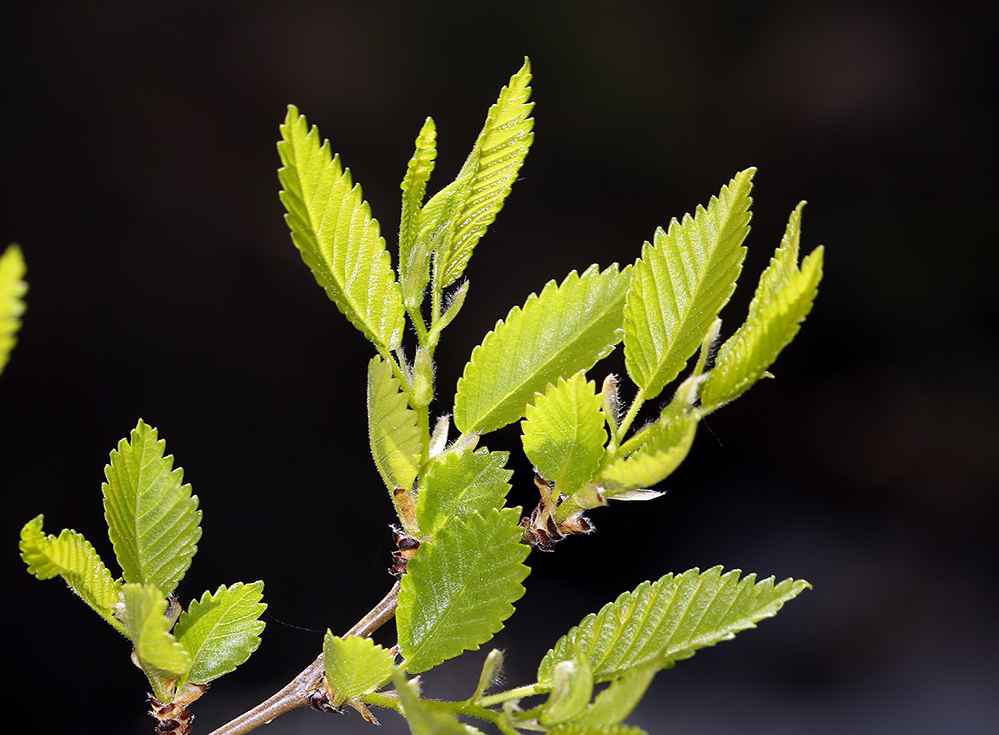
Siberian elm
Ulmus pumila
Ulmus pumila, the Siberian elm, is a tree native to Central Asia, eastern Siberia, the Russian Far East, Mongolia, Tibet, northern China, India (northern Kashmir) and Korea. It is also known as the Asiatic elm and dwarf elm, but sometimes miscalled the 'Chinese Elm' (Ulmus parvifolia). It is the last tree species encountered in the semi-desert regions of central Asia. Described by Pallas in the 18th century from specimens from Transbaikal, Ulmus pumila has been widely...
From the article Ulmus pumila on Wikipedia (CC BY-SA), quoted section by section
Description
The Siberian elm is usually a small to medium-sized, often bushy, deciduous tree growing to 25 m (82 ft) tall, the diameter at breast height to 1 m (3 ft 3 in). The bark is dark gray and irregularly longitudinally fissured. The branchlets are yellowish gray, glabrous or pubescent, unwinged, and without a corky layer, with scattered lenticels. The winter buds are dark brown to red-brown, globose to ovoid. The petiole is 4–10 millimetres (1⁄4–1⁄2 inch) and pubescent; the leaf blade is elliptic-ovate to elliptic-lanceolate, 2–8 by 1.2–3.5 centimetres (3⁄4 in–3+1⁄8 in × 1⁄2 in–1+3⁄8 in), the colour changing from dark green to yellow in autumn. The perfect, apetalous, wind-pollinated flowers bloom for one week in early spring, before the leaves emerge, in tight fascicles (bundles) on the last year's branchlets. Flowers emerging in early February are often damaged by frost (causing the species to be dropped from the Dutch elm breeding programme). Each flower is about 3 mm (1⁄8 in) across and has a green calyx with four or five lobes, four to eight stamens with brownish-red anthers, and a green pistil with a two-lobed style. …
Range & habitat
The tree is native to Central Asia, eastern Siberia, the Russian Far East, Mongolia, Tibet, northern China, India (northern Kashmir), and Korea. It is the last tree species encountered in the semidesert regions of Central Asia.
Wikipedia: “Distribution and habitat”
At the table
The unripe seeds have long been eaten by the peoples of Manchuria, and during the Great Chinese Famine, they also became one of the most important foodstuffs in the Harbin region. The leaves were also gathered, to the detriment of the trees, prompting a prohibition order by the authorities, which was largely ignored. The leaves eaten raw are not very palatable, but stewed and prepared with kaoliang or foxtail millet make a better-tasting and more filling meal.
Wikipedia: “Uses”
How it is grown
U. pumila was introduced into Spain as an ornamental, probably during the reign of Philip II (1556–98), and from the 1930s into Italy. In these countries, it has naturally hybridized with the field elm (U. minor). In Italy, it was widely used in viniculture, notably in the Po River Valley, to support the grape vines until the 1950s, when the demands of mechanization made it unsuitable. Three specimens were supplied by the Späth nursery of Berlin to the Royal Botanic Garden Edinburgh (RBGE) in 1902 as U. pumila, in addition to specimens of the narrow-leaved U. pumila cultivar 'Pinnato-ramosa'. One was planted in RBGE; the two not planted in the Garden may survive in Edinburgh, as it was the practice of the Garden to distribute trees about the city. Kew Gardens obtained specimens of U. pumila from the Arnold Arboretum in 1908 and, as U. pekinensis, via the Veitch Nurseries in 1910 from William Purdom in northern China. A specimen obtained from Späth and planted in 1914 stood in the Ryston Hall arboretum, Norfolk, in the early 20th century. Siberian Elm was propagated and marketed by the Hillier & Sons nursery, Winchester, Hampshire, from 1962 to 1977, during which time over 500 were sold. More recently, the popularity of U. pumila in Great Britain has been almost exclusively as a bonsai subject, and mature trees are largely restricted to arboreta. …
Wikipedia: “Cultivation”
Where it lives
Recorded sightings
—
geo-referenced records in GBIF, from museums, herbaria and field observers.
Drag the globe to turn it. Dots are where records exist, not a range map; darker means more records.
In the stacks
Searching the stacks…
Every page naming Ulmus pumila in the Biodiversity Heritage Library →
This page is assembled live from iNaturalist, GBIF, Wikipedia, the Source Library and the Internet Archive. It is not yet part of the hand-edited codex. iNaturalist taxon 79463.