- Plants
- ›Vascular Plants
- ›flowering plants
- ›Dicots
- ›Legumes, Milkworts, and Allies
- ›Legumes
- ›Acacias, Mimosas, Mesquites, and Allies
- ›Vachellia
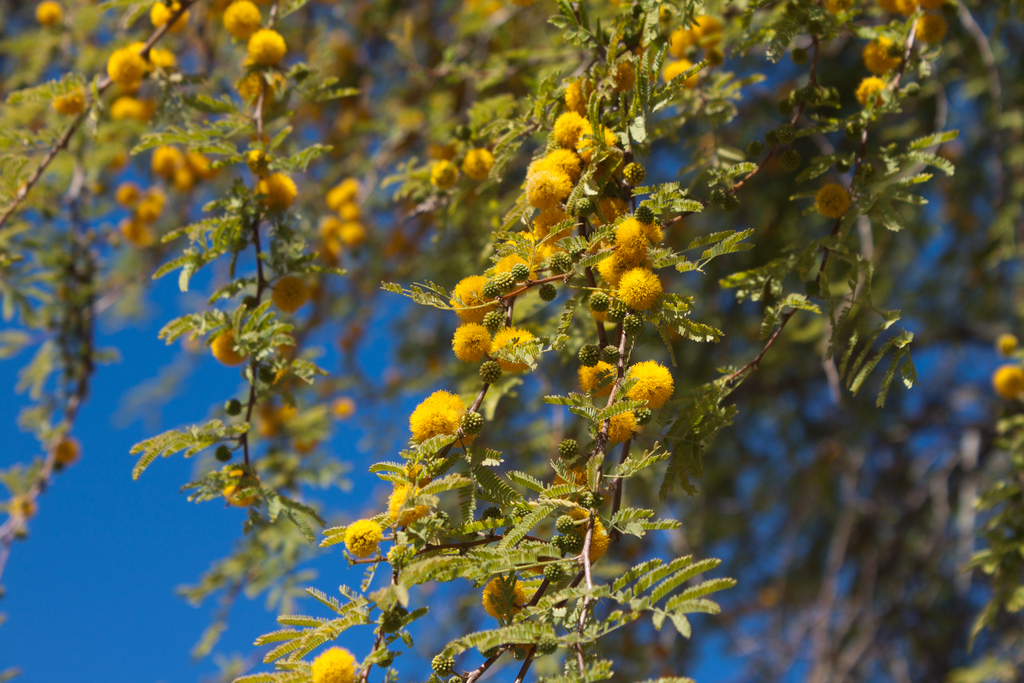
Sweet acacia
Vachellia farnesiana
Vachellia farnesiana, also known as Acacia farnesiana, and previously Mimosa farnesiana, commonly known as sweet acacia, huisache or needle bush, is so named because of the numerous thorns distributed along its branches. The native range of V. farnesiana is uncertain. While the point of origin is Mexico and Central America, the species has a pantropical distribution incorporating northern Australia and southern Asia. It remains unclear whether the extra-American distribution is primarily natural or anthropogenic. It is...
From the article Vachellia farnesiana on Wikipedia (CC BY-SA), quoted section by section
Description
The plant is deciduous over part of its range, but evergreen in most locales. Growing from multiple trunks, it reaches a height of 4.6–9.1 metres (15–30 feet). The bark is whitish gray. The base of each leaf is accompanied by a pair of thorns on the branch. The dark brown fruit is a seed pod.
Range & habitat
Of all Acacia species, this plant has the greatest distribution. It was first described by Europeans in 1625 by Tobias Aldini from plants grown from seed collected in Santo Domingo, in what is now the Dominican Republic. The native range of V. farnesiana has been or is sometimes disputed. While the point of origin is thought to be the Caribbean, the Guianas, Mexico, and/or Central America, the species has a pantropical distribution incorporating most of the Americas (from the Southern U.S. to Chile, excluding the Amazon), most of Australia, much of Africa, southern Europe, and southern Asia. In the Caribbean, it is present from the Bahamas and Cuba south to Trinidad, Curaçao, and Aruba, where in it is believed to be native to Hispaniola and certainly Cuba, but possibly native or naturalised elsewhere. In the U.S., it is thought to be native to southern Texas, southern New Mexico, southern Arizona, and southern California, but perhaps naturalized in southern Louisiana, coastal Mississippi, coastal Alabama, coastal Georgia, and southern Florida. Whether the extra-American distribution is natural (the seed pods have probably floated across the Pacific) or anthropogenic remains disputed. It was introduced to Europe, the Middle East, India, Africa, and recently Gran Canaria and Hawaii. …
Wikipedia: “Distribution and habitat”
What it does
Deer and peccaries eat its fruit, various birds use the plant for nesting and cover, and insects eat the nectar from its flowers. If disturbed, it readily resprouts. It thrives in dry, saline, or sodic soils. It is considered a serious pest plant in parts of Australia, as it interferes with cattle-ranching operations. It readily spreads in commercial grazing pastures, especially along creeks, which might affect ease of transport for farmers, complicates muster, and can damage farm machinery. The seeds are dispersed by cattle after they eat the nutritious pods, and growth is promoted by overgrazing. Numerous herbicides are used to control it on ranches; chemical control is the only way to kill it. The plant has been spread to many new locations as a result of human activity, and it is considered a serious weed in Fiji, where locals call it Ellington's curse.
Wikipedia: “Ecology”
In medicine
In Brazil, some people use the seeds of V. farnesiana to kill rabid dogs. V. farnesiana has been used in Colombia to treat malaria, and in one in vitro study, an ethanol extract from the leaves showed some activity against the malarial pathogen Plasmodium falciparum with an IC50 value of 1 to 2 microgram/millilitre (as did almost everything tested), though it showed no activity in animal models or a ferriprotoporphyrin biomineralization inhibition test. In the Philippines the leaves are traditionally rubbed on the skin to treat skin diseases in livestock. In Malaysia, an infusion of the plant's flowers and leaves is mixed with turmeric for post-partum treatment.
Wikipedia: “Traditional medicine”
In human culture
It was first described by Europeans under the name Acacia Indica Farnesiana in 1625 by Tobias Aldini from plants grown in Rome in the Farnese Gardens from seed collected in Santo Domingo, in what is now the Dominican Republic, which germinated in 1611. Aldini included an illustration of the plant, which he contrasted with an illustration of the first known Acacia; Acacia nilotica. This first (European) illustration of the plant was later designated as the (lecto-)type. In 1753, Carl Linnaeus used Aldini's work as basis for his taxon Mimosa farnesiana. In 1806 Carl Ludwig Willdenow moved this taxon to the genus Acacia. Partly due to its wide distributional range, the taxon has attracted many synonyms. Especially in the United States, taxonomy has been confused. In 1809, Willdenow described Acacia acicularis from Central America collected and named during Humboldt and Bonpland's scientific expedition to the Americas. Acacia ferox was described in 1843 in Belgium from collections in Mexico. …
Wikipedia: “Taxonomic history”
Where it lives
Recorded sightings
—
geo-referenced records in GBIF, from museums, herbaria and field observers.
Drag the globe to turn it. Dots are where records exist, not a range map; darker means more records.
In the stacks
Searching the stacks…
Every page naming Vachellia farnesiana in the Biodiversity Heritage Library →
This page is assembled live from iNaturalist, GBIF, Wikipedia, the Source Library and the Internet Archive. It is not yet part of the hand-edited codex. iNaturalist taxon 79472.