- Plants
- ›Vascular Plants
- ›flowering plants
- ›Dicots
- ›Heathers, Balsams, Primroses, and Allies
- ›heath family
- ›Epacrids, Styphelias and Allies
- ›Epacrideae
- ›Epacris
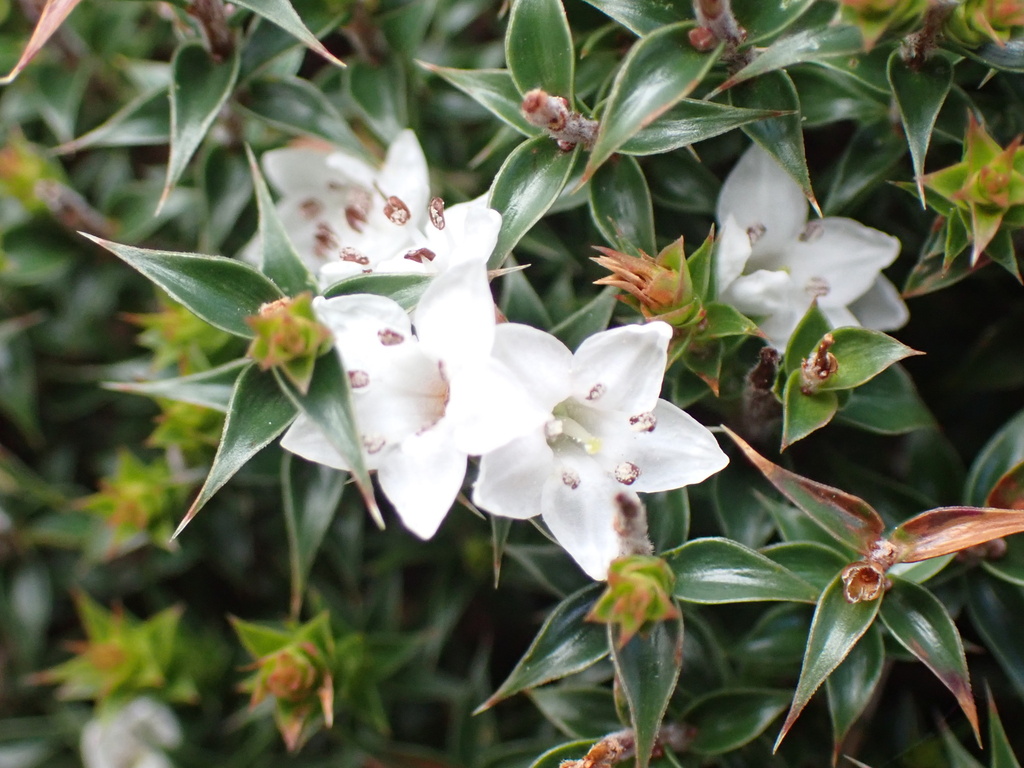
Epacris acuminata
Epacris acuminata, commonly known as claspleaf heath, is a species of flowering plant in the heath family Ericaceae and is endemic to Tasmania. It is a small, spreading shrub with egg-shaped, stem-clasping leaves and tube-shaped flowers with white petals.
From the article Epacris acuminata on Wikipedia (CC BY-SA), quoted section by section
Description
Epacris acuminata is an erect shrub that typically grows to a height of up to 1.5 m (4 ft 11 in), and has many branches from near the base. The leaves are egg-shaped, concave and stem-clasping, 4–9 mm (0.16–0.35 in) long and 3–5 mm (0.12–0.20 in) wide on a petiole less than 1 mm (0.039 in) long. The tip of the leaves is sharply-pointed and there are five to seven veins showing on the lower surface. The flowers are arranged singly in leaf axils in dense clusters along the branches. The petals are white and joined at the base, forming a tube 4–6 mm (0.16–0.24 in) long with lobes about the same length. The style is 6–8 mm (0.24–0.31 in) long and protrudes from the petal tube with the stamens. Flowering occurs from July to October and the fruit is a capsule about 2 mm (0.079 in) long with the remains of the sepals and bracts attached.
Range & habitat
Claspleaf heath grows in low shrubland on mountain peaks, in heathy woodland, forest and along watercourse. It occurs in the south-east, the midlands and the eastern edge of the Central Plateau in Tasmania.
== References ==
Wikipedia: “Distribution and habitat”
Where it lives
Recorded sightings
—
geo-referenced records in GBIF, from museums, herbaria and field observers.
Drag the globe to turn it. Dots are where records exist, not a range map; darker means more records.
In the stacks
Searching the stacks…
Every page naming Epacris acuminata in the Biodiversity Heritage Library →
This page is assembled live from iNaturalist, GBIF, Wikipedia, the Source Library and the Internet Archive. It is not yet part of the hand-edited codex. iNaturalist taxon 803263.