- Plants
- ›Vascular Plants
- ›flowering plants
- ›Dicots
- ›proteas, lotuses, planes, and allies
- ›Protea family
- ›Singlet Proteas
- ›Smokebushes and Blueboys
- ›Conosperminae
- ›Conospermum
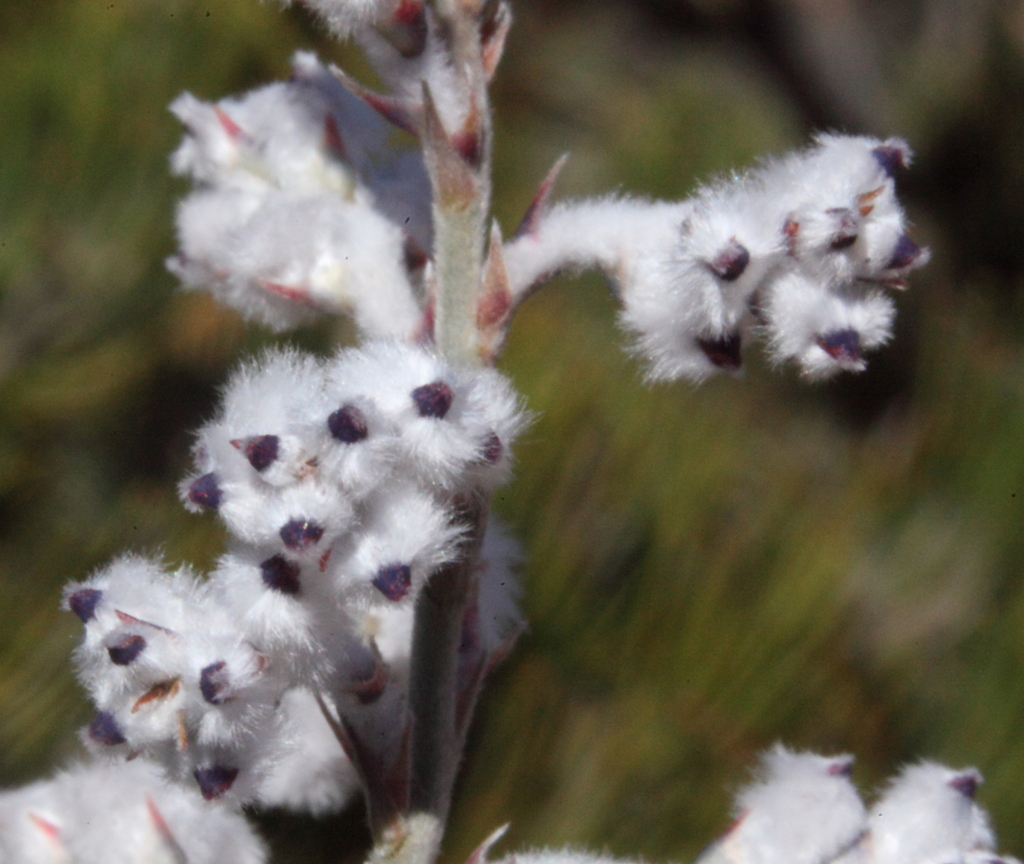
plume smokebush
Conospermum incurvum
Conospermum incurvum, commonly known as plume smokebush, is a species of flowering plant in the family Proteaceae and is endemic to the south-west of Western Australia. It is an erect, spindly or prostrate shrub with densely arranged cylindrical leaves, and panicles of white, tube-shaped flowers with dark blue bracteoles.
From the article Conospermum incurvum on Wikipedia (CC BY-SA), quoted section by section
Description
Conospermum incurvum is a prostrate or erect, spindly shrub that typically grows to a height of 0.4–1 m (1 ft 4 in – 3 ft 3 in), its stems densely covered in cylindrical leaves, 7–30 mm (0.28–1.18 in) long and 0.5–0.8 mm (0.020–0.031 in) wide. The leaves are s-shaped and the edges are curved upwards. The flowers are arranged in woolly panicles 50–400 mm (2.0–15.7 in) long on the ends of branches. The flowers have many bracts and dark blue, d-shaped bracteoles 2.2–3.5 mm (0.087–0.138 in) long and 2–3 mm (0.079–0.118 in) wide. The perianth is tube-shaped, 4–7 mm (0.16–0.28 in) long, woolly and white.
Range & habitat
Plume smokebush occurs in undulating sandplains of white, grey or yellow/brown sand over laterite, ranging from Eneabba south to Perth. Thus it primarily occurs in the Swan Coastal Plain and Geraldton Sandplains biogeographic regions. There are also some outlying populations in the Avon Wheatbelt and Jarrah Forest regions, and a single population in the Esperance Plains region north of Albany.
Wikipedia: “Distribution and habitat”
Where it lives
Recorded sightings
—
geo-referenced records in GBIF, from museums, herbaria and field observers.
Drag the globe to turn it. Dots are where records exist, not a range map; darker means more records.
In the stacks
Searching the stacks…
Every page naming Conospermum incurvum in the Biodiversity Heritage Library →
This page is assembled live from iNaturalist, GBIF, Wikipedia, the Source Library and the Internet Archive. It is not yet part of the hand-edited codex. iNaturalist taxon 804268.