- Plants
- ›Vascular Plants
- ›flowering plants
- ›monocots
- ›grasses, sedges, cattails, and allies
- ›Pipeworts
- ›Eriocaulon
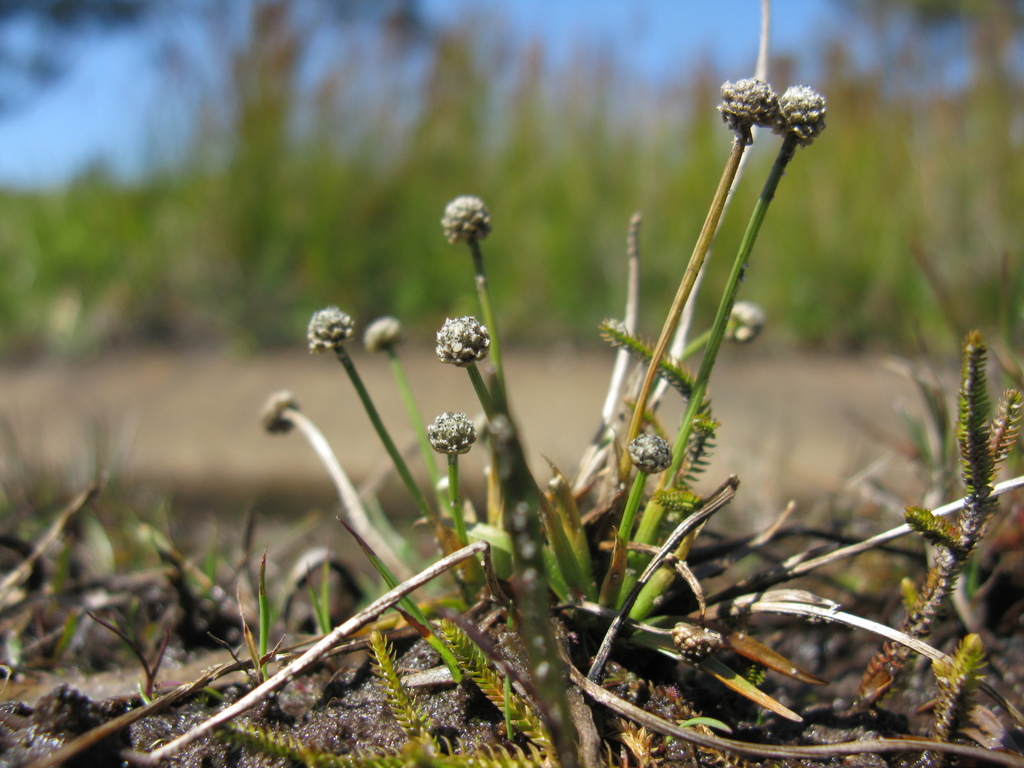
Rough Pipewort
Eriocaulon scariosum
Eriocaulon scariosum, commonly named common, rough or pale pipewort, is a species of tufted grass-like herbaceous plants, constituting part of the plant family Eriocaulaceae. The scientific name of Eriocaulon is derived from Ancient Greek ἔριον, erion, which means 'wool', and καυλός, caulos, which means 'stalk'.
Common pipewort plants grow naturally in wetlands, bogs and drainage areas, from central and eastern Victoria, through eastern New South Wales, including the Australian Capital Territory, to eastern and north Queensland, Australia.
From the article Eriocaulon scariosum on Wikipedia (CC BY-SA), quoted section by section
Description
Eriocaulon scariosum is an aquatic monocot in the Eriocaulaceae plant family. Eriocaulon scariosum is found across Victoria, New South Wales, Queensland and the Northern Territory. It is a small plant with small, thin and flat leaves and a thin, long stem. The plant has terminal buds, tiny flowers that bunched are together in a ball-like shape and at the flower base, there are fringed bracts. During the flowering period from January to June (NSW), the leaves of Eriocaulon scariosum can range from 15 to 80 mm long and 1.5–2 mm wide and the bracts have an inner surface glabrous that are concave and scarious. The outer surface glabrous; have inner bracts obovate to spathulate, greyish and concave. The outer surface of the plant has short white hairs on the distal abaxial surface. The flower heads of the plant species are 3–6 mm long, 3.5–5.5 mm wide. Eriocaulon produces new leaves outwards from the central crown. The involucral bracts are straw-yellow and are an egg-shaped leaf and come in elliptic to broadly elliptic forms. The involucral bracts are 1.75–2 mm long and 0.9–1.5 mm wide, they are obtuse and at maturity they are reflexed. Floral bracts have either a translucent to black appearance of a translucent base, they are 1.5–2.5 mm long, 0.6–1.1 mm wide. …
Range & habitat
Eriocaulon scariosum is native to Australia and its occurrence is rare in Victoria as stated in The Royal Botanic Gardens Victoria. It is categorised as “rare” in Victoria's in the Advisory list of rare or threatened plants in Victoria – 2014 maintained by the Victoria Department of Environment and Primary Industries (DEPI). This Advisory List is constructed from technical and scientific information and knowledge from a variety of botanic experts. The conservation status of Eriocaulon scariosum is deemed as to not be under threat and widespread across Australia. It is not classified in the Federal Environment Protection Biodiversity Conservation Act 1999 (EPBC Act). The plant's distribution is commonly spread in eastern and central Victoria, New South Wales, Queensland and Northern Territory. Eriocaulon scariosum grows in wet areas such as wetlands, bogs, melaleuca swamps and lakes and springs, drainage areas and soils that contain sand. In the damp areas, Eriocaulon scariosum is often overlooked and inconspicuous as it is difficult to find due to its small size. The Castlereagh Swamp Woodland Community, an endangered ecological community, facilitates habitat for several plant species that are described as of regional importance, according to the Urban Bushland Biodiversity Survey, NPWS (1997). …
Wikipedia: “Habitat and distribution”
What it does
The flowering period of Eriocaulon scariosum is from January through June each year. The Eriocaulaceae family grows the best in the Western Hemisphere, more specifically the ‘New World tropics’. The centres of diversity of Eriocaulon include Africa, the Indian subcontinent and South America. The species in the genus is mainly made up of small perennial herbs and are situated in shallow water or damp habitats. In Eriocaulon plants, the nectar glands on the apices of petals make fluid that acts on attracting insects, which leads to insect pollination. Within wet habitats, the abundance of Eriocaulon scariosum is determined by the occurrence of fire, water levels and other contesting plants such as grasses. Experiments found that the plant is weak in survival in comparison to other wetland plant species. The Eriocaulon species has become a more recurrent plant because their threats and requirements to grow has been studied and more understood. In order for the plants to grow better and more easily, the substrate levels for the environment needs to be soft water with substantiating CO2. They can do extremely better with higher CO2 levels and light. …
Wikipedia: “Ecology”
In human culture
In the past, the only treatment and taxonomy of Eriocaulon in Australia were from the nineteenth century. Leach (2000) listed nine new species that are endemic to northern Australia. This species was described with the name Eriocaulon scariosum, and it was published scientifically in The Cyclopedia by James E. Smith located in London. There are regional floral treatments and publications on Eriocaulon that facilitate information on the Australian genus. The seed coat morphology can facilitate a set of characteristics that are useful in the diagnosis and identification of species and data on the relationships of the species. Most species of Eriocaulon has a consistent seed coat pattern, as verified by research on the Australian species. Seed coat pattern can be observed through a microscope, dissecting it. The ontogenetic development of the floral features in the plant has been referenced by Phiiplis (1994) and Giulietti et al. (1987). What is key to the taxonomy of Eriocaulon taking place on mound springs in Australia is that the seed of the Eriocaulon is with papillae and is displayed in a reticulate pattern. The plant has large female sepals, oblong spatulate leaves. and has no thick or heavy dorsal keels. This appearance is on mound springs in the Taroom district and present in different habitats.
Wikipedia: “Taxonomic history”
Where it lives
Recorded sightings
—
geo-referenced records in GBIF, from museums, herbaria and field observers.
Drag the globe to turn it. Dots are where records exist, not a range map; darker means more records.
In the stacks
Searching the stacks…
Every page naming Eriocaulon scariosum in the Biodiversity Heritage Library →
This page is assembled live from iNaturalist, GBIF, Wikipedia, the Source Library and the Internet Archive. It is not yet part of the hand-edited codex. iNaturalist taxon 805548.