- Plants
- ›Vascular Plants
- ›flowering plants
- ›Dicots
- ›Mints, Plantains, Olives, and Allies
- ›bignonia family
- ›Handroanthus
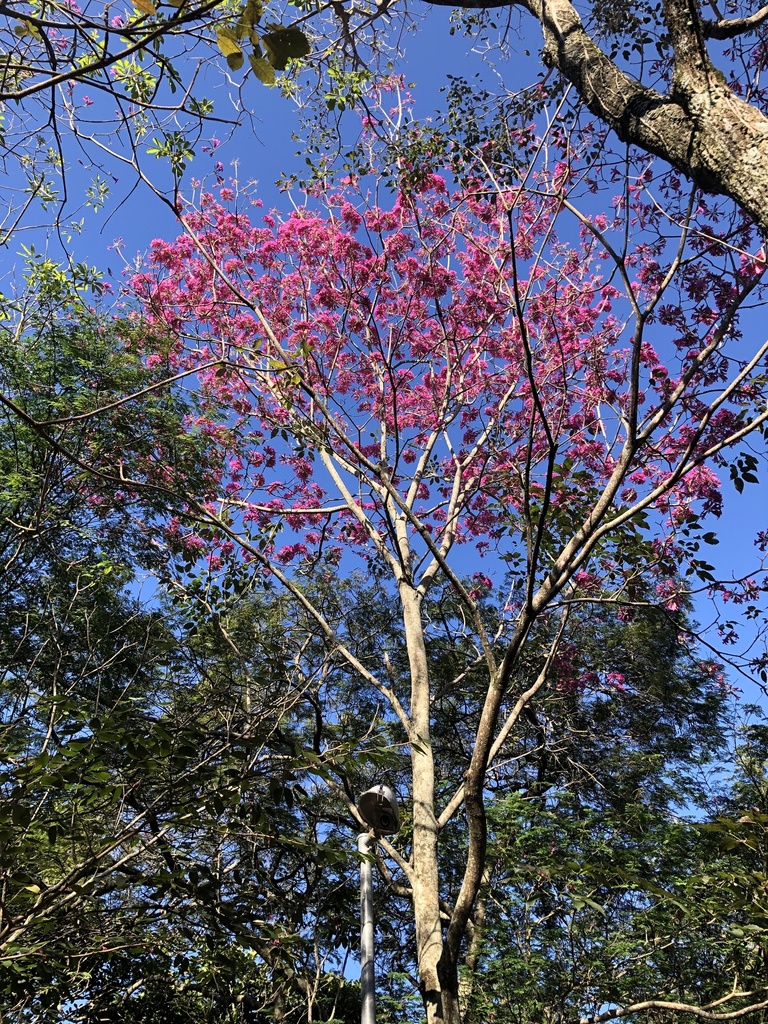
Pink Tab
Handroanthus heptaphyllus
Handroanthus heptaphyllus, commonly referred to as the pink trumpet tree or pink tab, is a Bignoniaceae tree native to tropical and subtropical regions of South America. It grows in the high forest watershed of the Paraná River, Paraguay River and Uruguay River. It has a limited distribution, almost exclusively inhabiting low lands with wet and deep soils, where it forms part of the upper layer of tree cover.
Along with all the other species in the Handroanthus genus, it is the national tree of Paraguay, as proposed by the School of Chemical Sciences at the National University of Asunción in celebration of the bicentenary of Paraguay's independence.
From the article Handroanthus heptaphyllus on Wikipedia (CC BY-SA), quoted section by section
Description
Handroanthus heptaphyllus can reach up to 40 m in height. The bark is brown-gray, very rough, with deep cracks in adult specimens. H. heptaphyllus requires specific light and humidity conditions, and is susceptible to frost when young. The tree is considered decorative, and is frequently used in parks, squares and public woodland. It is often confused with Handroanthus impetiginosus, which has similar characteristics except for tree height and leaf size. As per Brazilian botanist Lúcia Lohmann, Handroanthus heptaphyllus is a short-medium height tree with a maximum height of 15 m. Its leaves are palmate compound with opposite orientation. Each compound leaf contains 5-7 elliptical leaflets that are 10-15 cm long and have serrated edges. The tree is semi-deciduous with purple/pink tubular flowers that develop before the leaves. The flowers can vary in color from bright pink to pale pink or even white. The fruit of H. heptaphyllus is shaped like a long pod up to 30–40 cm long and 1-1.5 cm wide. The pods are brown when ripe and eventually open longitudinally and drop up to 150 winged seeds. It withstands high winds and has a strong and deep root system. Flowering begins in the first half of September. Approximately 30 days after flowering begins, the first leaves begin to appear. Ripe fruit appears between January and February.
Where it lives
Recorded sightings
—
geo-referenced records in GBIF, from museums, herbaria and field observers.
Drag the globe to turn it. Dots are where records exist, not a range map; darker means more records.
In the stacks
Searching the stacks…
Every page naming Handroanthus heptaphyllus in the Biodiversity Heritage Library →
This page is assembled live from iNaturalist, GBIF, Wikipedia, the Source Library and the Internet Archive. It is not yet part of the hand-edited codex. iNaturalist taxon 808333.