- Plants
- ›Vascular Plants
- ›flowering plants
- ›monocots
- ›Agaves, Orchids, Irises, and Allies
- ›Stargrasses and allies
- ›Hypoxis
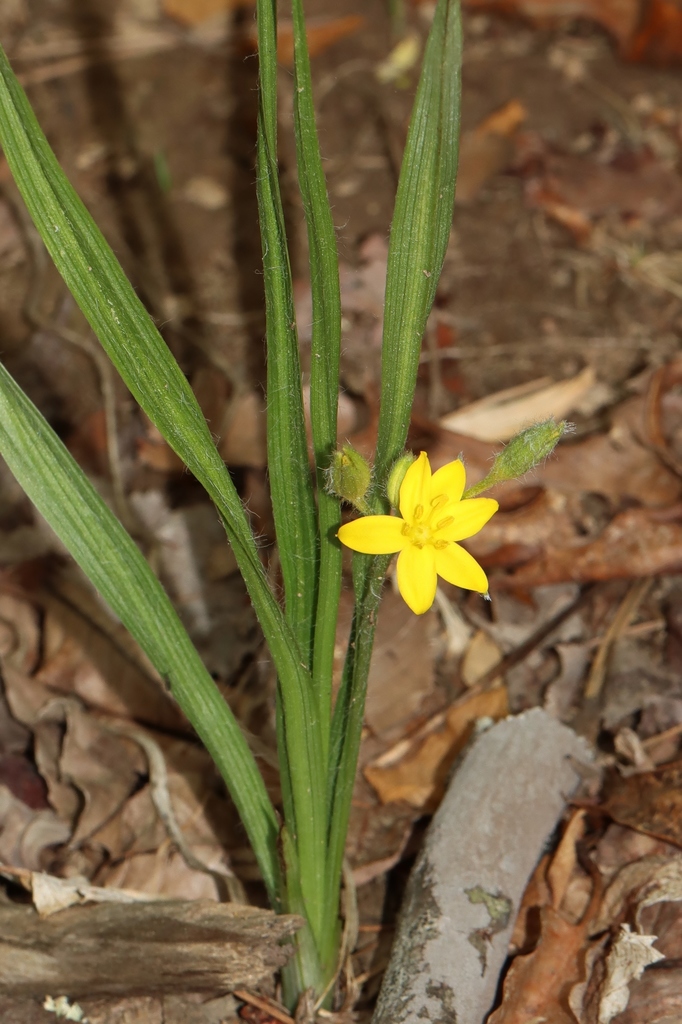
yellow star grass
Hypoxis hirsuta
Hypoxis hirsuta, commonly known as common goldstar, common star-grass, eastern yellow stargrass, yellow star grass, or yellow star flower, is a perennial ornamental plant in the family Hypoxidaceae. Sometimes this plant is placed in the family Amaryllidaceae or the family Liliaceae. The species is native to the United States, Canada, and northeastern Mexico.
From the article Hypoxis hirsuta on Wikipedia (CC BY-SA), quoted section by section
Description
H. hirsuta has grass-like, basal leaves that are up to 30 cm (12 in) long and one or more shorter stems, growing up from the rosette of leaves to 20 cm (8 in) long. The leaves have smooth margins and are elliptical in shape. Both the leaves and the stem have scattered white hairs. Flowers appear April to May at the end of each stem in a group, or umbel, of 2 to 6, occasionally only 1. The flowers are 5–13 mm (0.2–0.5 in) long, with 3 yellow petals and 3 yellow sepals spreading outwards. The flowers will open in the morning but typically wilt in the hot afternoon sun. When not flowering, the plant can resemble grass, but it is not a grass.
Range & habitat
H. hirsuta is native in the United States from New Mexico to the west, Texas to the south, the Canadian border to the north, and Maine to the east. In Canada, it is native in Manitoba, Saskatchewan, and Ontario. It is also native in northeastern Mexico, south to Tamualipas. The plant grows in moist to slightly dry habitats such as prairies, savannas, open woodlands, fens, glades, abandoned fields, and lawns.
Wikipedia: “Distribution and habitat”
In human culture
The genus name Hypoxis is from the Greek words hypo and oxys, meaning "sharp below", referring to how the seedpods have a tapered base. The specific epithet hirsuta is Latin for "hairy".
Wikipedia: “Etymology”
Where it lives
Recorded sightings
—
geo-referenced records in GBIF, from museums, herbaria and field observers.
Drag the globe to turn it. Dots are where records exist, not a range map; darker means more records.
In the stacks
Searching the stacks…
Every page naming Hypoxis hirsuta in the Biodiversity Heritage Library →
This page is assembled live from iNaturalist, GBIF, Wikipedia, the Source Library and the Internet Archive. It is not yet part of the hand-edited codex. iNaturalist taxon 81797.