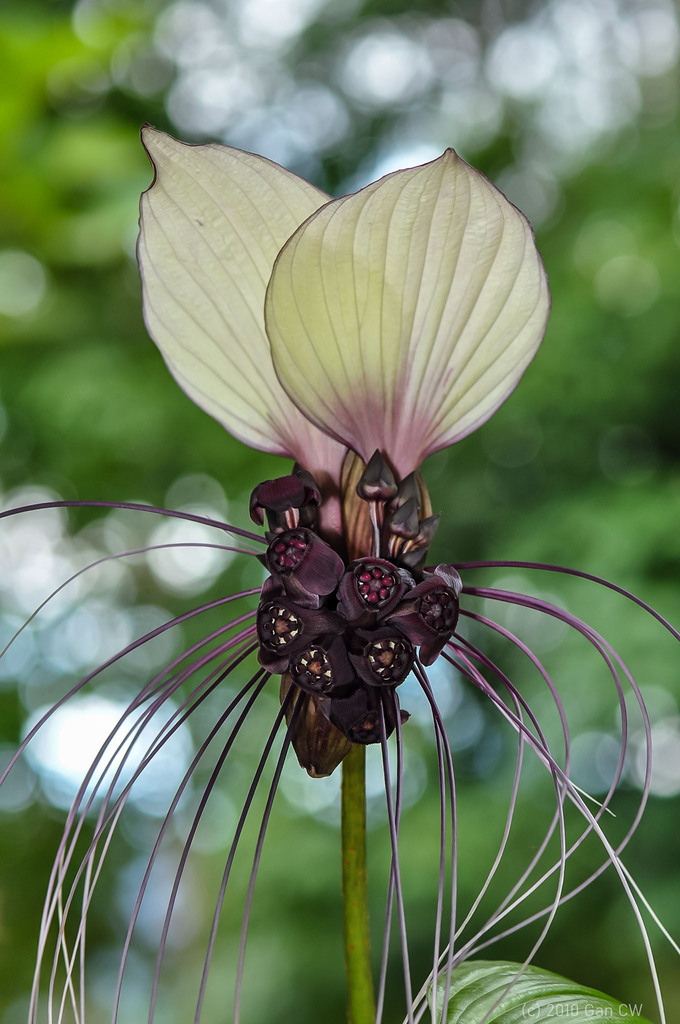
White Bat Flower
Tacca integrifolia
Tacca integrifolia, also known as the white batflower or the black lily, is a species of flowering plant in the family Dioscoreaceae. It is native to tropical and subtropical rainforests in hilly regions of South Asia, including India, Pakistan, Bangladesh, Indochina, the Malay Peninsula, Sumatra, Java and eastern China.
From the article Tacca integrifolia on Wikipedia (CC BY-SA), quoted section by section
Description
Tacca integrifolia is a herb growing from a thick, cylindrical rhizome as long as 12 cm (5 in) and a diameter of 3 cm (1 in). Its oblong-elliptical or lanceolate leaf blades are borne on long stems, some 50 by 20 cm (20 by 8 in) including the petioles, with tapering bases and slender pointed tips. White batflowers that grow in hilly areas are larger in size than batflowers that grow elsewhere.
Umbels. The flower scape is about 55 cm (22 in) long and is topped with a pair of involucral bracts, broad and erect, white with mauve venation. Among the individual nodding flowers, which are arranged in an umbel, are further long, filiform (thread-like) bracts. The perianth of each flower is tubular and purplish-black, 1 to 2 cm (0.4 to 0.8 in) long, with two whorls of three perianth lobes, the outer three narrowly oblong 12–15 cm (5–6 in) long and the inner three broadly obovate. The fruits are fleshy berries some 2 cm (0.8 in) long, and the seeds, which have six longitudinal ridges, have the remains of the perianth lobes still attached.
Range & habitat
It grows in the understorey of humid primary and secondary rainforests. The substrates it grows in are rocky soil and sandy soil underneath leaf litter.
Wikipedia: “Habitat”
What it does
The stamens are attached to the tube of the perianth in a helmet-like manner and, with the flat-topped stigma lobes, may form an insect trap; a sweet musky odour has been detected from these flowers and this may attract flies as pollinators. After pollination, the scape bends over and the developing fruits rest on the ground. The fleshy fruits are a dull colour with soft jelly-like pulp, and it is possible that the seeds are dispersed by rodents and other small mammals as they feed on the fruits.
Wikipedia: “Ecology”
Where it lives
Recorded sightings
—
geo-referenced records in GBIF, from museums, herbaria and field observers.
Drag the globe to turn it. Dots are where records exist, not a range map; darker means more records.
In the stacks
Searching the stacks…
Every page naming Tacca integrifolia in the Biodiversity Heritage Library →
This page is assembled live from iNaturalist, GBIF, Wikipedia, the Source Library and the Internet Archive. It is not yet part of the hand-edited codex. iNaturalist taxon 81995.