- Animals
- ›Arthropods
- ›Hexapods
- ›Insects
- ›Winged and Once-winged Insects
- ›Beetles
- ›Water, Rove, Scarab, Long-horned, Leaf, and Snout Beetles
- ›Cucujiform Beetles
- ›Longhorn Beetles and Allies
- ›Longhorn Beetles
- ›Flat-faced Longhorn Beetles
- ›Lamiini
- ›Monochamus
- ›Monochamus
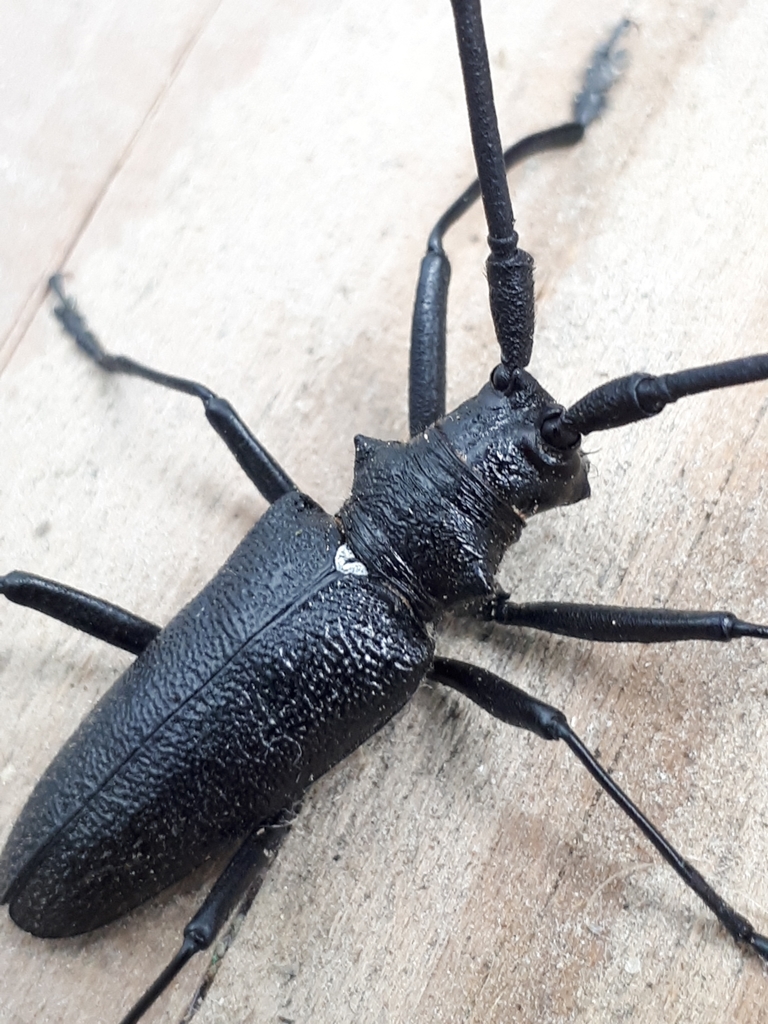
White-spotted Sawyer
Monochamus scutellatus
Monochamus scutellatus, commonly known as the white-spotted sawyer or spruce sawyer or spruce bug or a hair-eater, is a common wood-boring beetle found throughout North America. It is a species native to North America.
Adults are large-bodied and black, with very long antennae; in males, they can be up to twice the body length, but in females they are only slightly longer than body length. Both sexes have a white spot on the base of the wings, and may have white spots covering the wings. Both males and females also have a spine on the side of the prothorax. Most research done on M. scutellatus focuses on their relationship with burned forests and the logging industry, with interest also being shown in their mating behaviours.
From the article Monochamus scutellatus on Wikipedia (CC BY-SA), quoted section by section
Range & habitat
In boreal forests where fire has altered the landscape, changes come to plant communities and carbon flux. This change opens up opportunities for immigrant species to move into a competitor-free habitat. Several groups of insects, including the genus Monochamus, have become adapted to exploit these conditions. M. scutellatus is a saproxylic insect, which means that at least part of its life cycle is dependent on either dead or dying wood. For these beetles to successfully colonize a new habitat, such as an area that has been burned by forest fire, it must be of high enough quality and in close enough range. Studies have shown that several Monochamus species use the pheromones of bark beetles as kairomones to find suitable host habitats quickly and efficiently, enabling them to devote time and energy to other activities. In the cases of succession after fires, the abundance of M. scutellatus is positively correlated with the severity of the fire, the abundance and size of the burned trees, and the distance between burned and unburned land. However, more larvae tend to be found in areas with a larger percentage of unburned forest within 500 metres, which may be related to the dietary requirements of the adult beetles. Adult females seem to prefer to lay their eggs in trees with thick bark and phloem, and consequently trees with diameters greater than 8–10 centimetres. …
Wikipedia: “Habitat”
What it does
As with many other insects, both intraspecies and interspecies competition occurs in M. scutellatus over resources. Hughes and Hughes performed experiments to test the results of asymmetric contests of M. scutellatus and M. notatus, the eastern pine sawyer. They found that in M. scutellatus, females laid eggs that were fertilized by the male with whom they were currently sharing a pair-bond with, and the certainty of paternity decreases once the pair-bond is over. Consequently, females are the most valuable resource that males compete over. As for the females, the majority of their inter- and intraspecies competition was over oviposition holes. Female M. scutellatus individuals often spend over 20 minutes using their mandibles to chew oviposition holes in the bark of trees, which makes a very loud noise and incurs substantial risk of detection by predators. Therefore, it is greatly advantageous for females to steal holes chewed by other females to save time and risk. The study found that both within and between species, contests between larger resource holders and smaller challengers usually do not escalate and the resource holder retains their territory, but contests between smaller resource holders and larger challengers are more likely to escalate to fighting with the pro- and mesolegs and biting of the legs and antennae. …
Wikipedia: “Reproduction and mate choice”
In human culture
Adults feed preferentially on members of the pine and spruce families for up to seven days after emerging between mid-June and mid-August. After mating, females chew small egg niches into dead or dying trees or logs, into which they deposit one egg each. Both sexes mate repeatedly with different partners, and females have been found to lay between 15 and 20 eggs on average per lifetime. Once the larvae hatch, they burrow into the phloem and to the cambium, where they continue to feed until emergence. Life cycles ranging from one to four years have been recorded in different areas and specific habitats. About one week after pupae formation, adults emerge from their larval log by chewing through the bark.
Wikipedia: “Life history”
Listen
Looking for field recordings…
Where it lives
Recorded sightings
—
geo-referenced records in GBIF, from museums, herbaria and field observers.
Drag the globe to turn it. Dots are where records exist, not a range map; darker means more records.
In the stacks
Searching the stacks…
Every page naming Monochamus scutellatus in the Biodiversity Heritage Library →
This page is assembled live from iNaturalist, GBIF, Wikipedia, the Source Library and the Internet Archive. It is not yet part of the hand-edited codex. iNaturalist taxon 82043.