Eurasian Sweet-Flag
Acorus calamus
Acorus calamus (also called sweet flag, sway or muskrat root, among many other common names) is a species of flowering plant. It is a tall wetland monocot of the family Acoraceae, in the genus Acorus. Although used in traditional medicine over centuries to treat digestive disorders and pain, it has no clinical evidence of safety or efficacy and may be toxic if ingested, and so has been commercially banned for use in food in the United States.
From the article Acorus calamus on Wikipedia (CC BY-SA), quoted section by section
Description
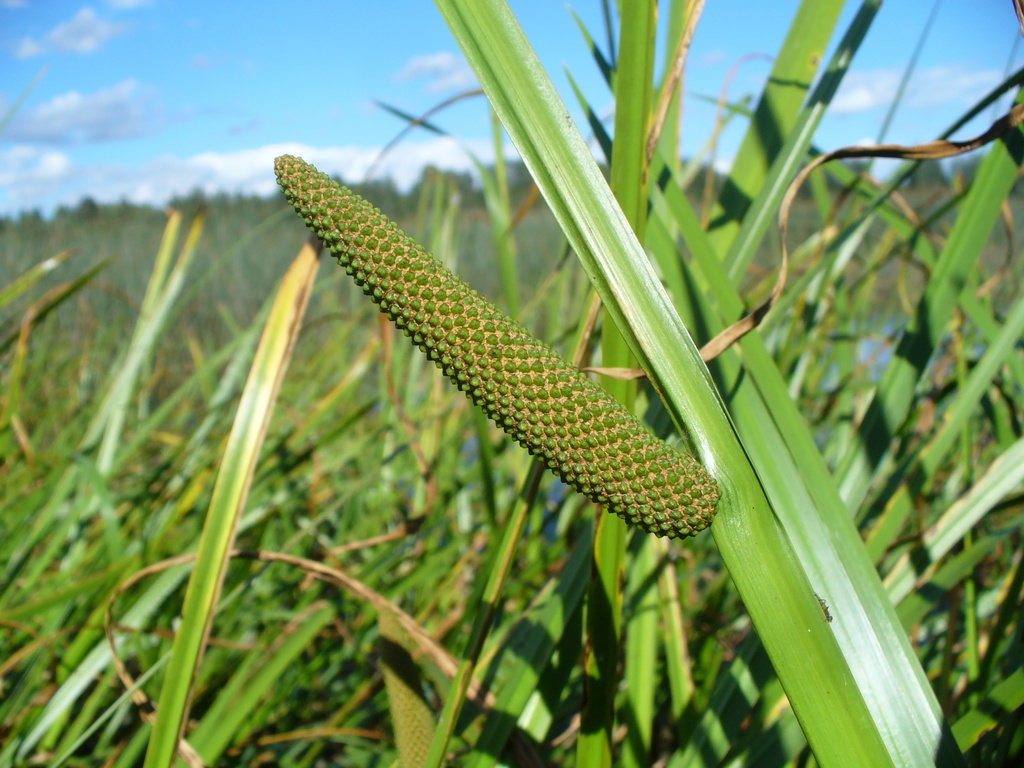
Sweet flag is a herbaceous perennial, 2 m (79 in) tall. Its leaves resemble those of the iris family. Sweet flag consists of tufts of basal leaves that rise from a spreading rhizome. The leaves are erect yellowish-brown, radical, with pink sheathing at their bases, sword-shaped, flat and narrow, tapering into a long, acute point, and have parallel veins. The leaves have smooth edges, which can be wavy or crimped. The sweet flag can be distinguished from iris and other similar plants by the crimped edges of the leaves, the fragrant odor it emits when crushed, and the presence of a spadix. Only plants that grow in water bear flowers. The fruit is a berry filled with mucus, which when ripe falls into the water and disperses by floating. The solid, triangular flower-stems rise from the axils of the outer leaves. A semi-erect spadix emerges from one side of the flower stem. The spadix is solid, cylindrical, tapers at each end, and is 5 to 10 cm in length. A covering spathe, as is usual with Araceae, is absent. The spadix is densely crowded with tiny greenish-yellow flowers. Each flower contains six petals and stamens enclosed in a perianth with six divisions, surrounding a three-celled, oblong ovary with a sessile stigma. The flowers are sweetly fragrant. In Europe, it flowers for about a month in late spring or early summer, but does not bear fruit. …
Range & habitat
Sweet flag is native to the Irtysh River valley in Kazakhstan, but has been widely introduced worldwide. Habitats include edges of small lakes, ponds and rivers, marshes, swamps, and other wetlands.
Wikipedia: “Range and habitat”
At the table
A. calamus has been an item of trade in many cultures for centuries. It has been used in traditional medicine for various ailments, and the aroma of its essential oil is used in the perfume industry. The essence from the rhizome is used as a flavor for foods, alcoholic beverages, and bitters in Europe. It was also once used to make candy.
Food. The young stalks can be pulled when under 30 cm (12 in); the inner stems can be eaten raw. The roots can be washed, peeled, cut into small pieces, boiled, and simmered in syrup to make candy.
In herbal medicine. Sweet flag has a long history of use in Chinese, Nepalese, and Indian herbal traditions. Sweet flag was and is used in herbalism by the Chipewyan people.
Horticulture. This plant is sometimes used as a pond plant in horticulture. There is at least one tetraploid ornamental cultivar known; it is usually called 'Variegatus', but the RHS recommends calling it 'Argenteostriatus'.
Insecticide and antifungal. The asarone from A. calamus, found most abundantly in the dried and pulverized roots, has been identified as having insecticidal properties. β-asarone also exhibits anti-fungal activity by inhibiting ergosterol biosynthesis in Aspergillus niger. …
Wikipedia: “Uses”
Toxicity
Although calamus has been used for its fragrance and ingested, it has not been studied by rigorous clinical research. Individual medical reports of toxicity mention severe nausea and prolonged vomiting over many hours following oral uses. Laboratory studies of its extracts indicate other forms of toxicity, due mainly to the emetic compound β-asarone. In Ayurveda, the rhizome is used only after a purification step (shodhana), in which it is boiled in media such as cow's milk. Analytical studies have reported that this processing significantly reduces the rhizome's β-asarone content, an effect attributed largely to volatilization of the heat-labile compound during prolonged boiling. Allegedly, the plant is psychoactive (hallucinogenic), but for example all experiments with American calamus have been completely unsuccessful, even those involving very high dosages (up to 300 g of rhizomes).
In human culture
In addition to "sweet flag" and "calamus" other common names include beewort, bitter pepper root, calamus root, flag root, gladdon, myrtle flag, myrtle grass, myrtle root, myrtle sedge, pine root, sea sedge, sweet cane, sweet cinnamon, sweet grass, sweet myrtle, sweet root, sweet rush, sweet sedge and wada kaha. The generic name is the Latin word acorus, which is derived from the Greek άχόρου (áchórou) of Dioscorides (note different versions of the text have different spellings). The word άχόρου itself is thought to have been derived from the word κόρη (kóri), which means pupil (of an eye), because of the juice from the root of the plant being used as a remedy in diseases of the eye ('darkening of the pupil'). The specific name calamus is derived from Greek κάλαμος (kálamos, meaning "reed"), cognate to Latin culmus ("stalk") and Old English healm ("straw"), Arabic قَلَم (qálam, "pen"), in turn from Proto-Indo European *kole-mo- (thought to mean "grass" or "reed"). The name "sweet flag" refers to its sweet scent and its similarity to Iris species, which have been commonly known as flags in English since at least the late fourteenth century.
Wikipedia: “Names and etymology”
Where it lives
Recorded sightings
—
geo-referenced records in GBIF, from museums, herbaria and field observers.
Drag the globe to turn it. Dots are where records exist, not a range map; darker means more records.
In the old herbals & bestiaries

Garden of Health
1507 · p.10

Notable Commentaries on the History of Plants
Leonhart Fuchs · 1549 · p.44

History of Rare Plants of Pannonia
Carolus Clusius · 1576 · p.282

History of Rare Plants Observed in Pannonia
Carolus Clusius · 1583 · p.264

Illustrated Herbal Primer
Chen Jiamo (陳嘉謨) · 1628 · p.65

The Dutch Herbarium or Herbal
Petrus Nylandt · 1670 · p.143

Illustrated Compendium of Materia Medica (Vol. 18)
吳其濬 · 1848 · p.6
In the stacks
Searching the stacks…
Every page naming Acorus calamus in the Biodiversity Heritage Library →
This page is assembled live from iNaturalist, GBIF, Wikipedia, the Source Library and the Internet Archive. It is not yet part of the hand-edited codex. iNaturalist taxon 82306.