 NL·0503
Herbarium of the Nature Library
- Name
- Cheilinus undulatus
- Family
- Labridae
- Native to
- Indo-Pacific from the Red Sea and East Africa to the Tuamotus, Japan and New Caledonia
- Habitat
- Coral reef
Humphead wrasse
Cheilinus undulatus
Also calledNapoleon wrasse / Napoleonfish · Mameng (Filipino) · So mei (Cantonese) · Napoléon (French) · Megane-mochinouo (Japanese)
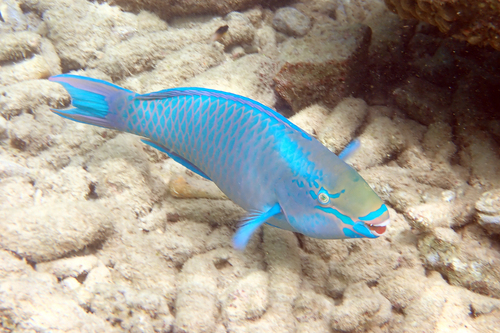
The largest living wrasse, a thick-lipped giant with a bulbous forehead and maze-like facial markings. Its value in the live reef-food trade of Hong Kong and southern China has made it endangered.
The humphead wrasse is the largest species of wrasse mainly found on coral reefs in the Indo-Pacific region. It is also known as the Māori wrasse, Napoleon wrasse, and Napoleonfish. Wikipedia
What it can do
- iOne of the few predators that eats toxic crown-of-thorns starfish, sea hares and boxfish
- iiProtogynous hermaphrodite: some females change into males
- iiiCrushes hard-shelled molluscs and sea urchins with heavy pharyngeal teeth
- ivCan live over 30 years
In the field
Field marks
- aMassive size with a prominent hump on the forehead of large adults
- bThick, fleshy lips
- cTwo black lines behind each eye and maze-like markings on the face
- dBlue-green to olive body with fine vertical lines on each scale
- Not to be confused with
- Bumphead parrotfish (Bolbometopon muricatum) also has a forehead hump but has a beak of fused teeth and moves in grazing schools; humphead wrasse has fleshy lips and usually swims alone.
- Where to see it
- Cod Hole and Ribbon Reefs (Great Barrier Reef), Red Sea reefs, Palau, Sipadan
- When
- Year-round
Life & habits
- Diet
- Molluscs, crustaceans, sea urchins, fish, crown-of-thorns starfish
- Habitat
- Outer reef slopes, channels and lagoon reefs to 100 m; juveniles in seagrass and branching coral
- Size
- Males up to about 2 m and 190 kg
- Lifespan
- About 30 years or more
Often approaches divers with apparent curiosity; rests in reef caves at night and gathers at predictable spawning sites on outer reefs.
Where it lives
Recorded sightings
—
geo-referenced records in GBIF, from museums, herbaria and field observers.
Native range
Indo-Pacific from the Red Sea and East Africa to the Tuamotus, Japan and New Caledonia
Drag the globe to turn it. Dots are where records exist, not a range map; darker means more records.
In the old herbals & bestiaries
No plate in the Source Library names this exact species, so these show its closest relatives as the old naturalists drew them: same genus, or the same kind of animal. Click a plate to read the page it came from, with translation.

History of Animals, Book II: On Oviparous Quadrupeds
Relative · Conrad Gessner · 1586 · p.384

Books on Marine Fishes
Relative · Guillaume Rondelet · 1554 · p.196

Books on Marine Fishes
Relative · Guillaume Rondelet · 1554 · p.195

History of Animals, Book II: On Oviparous Quadrupeds
Relative · Conrad Gessner · 1586 · p.389

Louis Renard — Poissons, ecrevisses et crabes (1754)
Relative · Louis Renard · 1754 · p.173

Louis Renard — Poissons, ecrevisses et crabes (1754)
Relative · Louis Renard · 1754 · p.71
In the stacks
Searching the stacks…
Every page naming Cheilinus undulatus in the Biodiversity Heritage Library →
Marginalia
Listed on CITES Appendix II in 2004 because of the live reef-food trade, where it is a banquet fish in Hong Kong and its lips are especially prized.
Curiosity
Most humphead wrasse begin life as females; only some change sex to become the large dominant males.
Kinship





Photographs: iNaturalist contributors under the licences shown. Records: GBIF.org. Historical plates: Source Library (CC BY-SA 4.0; originals public domain). Summary text: Nature Library editors and Wikipedia (CC BY-SA). Medicinal and edibility notes are historical and educational, not advice. iNaturalist taxon 82355.