- Plants
- ›Vascular Plants
- ›flowering plants
- ›Dicots
- ›Heathers, Balsams, Primroses, and Allies
- ›heath family
- ›Wintergreens
- ›Chimaphila
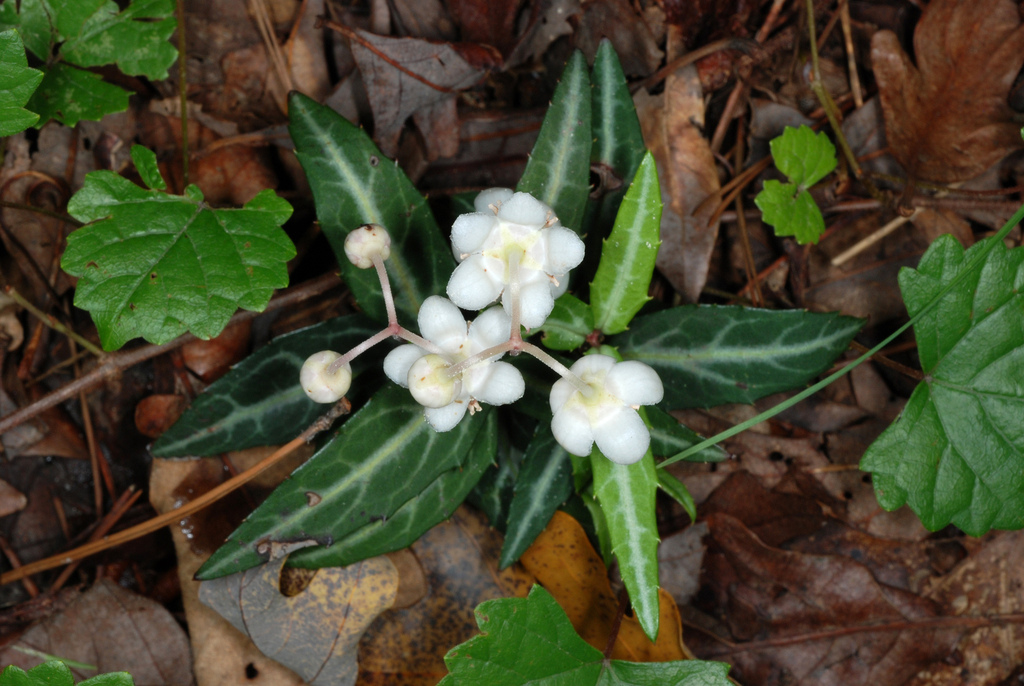
striped wintergreen
Chimaphila maculata
Chimaphila maculata (spotted wintergreen, also called striped wintergreen, striped prince's pine, spotted pipsissewa, ratsbane, or rheumatism root) is a small (10–25 cm tall), perennial evergreen herb native to eastern North America and Central America, from southern Quebec west to Illinois, and south to Florida and Panama.
From the article Chimaphila maculata on Wikipedia (CC BY-SA), quoted section by section
Description
It has dark green, variegated leaves 2–7 cm (0.8–2.8 in) in length, and 6–26 mm (0.2–1.0 in) in width. The variegation of the leaves arises from the distinct white veins contrasted with the dark green of the leaf. The stems emerge from creeping rhizomes, growing 10–25 cm (4–10 in) tall. The nearly round flowers, which appear in early summer, are found on top of tall stalks. They are white or pinkish and are insect pollinated. The flowers mature to small (6–8 mm (0.24–0.31 in) in diameter) capsules bearing the seeds of the plant, which are dispersed by the wind.
What it does
It can typically be found in sandy habitats, well-drained upland forests, wooded slopes, oak-pine woods, old-growth forests, and similar mesic habitats and woodlands. It is very tolerant of acidic soil and shade. Like many ericaceae species, the plant is believed to partially rely on delicate mycorrhizal (and possibly ericoid mycorrhizal) connections in order to thrive.
Wikipedia: “Ecology”
In medicine
"The Creek Indians called it 'pipsisikweu' – which means 'breaks into small pieces' – after the supposed ability to break down gallstones and kidney stones. ... Native Americans used its leaf tea to treat rheumatism and stomach problems, and crushed leaves were applied as a poultice to sores and wounds."
Wikipedia: “Medicinal history”
Where it lives
Recorded sightings
—
geo-referenced records in GBIF, from museums, herbaria and field observers.
Drag the globe to turn it. Dots are where records exist, not a range map; darker means more records.
In the stacks
Searching the stacks…
Every page naming Chimaphila maculata in the Biodiversity Heritage Library →
This page is assembled live from iNaturalist, GBIF, Wikipedia, the Source Library and the Internet Archive. It is not yet part of the hand-edited codex. iNaturalist taxon 82358.