- Plants
- ›Vascular Plants
- ›Ferns
- ›Leptosporangiate Ferns
- ›Polypod Ferns
- ›eupolypods II
- ›spleenwort family
- ›Asplenium
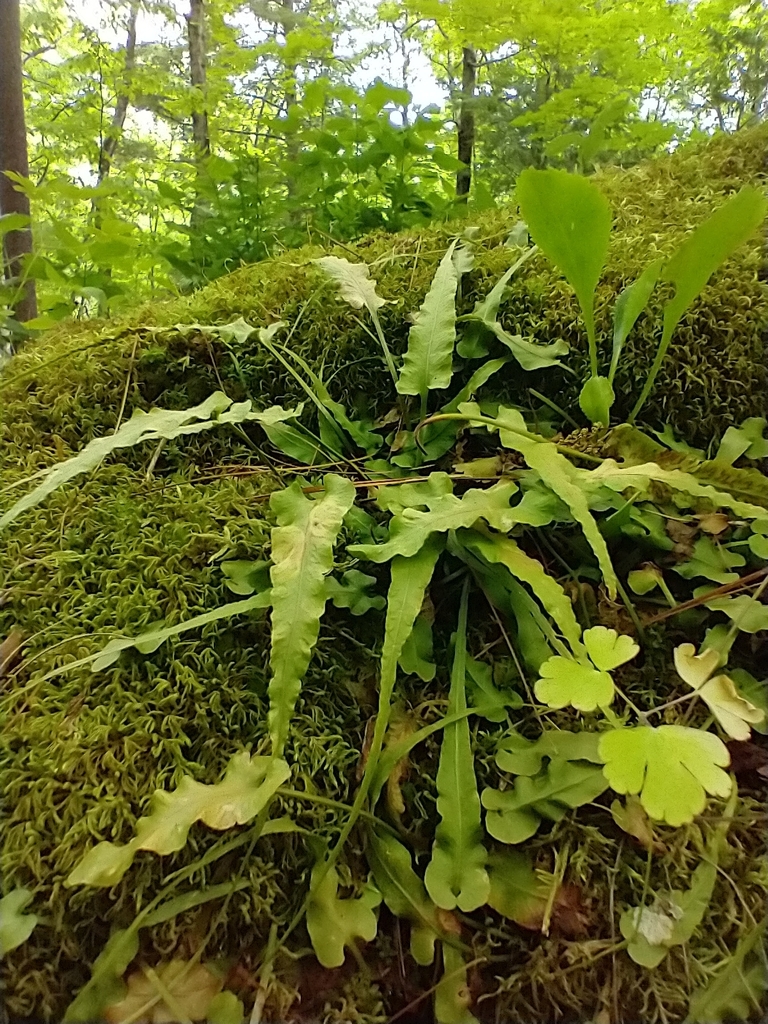
walking fern
Asplenium rhizophyllum
Asplenium rhizophyllum, the (American) walking fern, is a frequently-occurring fern native to North America. It is a close relative of Asplenium ruprechtii (syn: Camptosorus sibiricus) which is found in East Asia and also goes by the common name of "walking fern".
From the article Asplenium rhizophyllum on Wikipedia (CC BY-SA), quoted section by section
Description
Asplenium rhizophyllum is a small fern whose undivided, evergreen leaves and long, narrow leaf tips, sometimes curving back and rooting, give it a highly distinctive appearance. It grows in tufts, often surrounded by child plants formed from the leaf tips. The leaves of younger plants tend to lie flat to the ground, while older plants have leaves more erect or arching.
Roots and rhizomes. It does not spread and form new plants via the roots. Its rhizomes (underground stems) are upright or nearly so, short, about 1 millimetre (0.04 in) in diameter, and generally unbranched. They bear dark brown or blackish, narrowly triangular or lance-shaped scales which are strongly clathrate (bearing a lattice-like pattern). The scales are 2 to 3 millimetres (0.08 to 0.1 in) long and 0.5 to 1 millimetre (0.02 to 0.04 in) wide (occasionally as narrow as 0.2 millimetres (0.008 in)) with untoothed margins.
Leaves. The stipe (the stalk of the leaf, below the blade) is 0.5 to 12 centimetres (0.20 to 4.7 in) long (occasionally up to 15 centimetres (5.9 in) long), and ranges from one-tenth to one and one-half times the length of the blade. The stipe is reddish-brown and sometimes shiny at the base, becoming green above, and narrowly winged. …
Range & habitat
The principal range of A. rhizophyllum is in the Appalachian Mountains and the Ozarks. It can be found from southern Quebec and Ontario along the Appalachians and Piedmont southwestward to Mississippi and Alabama, along the Ohio Valley and into the Ozarks west to Nebraska and Oklahoma, and along the Mississippi Valley north to Wisconsin and Minnesota. It has become extinct in Maine and Delaware. It is also presumably extinct in Texas, where one collection from the 19th century has been discovered. The distribution typically follows area of limy soil; sometimes said to be rare, it is better described as locally abundant where conditions favor it.
Wikipedia: “Distribution”
What it does
Walking fern grows on shaded boulders, ledges and in crevices, usually covered with moss. On rare occasions, it is found on fallen tree trunks, as an epiphyte, or on the ground. It is usually found on limestone or other alkaline rocks, rarely on sandstone or other acidic rocks. While globally secure (G5), it is endangered in some states and provinces at the edge of its range. It is only known historically from Delaware and Maine. NatureServe considers it critically imperiled (S1) in Mississippi, New Hampshire and Rhode Island, imperiled (S2) in Michigan and South Carolina, and vulnerable (S3) in Kansas, North Carolina, Oklahoma and Quebec.
Wikipedia: “Ecology and conservation”
How it is grown
It was introduced into cultivation in England in 1680. It prefers low to medium light levels, and a moist, basic potting mix, or soil with added lime chips.
Wikipedia: “Cultivation”
Where it lives
Recorded sightings
—
geo-referenced records in GBIF, from museums, herbaria and field observers.
Drag the globe to turn it. Dots are where records exist, not a range map; darker means more records.
In the stacks
Searching the stacks…
Every page naming Asplenium rhizophyllum in the Biodiversity Heritage Library →
This page is assembled live from iNaturalist, GBIF, Wikipedia, the Source Library and the Internet Archive. It is not yet part of the hand-edited codex. iNaturalist taxon 82558.