- Plants
- ›Vascular Plants
- ›Ferns
- ›Leptosporangiate Ferns
- ›Polypod Ferns
- ›eupolypods II
- ›spleenwort family
- ›Asplenium
- ›Ceterach
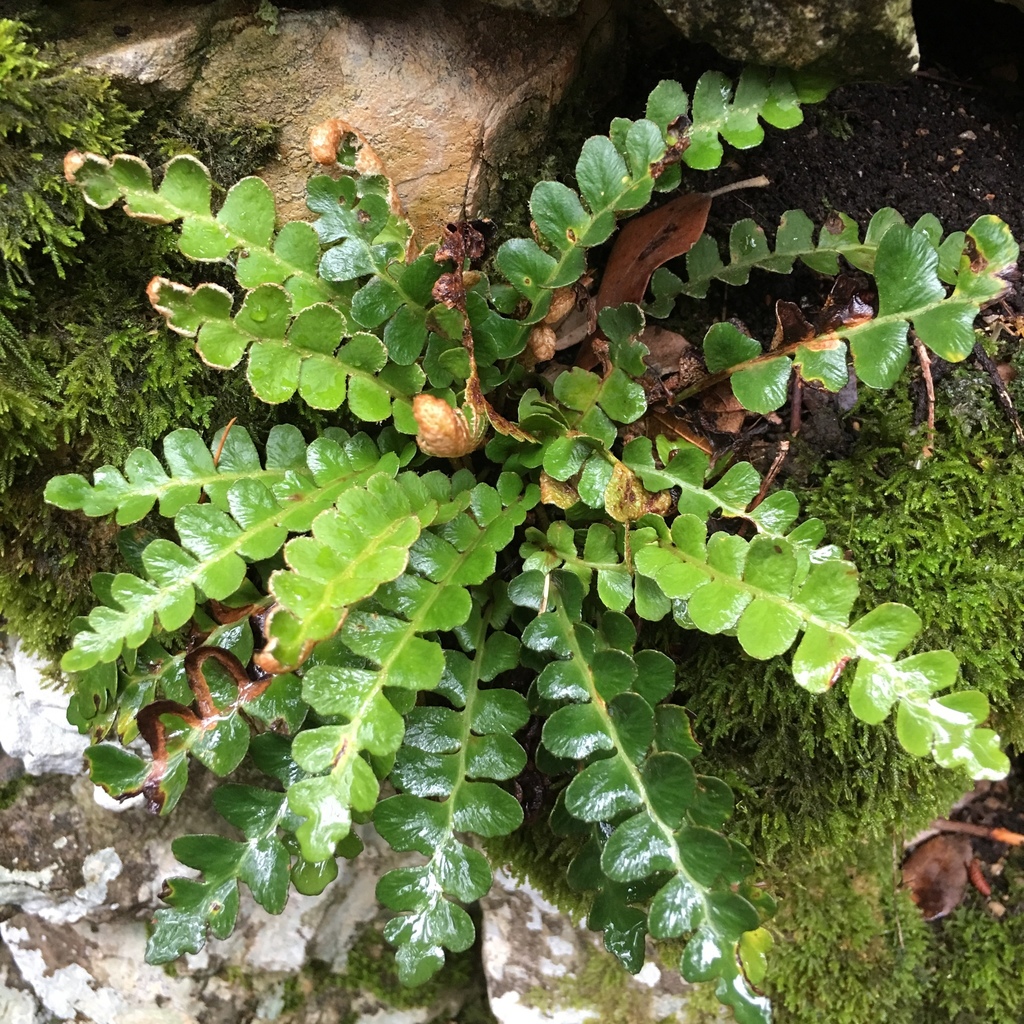
Rustyback
Asplenium ceterach
Asplenium ceterach (syn. Ceterach officinarum) is a fern species commonly known as Rustyback. It is characterised by a short rhizome which gives rise to several green fronds that have a pinnated lamina with trichomes on the abaxial (lower) surface, but not the adaxial (upper) one. These trichomes (hairs) are orange-brown in colour, hence the name "rustyback". The petiole is shorter than the corpus of the leaf.
From the article Asplenium ceterach on Wikipedia (CC BY-SA), quoted section by section
Description
Asplenium ceterach is a perennial and evergreen fern species characterized by its compact size and robust, intricately divided fronds, measuring up to 20 cm (7.9 in) in length. The undersides of these fronds are covered in a dense layer of pale reddish-brown scales, from which the common name originates. The leaves roll up in the summer, showing just the scaly undersides.
Range & habitat
Asplenium ceterach has a large Western and Central European distribution, where it is located in the countries of: Albania, Austria, Belgium, Bulgaria, Crimea, Croatia, Cyprus, France, Germany, Great Britain, Greece, Hungary, Ireland, Italy, Kazakhstan, Malta, Netherlands, Portugal, Romania, Spain, Sweden, Switzerland. The species is also native to the European island territories of: Baleares, Corsica, Crete, Sardinia and Scilly. It can also be found within the North Caucasus region and European Turkey. A. ceterach is believed to be locally extinct in Poland. Within Asia Asplenium ceterach can be found within the countries of: Afghanistan, China, Iran, Iraq, Lebanon, Syria, Pakistan, Israel, Tadzhikistan, Turkey, Uzbekistan. The species has a range extending throughout the Transcaucasus region which extends along the West Himalayas where the species can also be found in Tibet. The African range of Asplenium ceterach includes several countries within North Africa. These countries include Algeria, Djibouti, Libya, Morocco and Tunisia. Just off the coast of Africa the species can also be found living on the Canary Islands.
Wikipedia: “Distribution”
At the table
Asplenium ceterach has been traditionally used as a medicinal herb. The plant has been historically utilized to treat a large variety of health problems in humans. A. ceterach extract has been used as a mucoactive agent, diuretic and laxative. A. ceterach was also used to treat kidney stones, spleen issues, haemorrhoids and intestinal disorders. The plant has even been used to treat respiratory disorders and hypertension. Extracts created from A. ceterach display anticancer properties. Extracts possess a selective inhibitory effect against cervical cancer cells and a low cytotoxicity towards healthy non-cancerous cells in humans.
Wikipedia: “Traditional uses”
Where it lives
Recorded sightings
—
geo-referenced records in GBIF, from museums, herbaria and field observers.
Drag the globe to turn it. Dots are where records exist, not a range map; darker means more records.
In the old herbals & bestiaries


In the stacks
Searching the stacks…
Every page naming Asplenium ceterach in the Biodiversity Heritage Library →
This page is assembled live from iNaturalist, GBIF, Wikipedia, the Source Library and the Internet Archive. It is not yet part of the hand-edited codex. iNaturalist taxon 82591.