- Plants
- ›Vascular Plants
- ›flowering plants
- ›Dicots
- ›Soapberries, Cashews, Mahoganies, and Allies
- ›Cashew Family
- ›cashews, sumacs, and allies
- ›Pistacia
mastic
Pistacia lentiscus
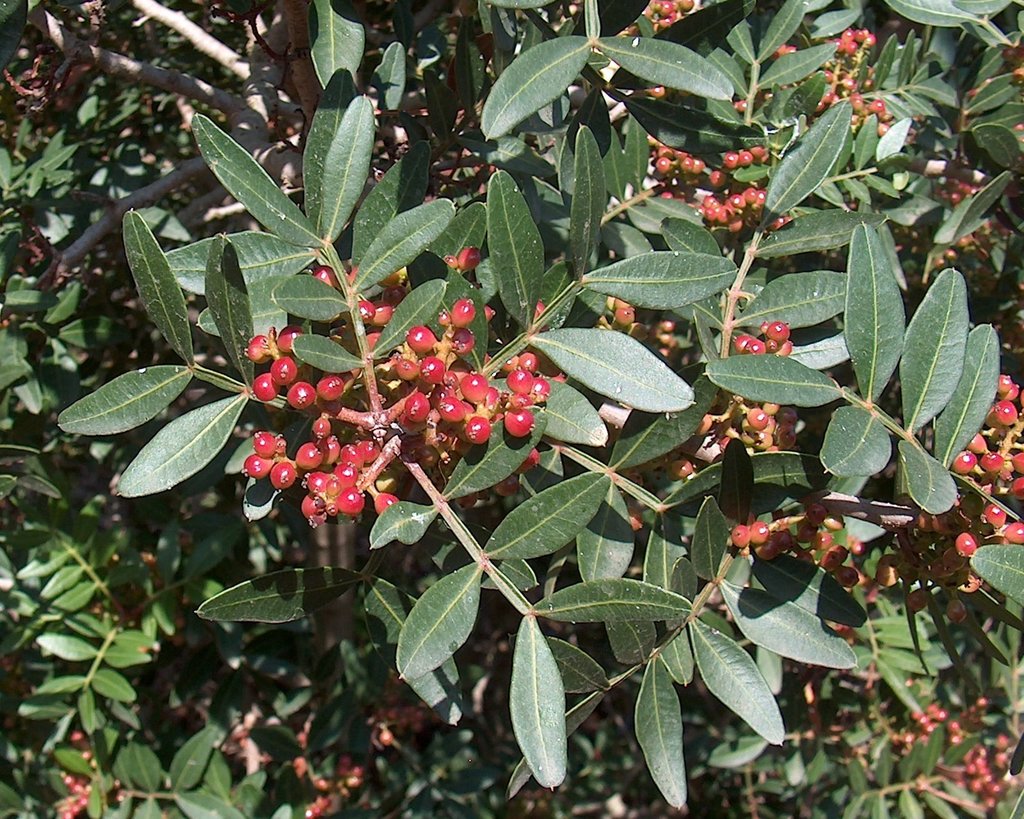
Pistacia lentiscus (also lentisk, schinos or mastic) is a dioecious evergreen shrub or small tree of the genus Pistacia native to the Mediterranean Basin. It grows up to 4 m (13 ft) tall and is cultivated for its aromatic resin, mainly on the Greek island of Chios, around the Turkish town of Çeşme and northern parts of Iraq.
From the article Pistacia lentiscus on Wikipedia (CC BY-SA), quoted section by section
Description
The plant is evergreen, from 1 to 5 m (3 ft 3 in to 16 ft 5 in) high, with a strong smell of resin, growing in dry and rocky areas in North Africa and Mediterranean Europe. It resists mild to heavy frosts but prefers milder winters and grows on all types of soils, and can grow well in limestone areas and even in salty or saline environments, making it more abundant near the sea. It is also found in woodlands, dehesas (almost deforested pasture areas), Kermes oak woods, wooded areas dominated by other oaks, garrigues, maquis shrublands, hills, gorges, canyons, and rocky hillsides of the entire Mediterranean area. It is a typical species of Mediterranean mixed communities which include myrtle, Kermes oak, Mediterranean dwarf palm, buckthorn and sarsaparilla, and serves as protection and food for birds and other fauna in this ecosystem. It is a very hardy pioneer species dispersed by birds. When older, it develops some large trunks and numerous thicker and longer branches. In appropriate areas, when allowed to grow freely and age, it often becomes a tree of up to 7 m (23 ft). However, logging, grazing, and fires often prevent its development. The leaves are alternate, leathery, and paripinnately compound (i.e., pinnately compound without terminal leaflet) with five or six pairs of deep-green leaflets. …
Range & habitat
Pistacia lentiscus is native throughout the Mediterranean region, from Morocco, Algeria, Tunisia and the Iberian Peninsula in the west through southern France and Turkey to Iraq and Iran in the east. It is also native to the Canary Islands.
Wikipedia: “Distribution”
At the table
Mastic gum is principally used either as a flavouring or for its gum properties, as in mastic chewing gum. As a spice, it continues to be used in Greece to flavour spirits and liqueurs (such as Chios's native drink mastiha), chewing gum, and a number of cakes, pastries, spoon sweets, and desserts. Sometimes, it is even used in making cheese. Mastic resin is a key ingredient in dondurma and Turkish puddings, giving those confections their unusual texture and bright whiteness. In Lebanon and Egypt, the spice is used to flavour many dishes, ranging from soups to meats to desserts, while in Morocco, smoke from the resin is used to flavour water. In Turkey, mastic is used as a flavor of Turkish delight. In the Kurdish parts of Iraq, the fresh resin is used as a spice particularly used for Torshi. Mastic resin is a key ingredient in Greek festival breads, for example, the sweet bread tsoureki and the traditional New Year's vasilopita. Furthermore, mastic is also essential to myron, the holy oil used for chrismation by the Orthodox Churches.
Wikipedia: “Culinary use”
In medicine
Mastic has been used in the Mediterranean region with the belief it has folk medicine properties, as indicated by first-century Greek physician and botanist Dioscorides in the treatise De Materia Medica (About Medical Substances). Hippocrates is reported to have used it for treating gastrointestinal disorders. There might be some scientific explanation for such use, with mastic gum possibly killing Helicobacter pylori.
Wikipedia: “Folk medicine”
How it is grown
The resin is collected by bleeding the trees from small cuts made in the bark of the main branches, and allowing the sap to drip onto the specially prepared ground below. The harvesting is done during the summer between July and September. After the mastic is collected, it is washed manually and is set aside to dry, away from the sun, as it will start melting again.
Mastic resin is a relatively expensive kind of spice; it has been used principally as a chewing gum over centuries. The flavour can be described as a strong, slightly smoky, resiny aroma and can be an acquired taste.
Culinary use. Mastic gum is principally used either as a flavouring or for its gum properties, as in mastic chewing gum. As a spice, it continues to be used in Greece to flavour spirits and liqueurs (such as Chios's native drink mastiha), chewing gum, and a number of cakes, pastries, spoon sweets, and desserts. Sometimes, it is even used in making cheese. Mastic resin is a key ingredient in dondurma and Turkish puddings, giving those confections their unusual texture and bright whiteness. In Lebanon and Egypt, the spice is used to flavour many dishes, ranging from soups to meats to desserts, while in Morocco, smoke from the resin is used to flavour water. In Turkey, mastic is used as a flavor of Turkish delight. …
Wikipedia: “Cultivation history”
Where it lives
Recorded sightings
—
geo-referenced records in GBIF, from museums, herbaria and field observers.
Drag the globe to turn it. Dots are where records exist, not a range map; darker means more records.
In the old herbals & bestiaries

The Great Herbary with all the figures of the herbs
1532 · p.216

Garden of Health
Jacob Meydenbach · 1491 · p.278

Ortus sanitatis
1491 · p.278

Garden of Health
1507 · p.225

De medicinali materia libri sex
Dioscorides · 1552 · p.113

Commentaries on the Six Books of Dioscorides
Pietro Andrea Mattioli · 1560 · p.185

Commentaries on the Six Books of Dioscorides on Medical Matter
Pietro Andrea Mattioli · 1563 · p.185

Commentaries on the Six Books of Pedanius Dioscorides on Medical Matter
Pietro Andrea Mattioli · 1565 · p.285

Discourses on the Six Books of Dioscorides
Dioscorides; Pietro Andrea Mattioli (comm.) · 1568 · p.304

A New Herbal, or History of Plants
Rembert Dodoens (trans. Henry Lyte) · 1578 · p.803

Six Groups of the History of Plants
Rembert Dodoens · 1583 · p.880

History of Rare Plants
Carolus Clusius · 1601 · p.26
In the stacks
Searching the stacks…
Every page naming Pistacia lentiscus in the Biodiversity Heritage Library →
This page is assembled live from iNaturalist, GBIF, Wikipedia, the Source Library and the Internet Archive. It is not yet part of the hand-edited codex. iNaturalist taxon 82600.