- Plants
- ›Vascular Plants
- ›flowering plants
- ›Dicots
- ›carrots, ivies, and allies
- ›carrot family
- ›Apioideae
- ›Bupleureae
- ›Bupleurum
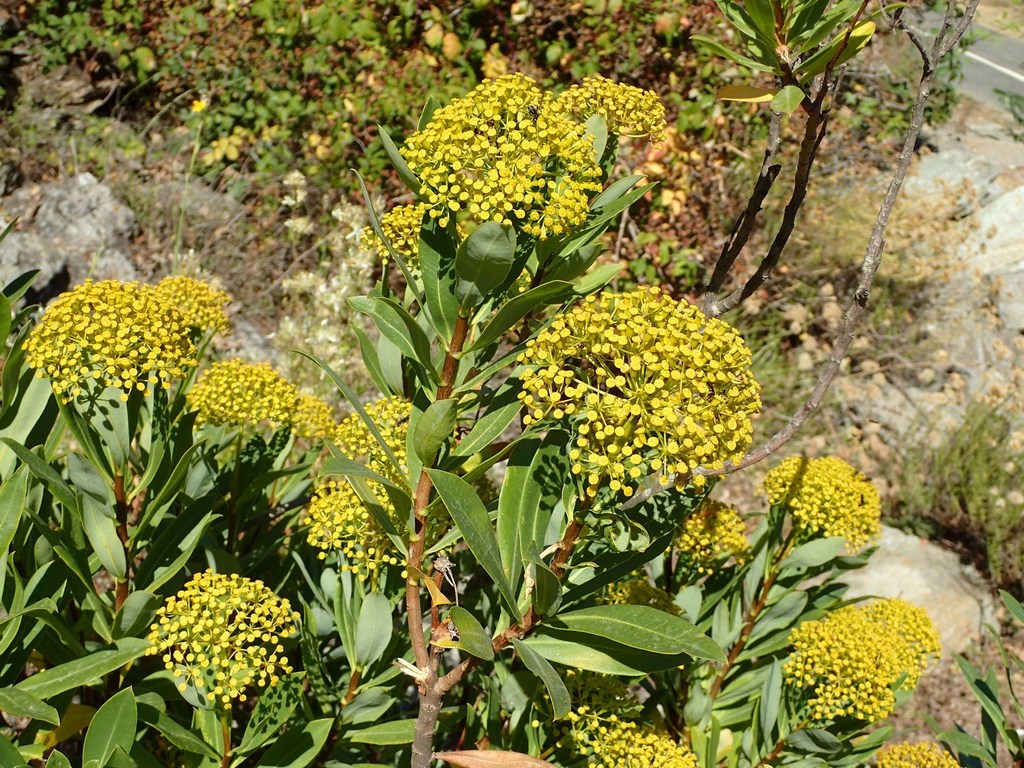
Shrubby Hare's-ear
Bupleurum fruticosum
Bupleurum fruticosum or shrubby hare's-ear is a species of flowering plant in the family Apiaceae.
It is endemic to the Mediterranean region. It lives in sunny hills, walls and rocky places.
From the article Bupleurum fruticosum on Wikipedia (CC BY-SA), quoted section by section
Description
This plant is an evergreen shrub up to 2 metres (6.6 ft) tall, with simple, obovate, blue-green leaves and clusters of tiny yellow flowers. It is in flower from June to September, and the seeds ripen from August to October. The flowers are hermaphrodite (have both male and female organs) and are pollinated by wasps. The plant is self-fertile. It is noted for attracting wildlife.
At the table
It grows in any well-drained soil in a warm sheltered site with full sun. It propagates by seed in containers in a cold frame in spring, and semi-ripe cuttings can also be rooted in summer. This species makes a very good wind-shelter hedge in exposed maritime positions, though it is slow growing. Plants can be used as a tall ground cover when planted about 1.2 metres (3.9 ft) apart each way.
== References ==
Wikipedia: “Cultivation and uses”
Where it lives
Recorded sightings
—
geo-referenced records in GBIF, from museums, herbaria and field observers.
Drag the globe to turn it. Dots are where records exist, not a range map; darker means more records.
In the stacks
Searching the stacks…
Every page naming Bupleurum fruticosum in the Biodiversity Heritage Library →
This page is assembled live from iNaturalist, GBIF, Wikipedia, the Source Library and the Internet Archive. It is not yet part of the hand-edited codex. iNaturalist taxon 82601.