- Plants
- ›Vascular Plants
- ›flowering plants
- ›Dicots
- ›carrots, ivies, and allies
- ›carrot family
- ›Apioideae
- ›Oenantheae
- ›Oenanthe
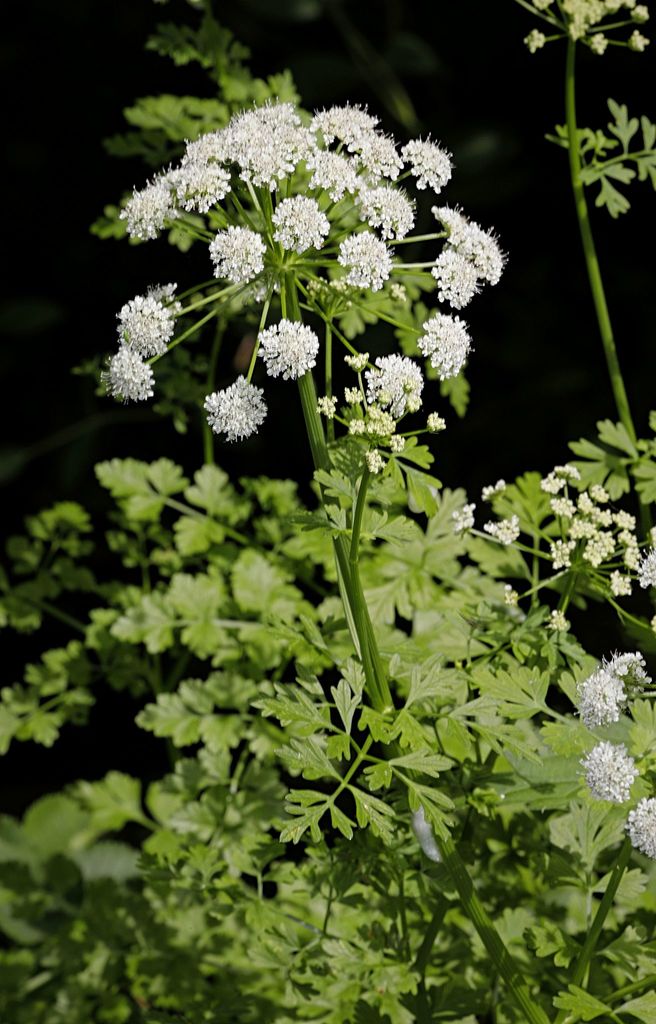
Hemlock Water-dropwort
Oenanthe crocata
Oenanthe crocata, hemlock water-dropwort (sometimes known as dead man's fingers) is a flowering plant in the carrot family, native to Europe, North Africa and western Asia. It grows in damp grassland and wet woodland, often along river and stream banks. All parts of the plant are extremely toxic and it has been known to cause human and livestock poisoning.
From the article Oenanthe crocata on Wikipedia (CC BY-SA), quoted section by section
Description
Hemlock water-dropwort is a robust hairless perennial growing up to 150 cm tall with hollow, cylindrical, grooved stems up to 3.5 centimetres (1.4 in) across. The stems are often branched. The upper part of the roots include five or more obovoid, pale yellow, fleshy tubers up to 6 centimetres (2.4 in) long, which exude a yellowish oily fluid when cut that stains the skin.
The lower leaves are 3–4 times pinnate, triangular, with oval toothed leaflets 10–20 millimetres (0.39–0.79 in) long, that are basally tapered to the stalk (cuneate). The upper leaves are 1–2 pinnate, with narrower lobes and a shorter petiole (leaf stalk). All the leaves are spirally arranged and have petioles that are slightly sheathing around the stem. The leaves have a characteristically deceptive odour of parsley or celery. Like other species in the genus, hemlock water-dropwort has compound umbels, with 12–40 smooth rays (stalks), 3–8 centimetres (1.2–3.1 in) aclong, which carry the smaller umbellules. These rays are shorter than the stalk (peduncle) below, and they do not become thicker after flowering. At the base of the rays are about five bracts, which are linear to trifid in shape. …
Range & habitat
The native distribution of hemlock water-dropwort is concentrated along the Atlantic seaboard of Europe, from the coast of the Netherlands south to Portugal and Spain, rapidly becoming rare inland. It is common again in Corsica and Sardinia but otherwise only sparsely distributed around the Mediterranean east to Syria and southwards to Morocco. It is perhaps most common in Britain and Ireland, where it is widespread throughout, even in inland locations. There are few records of it as an introduction outside its native range, although it has been reported from Argentina. In France, where it is known as oenanthe jaune safran, it is considered unthreatened ("Least Concern", or LC), although in some départements it is rarer; for example, in Île-de-France and Picardy it is classified as Critically Endangered (CR). In Britain, it is similarly listed as LC.
Wikipedia: “Distribution and status”
What it does
Hemlock water-dropwort is a plant of shallow fresh water streams, marshes, lakes, ponds, canals and wet woodland. It is usually a calcifuge, and as a lowland species it nearly always occurs below 300 m, although in Britain it is found as high as 340 m in the Brecon Beacons. In Wales, where it is known as cegiden y dŵr, it is reported to be salt-tolerant, and is known on the inland edges of salt marshes and even on harbour walls.
Although it is widespread in a variety of wetland types, there are two main habitats for this species: woodland and grassland. In woodland, it is found in alder carr (mainly W5 Alnus glutinosa in Britain) in bogs and peaty river valleys, and willow carr (chiefly W6 Salix x fragilis) in river floodplains. In both these communities, it can become abundant in open areas where the trees have been thinned by flooding. In alder carr in particular, it is sometimes found with cowbane, which it strongly resembles. In grassland, the main habitat is MG10 yorkshire fog grassland, which is typically a kind of rush-pasture with associates such as yellow flag, soft rush and cuckooflower. It is common throughout the British lowlands, extending into the upland fringes. …
Wikipedia: “Habitat and ecology”
At the table
Scientists at the University of Eastern Piedmont in Italy wrote that they had identified Oenanthe crocata as the plant responsible for producing the sardonic grin. The poison constricts the muscles causing death by asphyxia which causes a death grin, the sardonic grin. This plant is a possible candidate for the "sardonic herb", which was a neurotoxic plant referred to in ancient histories. It was purportedly used for the ritual killing of elderly people and criminals in Nuragic Sardinia. The subjects were intoxicated with the herb and then dropped from a high rock or beaten to death. The essential oils from the seeds of O. crocata have been shown to have moderate antibacterial effect against Enterococcus faecalis and Bacillus lentus. The oils are also anti-inflammatory, antioxidant and anti-fungal (esp. against Cryptococcus neoformans), and they have been suggested for use in counteracting inflammatory diseases. In the past, extracts from this plant have been used in medicine, for example as a treatment for epilepsy, and in Ireland it was apparently commonly used in a poultice for treating skin disorders and even cancers.
== References ==
Wikipedia: “Uses and in culture”
Toxicity
The toxic principle in the plant is oenanthotoxin, a polyunsaturated fatty alcohol that works by blocking γ-aminobutyric acid (GABA) receptors. The plant is very poisonous to humans and livestock and can cause death if poisoning is left untreated after ingestion. Symptoms in livestock include increased salivation, dilated pupils, respiratory distress, and convulsions. Cattle poisoning from this plant occurs sporadically. For example, several cases were reported during the 1995 drought in the West Country, England. Due to the shortage of grass in the fields, the cattle were driven to graze by ditches where hemlock water-dropwort grew. Instances of poisoning in humans are rare, with only 13 cases reported in Britain between 1900 and 1978, mostly involving children. However, 9 of these 13 were fatal. Serious cases usually involved consumption of the roots, which were mistaken for parsnip. Symptoms include nausea, vomiting, seizures, hallucinations, ataxia, and haemorrhaging of the brain and lungs. Accidental splashing of some sap in the eye of a laboratory worker led to symptoms of poisoning that lasted 12 hours. …
Where it lives
Recorded sightings
—
geo-referenced records in GBIF, from museums, herbaria and field observers.
Drag the globe to turn it. Dots are where records exist, not a range map; darker means more records.
In the old herbals & bestiaries

In the stacks
Searching the stacks…
Every page naming Oenanthe crocata in the Biodiversity Heritage Library →
This page is assembled live from iNaturalist, GBIF, Wikipedia, the Source Library and the Internet Archive. It is not yet part of the hand-edited codex. iNaturalist taxon 82616.