- Plants
- ›Vascular Plants
- ›flowering plants
- ›Dicots
- ›Heathers, Balsams, Primroses, and Allies
- ›heath family
- ›typical heathers, azaleas, and allies
- ›Ericeae
- ›Erica
- ›Erica
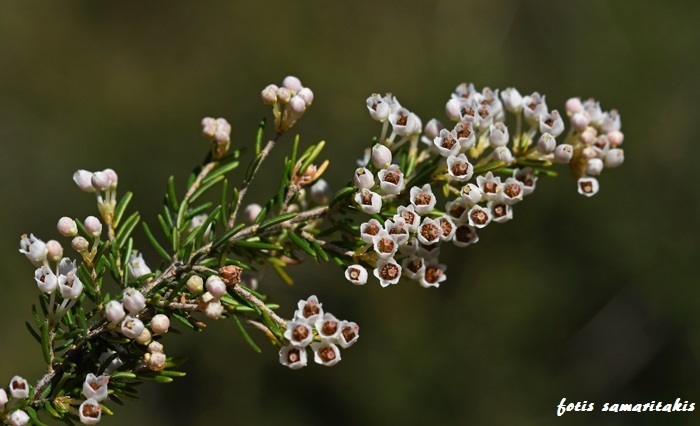
Tree heath
Erica arborea
Erica arborea, the tree heath or tree heather, is a species of flowering plant (angiosperms) in the heather family Ericaceae, native to the Mediterranean Basin and Ethiopia, Kenya and Tanzania in East Africa. It is also cultivated as an ornamental.
The wood, known as briar root (French: bruyère, Catalan: bruc, Portuguese: betouro, Spanish: brezo), is extremely hard and heat-resistant, and is used for making smoking pipes. Leaf fossils attributed to this species were described for the Mio-Pleistocene deposit of São Jorge in Madeira Island.
From the article Erica arborea on Wikipedia (CC BY-SA), quoted section by section
Description
Erica arborea is an upright evergreen shrub or small tree with a typical height in the wild of some 7 m (23 ft), especially in Africa, but more typically 1–4 m (3–13 ft) in gardens. It bears dark green needle-like leaves and numerous small honey-scented bell-shaped white flowers. It is a calcifuge, preferring acid soil in an open sunny situation.
Range & habitat
The heather has a disjunct distribution, including both sides of the Mediterranean basin, the western Caucasus, tropical eastern African mountains, and the Arabian Peninsula. Throughout the Mediterranean Basin, its distribution is not continuous, extending from the Atlantic coasts of Portugal and Spain to the coast of the Black Sea in Turkey and Georgia. The heather occurs within the Mediterranean maquis shrublands in semi-arid habitats but can also be found in forest undergrowth up to 1400 m a.s.l. in fresher and more humid environments. It prefers acidic or acidified soils derived from siliceous substrates. It is also present in an isolated population in the Tibesti Mountains (Chad) in the Sahara, where it occurs at the top of upper montane desert steppe vegetation between 2500 and 3000 m a.s.l. In eastern Africa, it is normally referred to as giant heather. It occurs in the Ethiopian Highlands, in the highest mountains along the East African Rift, from southern Uganda to northern Malawi. It is also present in the Sarawat Mountains in the southwestern Arabian Peninsula, including Yemen and Saudi Arabia. …
Wikipedia: “Distribution and habitat”
At the table
The wood, known as briar root, is extremely hard, dense and heat-resistant, and is primarily used for making smoking pipes, as it does not affect the aroma of tobacco. The football-sized tubers are harvested at the age of 30 to 60 years. They are cooked for several hours, then dried for several months before they are further processed. The wood is also used for making jewellery, fountain pens and knife handles.
Wikipedia: “Uses”
Where it lives
Recorded sightings
—
geo-referenced records in GBIF, from museums, herbaria and field observers.
Drag the globe to turn it. Dots are where records exist, not a range map; darker means more records.
In the stacks
Searching the stacks…
Every page naming Erica arborea in the Biodiversity Heritage Library →
This page is assembled live from iNaturalist, GBIF, Wikipedia, the Source Library and the Internet Archive. It is not yet part of the hand-edited codex. iNaturalist taxon 82688.