- Plants
- ›Vascular Plants
- ›conifers
- ›conifers
- ›pine family
- ›pines, spruces, larches, and allies
- ›Pinus
- ›Pinus
- ›Pinus
- ›Pinaster
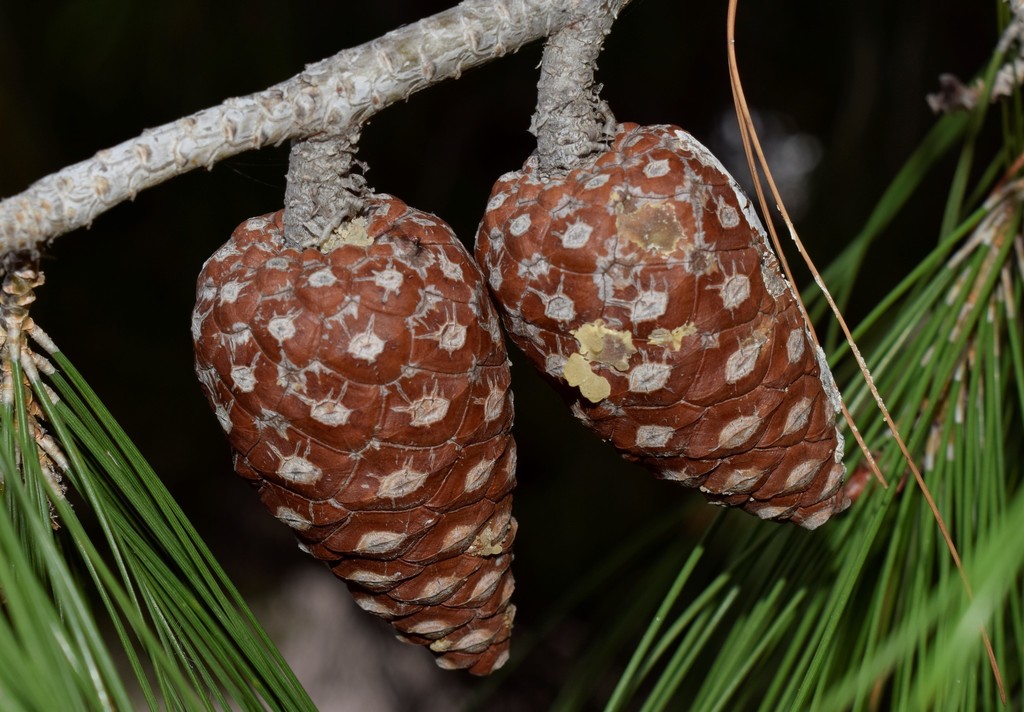
Aleppo pine
Pinus halepensis
Pinus halepensis, commonly known as the Aleppo pine, also known as the Jerusalem pine, is a species of conifer in the family Pinaceae, a pine native to the Mediterranean region. It was officially named by the botanist Philip Miller in his 1768 book The Gardener's Dictionary; he probably never went to Aleppo but mentions seeing large specimens at Goodwood in the garden of the Duke of Richmond, which were transplanted (perhaps sent by Alexander Russell from Syria) in 1739.
From the article Pinus halepensis on Wikipedia (CC BY-SA), quoted section by section
Description
Pinus halepensis is a small to medium-sized tree, 15–25 metres (49–82 feet) tall, with a trunk diameter up to 60 centimetres (24 inches), exceptionally up to 1 m (3 ft 3 in). The bark is orange-red, thick, and deeply fissured at the base of the trunk, and thin and flaky in the upper crown. The leaves ('needles') are very slender, 6–12 cm (2+1⁄4–4+3⁄4 in) long, distinctly yellowish green, and produced in pairs (rarely a few in threes). The cones are narrow conic, 5–12 cm (2–4+3⁄4 in) long and 2–3 cm (3⁄4–1+1⁄4 in) broad at the base when closed, green at first, ripening glossy red-brown when 24 months old. They open slowly over the next few years, a process quickened if they are exposed to heat such as in forest fires. The cones open 5–8 cm (2–3+1⁄4 in) wide to allow the seeds to disperse. The seeds are 5–6 millimetres (3⁄16–1⁄4 in) long, with a 20 mm (13⁄16 in) wing, and are wind-dispersed.
Related species. The Aleppo pine is closely related to the Turkish pine, Canary Island pine, and maritime pine, which all share many of its characteristics. Some authors include the Turkish pine as a subspecies of the Aleppo pine, as Pinus halepensis subsp. brutia (Ten.) Holmboe, but it is usually regarded as a distinct species. It is a relatively nonvariable species, in that its morphological characteristics stay constant over the entire range.
Range & habitat
The native range of Pinus halepensis extends from Morocco, Algeria, Tunisia, and Spain north to southern France, Malta, Italy, Croatia, Montenegro, and Albania, and east to Greece. It has been introduced into many parts of the world, including Portugal. There is an outlying population (from which it was first described) in Syria, Lebanon, southern Turkey, Jordan, Israel and Palestine. The species is generally found at low altitudes, mostly from sea level to 200 m (660 ft), but can grow above 1,000 m (3,300 ft) in southern and eastern Spain, well over 1,200 m (3,900 ft) on Crete, and up to 1,700 m (5,600 ft) in the south, in Morocco, Algeria and Tunisia. The tree is able to colonise open and disturbed areas quickly. It is classed as an invasive species in South Africa. It can grow on all substrates and almost in all bioclimates in the Mediterranean. Pinus halepensis is a diagnostic species of the vegetation class Pinetea halepensis.
Wikipedia: “Distribution and habitat”
At the table
The resin of the Aleppo pine is used to flavour the Greek wine retsina. From the pine nuts of the Aleppo pine is made a pudding called asidet zgougou in the Tunisian dialect; it is served in bowls, covered with cream, and topped with almonds and small candies. The Maltese dessert prinjolata is also prepared using these pine nuts, both in its filling as well as a topping.
Wikipedia: “Local cuisines”
In human culture
Paul Cézanne had an Aleppo pine in his garden at Aix-en-Provence; this tree was the inspiration and model for his painting The Big Trees. As of 2005, the tree is still growing in Cézanne's garden. The Aleppo pine is associated with ANZAC Day and the ANZACs in Australia due to its use by soldiers in the Battle of Lone Pine during the Gallipoli campaign. It is often planted at war memorials.
Wikipedia: “In culture”
Where it lives
Recorded sightings
—
geo-referenced records in GBIF, from museums, herbaria and field observers.
Drag the globe to turn it. Dots are where records exist, not a range map; darker means more records.
In the stacks
Searching the stacks…
Every page naming Pinus halepensis in the Biodiversity Heritage Library →
This page is assembled live from iNaturalist, GBIF, Wikipedia, the Source Library and the Internet Archive. It is not yet part of the hand-edited codex. iNaturalist taxon 82722.