- Animals
- ›Arthropods
- ›Hexapods
- ›Insects
- ›Winged and Once-winged Insects
- ›Beetles
- ›Water, Rove, Scarab, Long-horned, Leaf, and Snout Beetles
- ›Scarabaeiform Beetles
- ›Scarabs, Stag Beetles, and Allies
- ›Scarabs
- ›Rhinoceros Beetles
- ›Oryctini
- ›Oryctes
- ›Oryctes
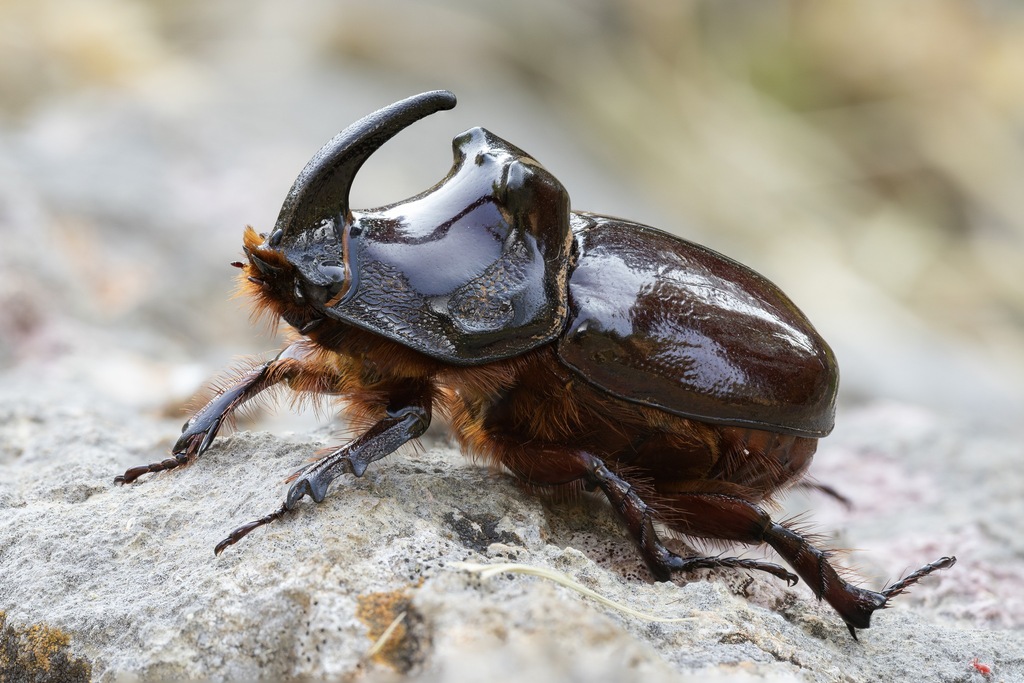
European Rhinoceros Beetle
Oryctes nasicornis
The European rhinoceros beetle (Oryctes nasicornis) is a large flying beetle belonging to the subfamily Dynastinae.
From the article European rhinoceros beetle on Wikipedia (CC BY-SA), quoted section by section
Description
One of the largest beetles found in Europe, Oryctes nasicornis reach a length of 20–42 millimetres (3⁄4–1+3⁄4 inches), with a maximum of 47 mm (1+7⁄8 in). The elytra are reddish brown with a glazed appearance, while the head and pronotum are slightly darker. The underside of the body and the legs are covered with long red hair. It is a sexually dimorphic species. The male's head is topped by a long curved horn (hence its common name), while the females have no horns.
Life cycle. The larvae grow in decaying plants feeding on woody debris (xylophagy), generally non-resinous. They can reach a length of 60–100 mm (2+1⁄4–4 in). The development period lasts 2 to 4 years. The adult’s size is influenced by the quality and abundance of food. The mammoth wasp Regiscolia maculata is a parasitoid of O. nasicornis larvae. The female wasp lays one egg inside the beetle larva; when the egg hatches, the wasp larva will feed on the host. The adult beetle emerges between the end of March to May, and lives for a few months until autumn. It occurs mainly during the months of June and July and is very active, flying at dusk and by night, attracted by lights. In this stage they do not feed, consuming only the reserves accumulated during the larval stages.
Range & habitat
Oryctes nasicornis inhabits the Palaearctic region, excluding the British Isles. It is the only representative of the Dynastinae family found in Northern Europe. It is widespread in the Mediterranean basin up to Pakistan, the Near East and North Africa. The rhinoceros beetle lives on wood, and the large larvae can be found in rotting wood stumps and around sawdust. At the margin of its distribution, the beetle is often found in connection with sawmills and horse racing tracks.
Wikipedia: “Distribution and habitat”
In human culture
This insect is well-known because Dim from A Bug's Life is a European rhinoceros beetle.
Wikipedia: “In popular culture”
Listen
Looking for field recordings…
Where it lives
Recorded sightings
—
geo-referenced records in GBIF, from museums, herbaria and field observers.
Drag the globe to turn it. Dots are where records exist, not a range map; darker means more records.
In the stacks
Searching the stacks…
Every page naming Oryctes nasicornis in the Biodiversity Heritage Library →
This page is assembled live from iNaturalist, GBIF, Wikipedia, the Source Library and the Internet Archive. It is not yet part of the hand-edited codex. iNaturalist taxon 82774.