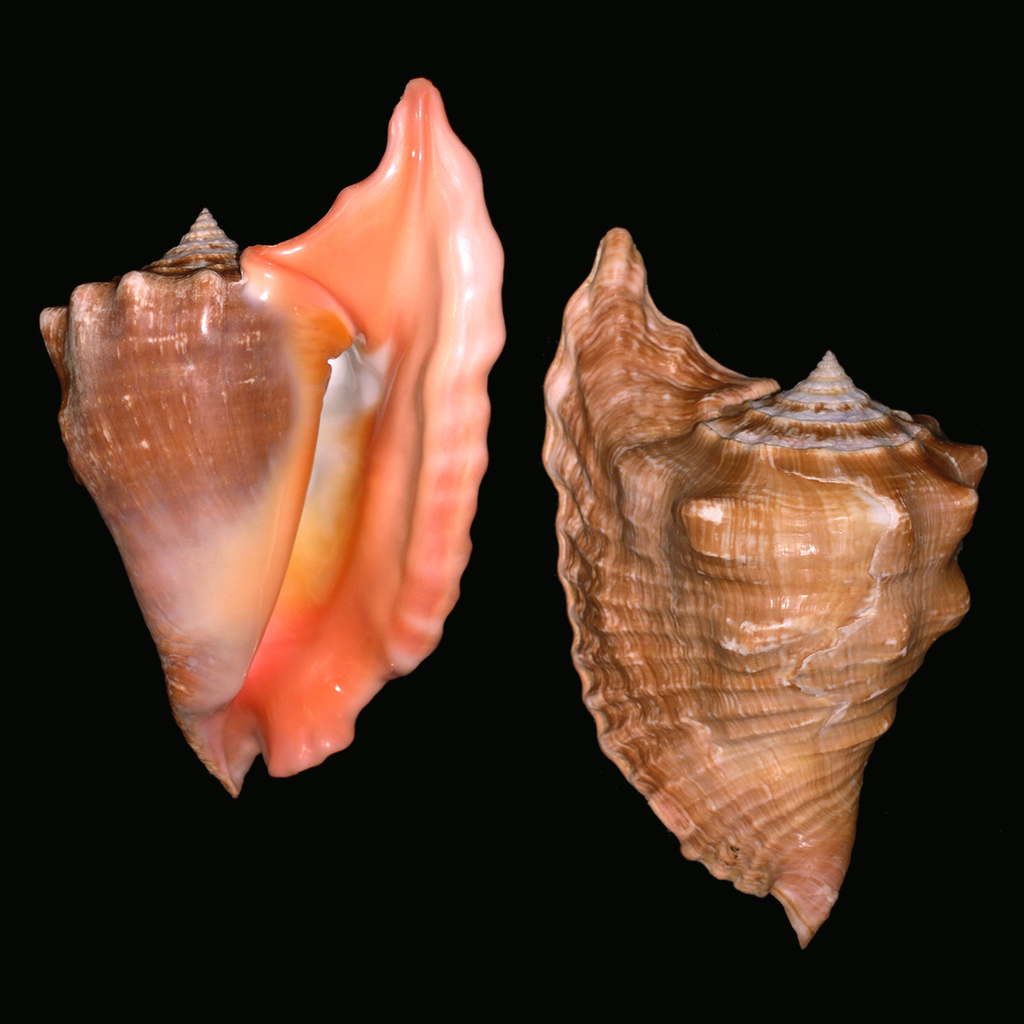
Peruvian conch
Lobatus peruvianus
Lobatus peruvianus, commonly known as the Peruvian conch or the cock's comb conch, is a species of large sea snail, a marine gastropod mollusk in the family Strombidae, the true conchs and their allies.
From the article Lobatus peruvianus on Wikipedia (CC BY-SA), quoted section by section
Description
The shell of Lobatus peruvianus is large, ranging from 60–210 millimetres (2.4–8.3 in). It was originally described by William Swainson in 1823, with him stating that the shell is "heavy, with a depressed spire, and a prominent tip". Like other species in the same genus, Lobatus peruvianus's outer lip is very pronounced and ornamental. The outside color of the shell falls into the tan and light brown range, sometimes also pink; while both the inner and outer lips are cream, pink, or white. While not much information is available regarding the Peruvian conch specifically, similar species in the same Genus have life spans of up to 40 years; while the majority live between 10 and 30 years.
Range & habitat
Lobatus peruvianus occurs along the benthic tropical coastal waters of the Eastern Pacific Ocean. Their distribution stretches across various countries and regions including the Gulf of California, Mexico, Pacific Panama, Nicaragua, Costa Rica, Ecuador, and Peru. These Peruvian Conchs are sand dwellers and are found in depths up to 130 feet.
Wikipedia: “Distribution”
What it does
Similar to other animals in the family Strombidae, Lobatus peruvianus moves around by using their muscular foot that sinks like a claw into the sand to exert force and move forward. This behavior is also beneficial in terms of predator avoidance. It causes the conch's chemical trail to be scattered and inconsistent therefore confusing predators. Similar to other conchs in the family Strombidae, Peruvian conchs can take around 5 years to reach maturity and are therefore very slow-growing creatures.
Wikipedia: “Behavior”
At the table
Lobatus peruvianus is a major source of protein for many groups along the Pacific coast, and the shells have historically been used as trumpets. Conchs are vulnerable to overfishing due to their slow growth rates and late mating tendencies; because of this, it is illegal or frowned upon to harvest these types of conch.
== References ==
Wikipedia: “Human Uses”
Where it lives
Recorded sightings
—
geo-referenced records in GBIF, from museums, herbaria and field observers.
Drag the globe to turn it. Dots are where records exist, not a range map; darker means more records.
In the stacks
Searching the stacks…
Every page naming Lobatus peruvianus in the Biodiversity Heritage Library →
This page is assembled live from iNaturalist, GBIF, Wikipedia, the Source Library and the Internet Archive. It is not yet part of the hand-edited codex. iNaturalist taxon 829205.