- Plants
- ›Vascular Plants
- ›flowering plants
- ›Dicots
- ›beeches, oaks, walnuts, and allies
- ›beech family
- ›Quercus
- ›Quercus
- ›Quercus
- ›Galliferae
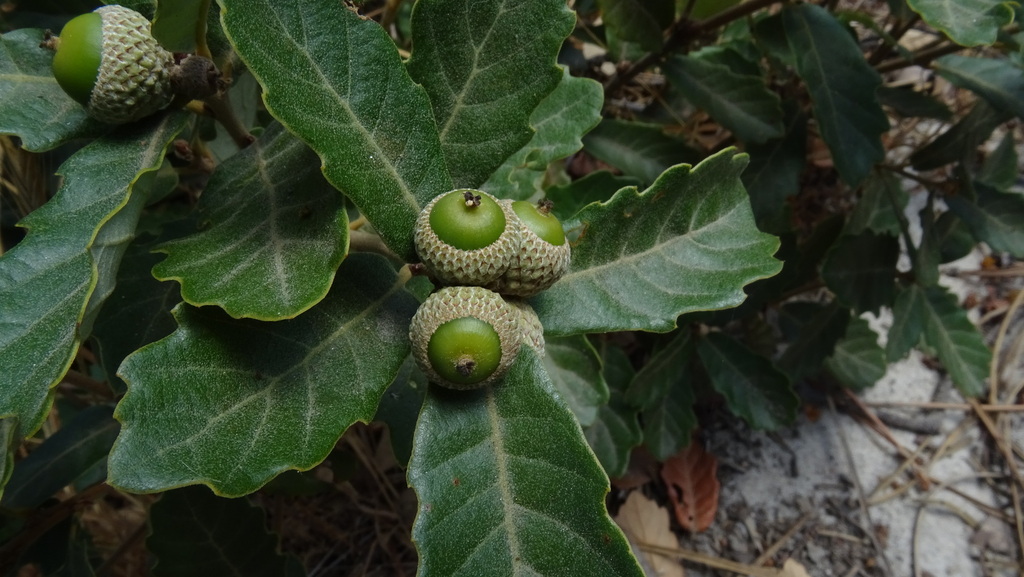
Gall Oak
Quercus lusitanica
Quercus lusitanica, commonly known as gall oak, Lusitanian oak, or dyer's oak, is a species of oak native to Portugal, Spain (Galicia and western Andalucia) and Morocco. Quercus lusitanica is the source of commercial nutgalls. These galls are produced by the infection from the insect Cynips gallae tinctoriae. They are used for dyeing.
Several other species are known colloquially as "gall oaks;" indeed, galls can be found on a large percentage of oak species. The specific epithet "lusitanica" refers to the ancient Roman Province of Lusitania, corresponding roughly to present-day Portugal and Extremadura in Spain.
From the article Quercus lusitanica on Wikipedia (CC BY-SA), quoted section by section
Description
Quercus lusitanica is a stoloniferous shrub, usually prostrate, under 3 m in height.
Range & habitat
Quercus lusitanica is native to the Iberian Peninsula (in Portugal and western Andalusia, Spain, also rare on Galicia) and Morocco It is commonly associated in oak and pine forests and does well in acidic soils. It favors mild coastal Mediterranean climates but it also succeeds in moist, mild, maritime climates. It is relatively sensitive to cold temperatures and is hardy down to −8 °C (18 °F). It inhabits sandy or gravelly soils up to 600 m (2,000 ft) in elevation.
Wikipedia: “Distribution and habitat”
Where it lives
Recorded sightings
—
geo-referenced records in GBIF, from museums, herbaria and field observers.
Drag the globe to turn it. Dots are where records exist, not a range map; darker means more records.
In the stacks
Searching the stacks…
Every page naming Quercus lusitanica in the Biodiversity Heritage Library →
This page is assembled live from iNaturalist, GBIF, Wikipedia, the Source Library and the Internet Archive. It is not yet part of the hand-edited codex. iNaturalist taxon 82943.