- Plants
- ›Vascular Plants
- ›flowering plants
- ›Dicots
- ›beeches, oaks, walnuts, and allies
- ›beech family
- ›Quercus
- ›Quercus
- ›Quercus
- ›Galliferae
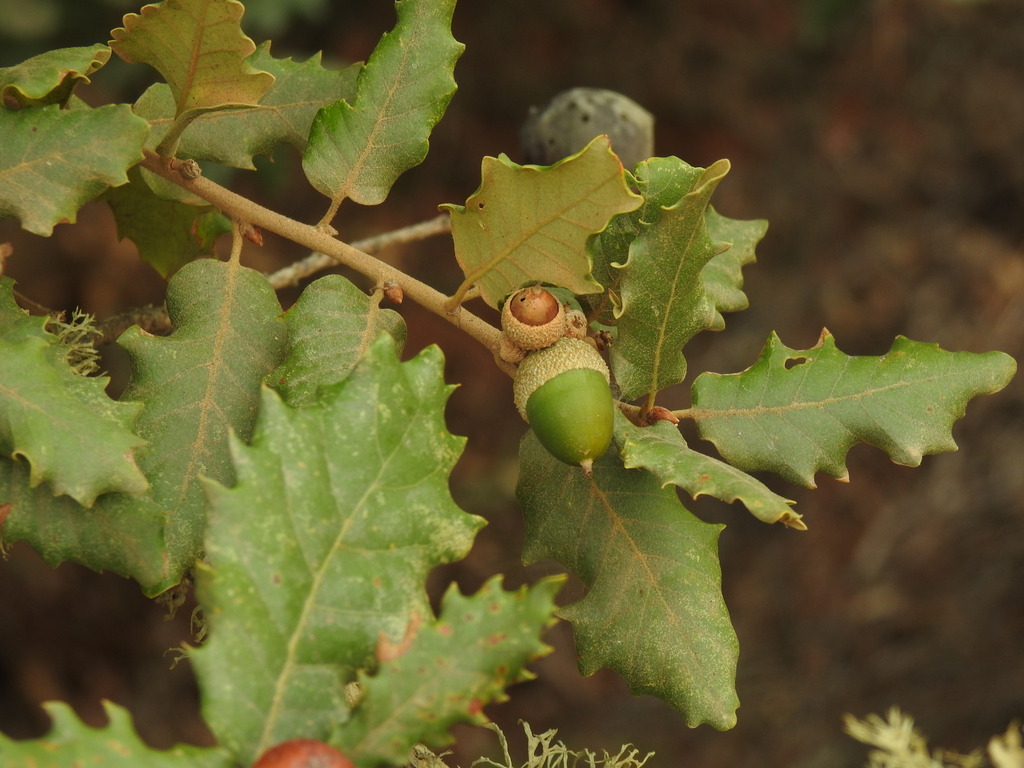
Portuguese oak
Quercus faginea
Quercus faginea, the Portuguese oak, is a species of oak native to the western Mediterranean region in the Iberian Peninsula. Similar trees in the Atlas Mountains of northwest Africa are usually included in this species, or sometimes treated as a distinct species, Quercus tlemcenensis. It occurs in mountains from sea level to 1,900 metres (6,200 feet) above sea level, and flourishes in a variety of soils and climates. Out of all the oak forests in the Iberian Peninsula, the southern populations of Portuguese oak were found to have the highest diversity and endemism of spider species.
From the article Quercus faginea on Wikipedia (CC BY-SA), quoted section by section
Description
Q. faginea is a medium-sized deciduous or semi-evergreen tree growing to 20 metres (66 feet) tall, with a trunk up to 80 centimetres (31 inches) in diameter, with grey-brown bark. The tree can live as long as 600 years. The leaves are 4–10 cm (1+1⁄2–4 in) long and 1.2–4 cm broad (rarely to 15 cm long and 5 cm broad), glossy dark green to gray-green above, and variably felted grey-white below; the margins have five to 12 pairs of irregular teeth. Leaf fall is typically in mid- to late winter. The flowers are catkins, produced between March and April, almost always before holm oak, which grows in similar areas. The acorns are oblong-ovoid, 2–2.5 cm long, maturing in 6 months to disperse in September or October. The species commonly develops galls due to gall wasp activity; the galls are brown, 1–2 cm diameter, and have a spongy, cork-like interior. The two subspecies are:
Portuguese oak also hybridises readily with other related oaks such as Algerian oak (Q. canariensis), downy oak (Q. pubescens), and Pyrenean oak (Q. pyrenaica) (producing the hybrids Q. × tlemcenensis, Q. × subpyrenaica and Q. × numantina, respectively) which can make identification difficult. The specific name faginea refers to the superficial resemblance of the leaves to those of the beech (Fagus).
At the table
The wood has been used traditionally as firewood and as timber for construction (beams and posts). The acorns, like those of the holm oak or cork oak, are an important food for free-range black Iberian pigs reared for jamón ibérico production. It is also occasionally planted as an ornamental tree.
Wikipedia: “Uses”
Where it lives
Recorded sightings
—
geo-referenced records in GBIF, from museums, herbaria and field observers.
Drag the globe to turn it. Dots are where records exist, not a range map; darker means more records.
In the stacks
Searching the stacks…
Every page naming Quercus faginea in the Biodiversity Heritage Library →
This page is assembled live from iNaturalist, GBIF, Wikipedia, the Source Library and the Internet Archive. It is not yet part of the hand-edited codex. iNaturalist taxon 82980.