- Plants
- ›Vascular Plants
- ›flowering plants
- ›Dicots
- ›saxifrages, stonecrops, and allies
- ›sweetspire family
- ›Itea
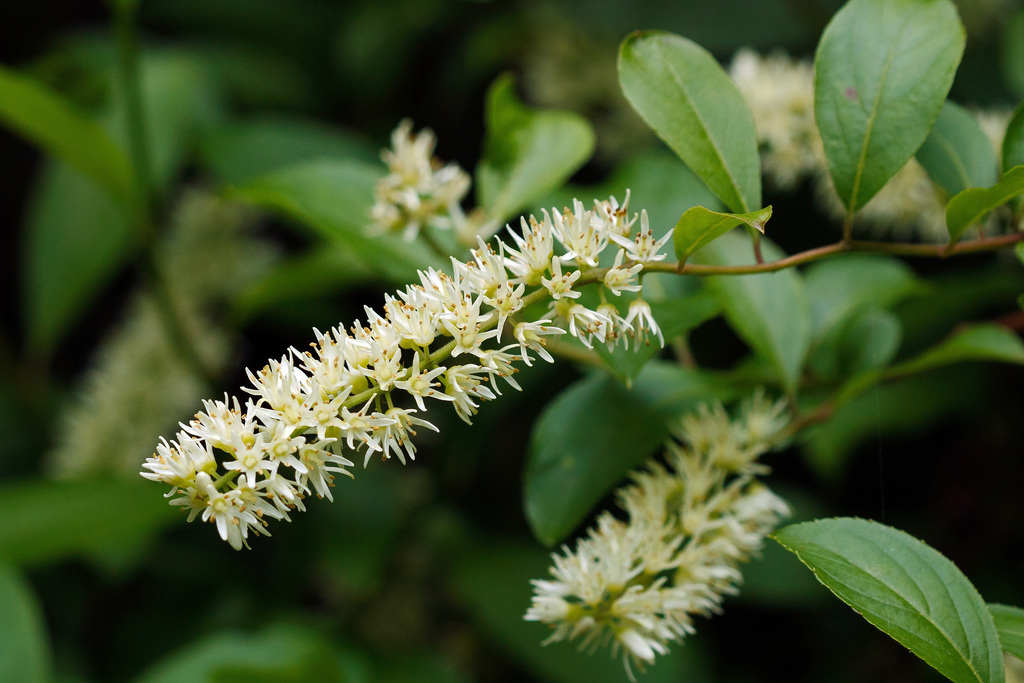
Virginia sweetspire
Itea virginica
Itea virginica, commonly known as Virginia willow or Virginia sweetspire, is a small North American flowering shrub that grows in low-lying woods and wetland margins. Virginia willow is a member of the Iteaceae family, and native to the southeast United States. Itea virginica has small flowers on pendulous racemes.
Depending on location, the species will bloom in late spring to early summer. It prefers moist rich soil, but it can tolerate a wide range of soil types. When Virginia willow is used in horticulture it can form large colonies and may form dense root suckers, making the shrub hard to remove.
From the article Itea virginica on Wikipedia (CC BY-SA), quoted section by section
Description
Itea virginica is a deciduous shrub that grows to 2.5 m (8.2 ft) tall and 1.5 m (4.9 ft) broad, with alternate, simple leaves on arching stems. The plant's white or cream flowers bloom in summer, borne in downward-pointing, slightly curved spikes. It is a multi-stemmed, suckering and colonizing plant, with the stems branching infrequently except at the tops. In favorable conditions it may become semi-evergreen. The leaves turn shades of red in fall (autumn). It is hardy down to at least −29 °C (−20 °F).
Range & habitat
I. virginica's range extends from New Jersey south to Florida, and westward to Texas and Oklahoma. This species' has been observed in shaded and wet areas, such as swamps, wooded floodplains, pine forests, and hydric hammocks.
Wikipedia: “Distribution and habitat”
How it is grown
In cultivation in the UK the cultivar 'Henry's Garnet' has gained the Royal Horticultural Society's Award of Garden Merit. Itea virginica is used as a native ornamental landscape plant in North America, and numerous cultivars have been named. The flowers attract pollinators, and the shrub can be used for erosion control.
Wikipedia: “Horticulture”
Where it lives
Recorded sightings
—
geo-referenced records in GBIF, from museums, herbaria and field observers.
Drag the globe to turn it. Dots are where records exist, not a range map; darker means more records.
In the old herbals & bestiaries

In the stacks
Searching the stacks…
Every page naming Itea virginica in the Biodiversity Heritage Library →
This page is assembled live from iNaturalist, GBIF, Wikipedia, the Source Library and the Internet Archive. It is not yet part of the hand-edited codex. iNaturalist taxon 83152.