- Plants
- ›Vascular Plants
- ›flowering plants
- ›Dicots
- ›Roses, Elms, Figs, and Allies
- ›rose family
- ›brambles, roses, strawberries, and allies
- ›agrimonies and burnets
- ›burnet subtribe
- ›Acaena
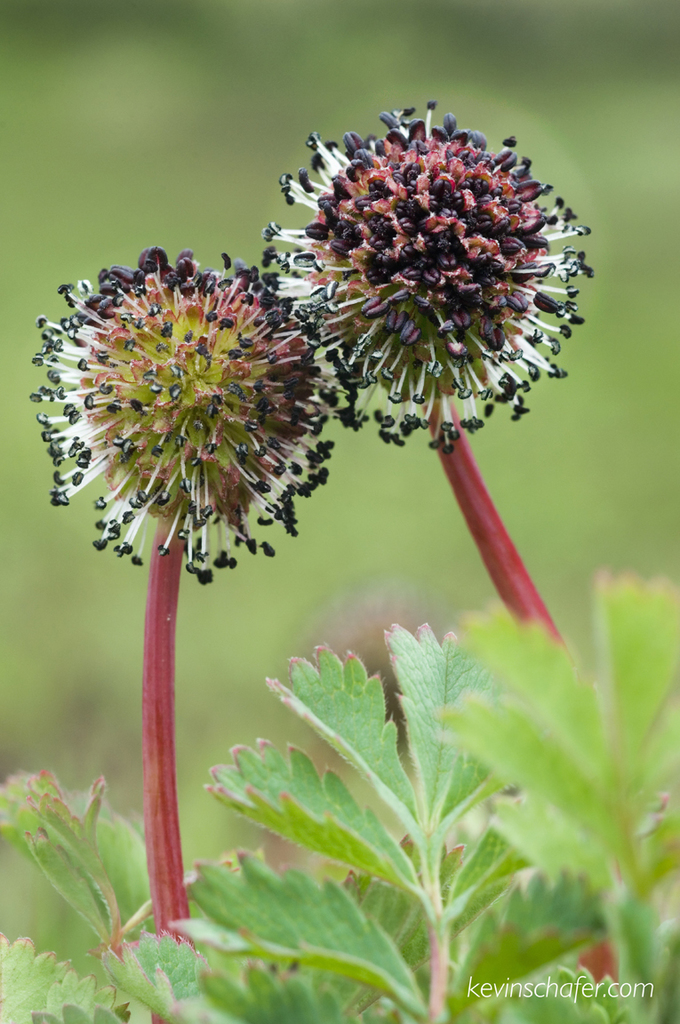
Greater Burnet
Acaena magellanica
Acaena magellanica, commonly called buzzy burr or greater burnet, is a species of flowering plant whose range includes the southern tip of South America and many subantarctic islands.
From the article Acaena magellanica on Wikipedia (CC BY-SA), quoted section by section
Description
Acaena magellanica is a perennial, mat-forming plant with creeping stems, up to 14 cm (6 in) high. The leaves are oblong to linear-lanceolate, with 5 to 10 pairs of ovate leaflets. The flower heads are globular and grow on wiry stems well clear of the foliage. They are followed by brown, prickly seed heads; the seeds have small hooks which enables them to adhere to clothing, feathers or fur.
Range & habitat
The species is native to the southern part of South America. Its range includes Argentina, Chile and various sub-Antarctic islands including the Falkland Islands, the Kerguelen Islands, the Prince Edward Islands, Crozet Islands, South Georgia and the South Sandwich Islands, Macquarie Island and the Heard Island and McDonald Islands. Its typical habitat is damp places such as the edge of bogs, the banks of streams, waterlogged places, meadows and forest margins. It grows from sea level to an altitude of about 4,200 m (13,800 ft).
Wikipedia: “Distribution and habitat”
What it does
In South Georgia, Acaena magellanica may cover the ground in dense patches. It is deciduous, and when the leaves are shed, mosses like Tortula robusta, which grows underneath, flourish. The Kerguelen Islands are in the Southern Indian Ocean Islands tundra ecoregion which is characterised by tussock grasses, lichens and liverworts. A. magellanica is one of the few low forbs that grew here, but the introduction of the European rabbit (Oryctolagus cuniculus), which selectively grazes the species it prefers, eliminated many of the native forbs. When the rabbit was eradicated, A. magellanica and other forbs failed to recover because years of herbivory had depleted their seed banks, and introduced species such as annual meadow grass (Poa annua), mouse-ear chickweed (Cerastium fontanum) and dandelion (Taraxacum officinale) out-competed them.
== References ==
Wikipedia: “Ecology”
Where it lives
Recorded sightings
—
geo-referenced records in GBIF, from museums, herbaria and field observers.
Drag the globe to turn it. Dots are where records exist, not a range map; darker means more records.
In the stacks
Searching the stacks…
Every page naming Acaena magellanica in the Biodiversity Heritage Library →
This page is assembled live from iNaturalist, GBIF, Wikipedia, the Source Library and the Internet Archive. It is not yet part of the hand-edited codex. iNaturalist taxon 83487.