- Plants
- ›Vascular Plants
- ›flowering plants
- ›Dicots
- ›carrots, ivies, and allies
- ›cheesewood family
- ›Bursaria
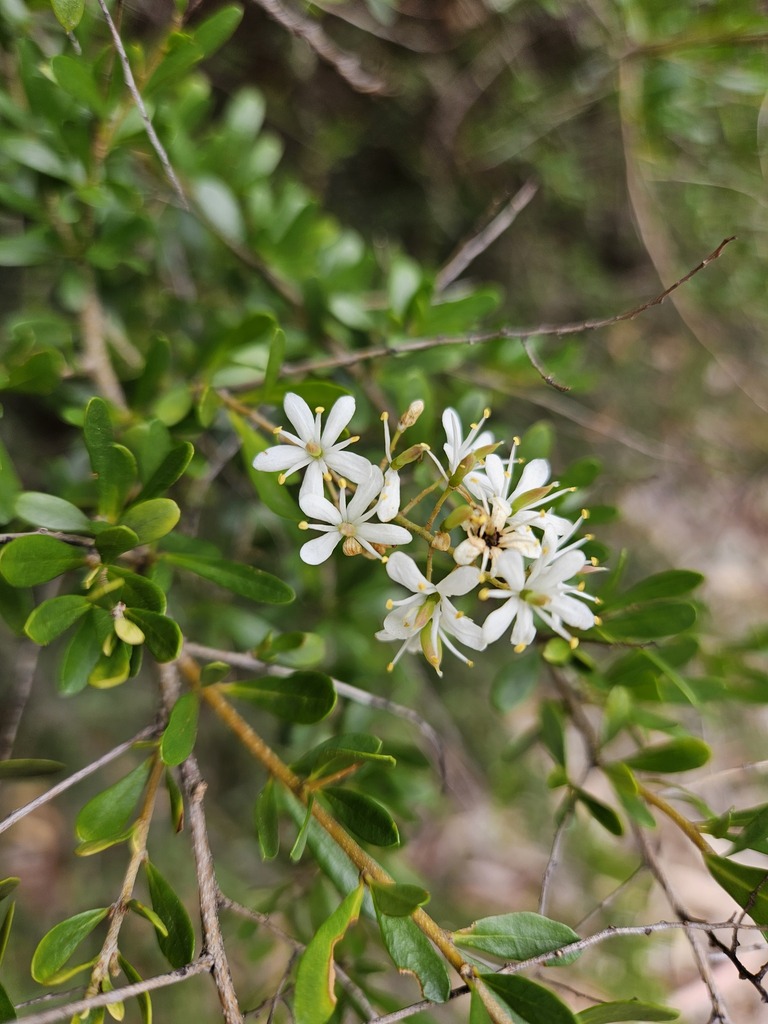
Australian Blackthorn
Bursaria spinosa
Bursaria spinosa is a small tree or shrub in the family Pittosporaceae. The species occurs mainly in the eastern and southern half of Australia and not in Western Australia or the Northern Territory. Reaching 10 m (35 ft) high, it bears fragrant white flowers at any time of year but particularly in summer. A common understorey shrub of eucalyptus woodland, it colonises disturbed areas and fallow farmland. It is an important food plant for several species of butterflies and moths, particularly those of the genus Paralucia, and native bees.
From the article Bursaria spinosa on Wikipedia (CC BY-SA), quoted section by section
Description
Bursaria spinosa has a variable habit, and can grow anywhere from 1 to 12 m high. The dark grey bark is furrowed. The smooth branches are sometimes armed with thorns, and the leaves are arranged alternately along the stems or clustered around the nodes and have a pine-like fragrance when bruised. Linear to oval or wedge-shaped (ovate, obovate or cuneate), they are 2–4.3 cm long and 0.3–1.2 cm wide with a rounded apex. The fragrant flowers can occur at any time of year, but mainly appear in the summer. They are arranged in leafy pyramid-shaped panicles.
Range & habitat
Bursaria spinosa is widespread and common in the understorey of eucalypt woodland in all states of Australia, apart from Western Australia and the Northern Territory. In New South Wales, B. spinosa grows in dry to wet forest in all but the most arid parts of the state, and is sometimes a weed on cleared land. In the Sydney region, it grows on clay- and shale-based soils, as an understory plant in association with grey box (Eucalyptus moluccana) and forest red gum (E. tereticornis) as well as the grass Themeda australis. It can form thickets on ungrazed farmland. In Victoria, the species is widespread and common throughout the state, except for the far northwest, in heavier soils and in alpine areas, in South Australia it is widespread in the south-east of the state, and in Tasmania it mainly occurs in dry areas. Subspecies lasiophylla has a more restricted distribution, and in New South Wales is found on the central and south coasts and central and southern tablelands, growing in woodland on heavier clay soils than subsp. spinosa. In Victoria, this subspecies mainly grows in dry, rocky places in forest and shrubland in eastern and central-western areas of that state.
Wikipedia: “Distribution and habitat”
What it does
Living for 25 to 60 years, Bursaria spinosa can resprout from its woody base after bushfire. Highly rhizomatous, plants of a stand are often genetically a single plant. Despite being genetically identical, different plants and even single shoots can be very distinct in appearance (for instance, spineless shoots previously regarded as a subspecies "inermis"). Its seed is wind-dispersed and it is a colonising plant. A wide variety of insects visit the flowers of Bursaria spinosa, the most important pollinators of which appear to be beetles of several families. Common visitors recorded from field work around Armidale were jewel beetle species, such as Curis splendens and Stigmodera inflata; longicorn beetles including Amphirhoe sloanei and Tropocalymma dimidiatum; scarab beetles; and tumbling flower beetles. Beetles and scoliid wasps all carried significant amounts of pollen. Other visitors, such as flies and butterflies, carried much lower amounts. The larvae of the jewel beetle species Astraeus crassus live in tunnels in dead and dying branches. …
Wikipedia: “Ecology”
At the table
The drug aesculin, used in medical research and in the 1940s, as an ingredient in sunscreen, is harvested from the plant in the Sydney region. Although its thorns make it unpopular in cultivation, it can be useful as a deterrent barrier. It can be grown from fresh seed or from cuttings and is hardy in most situations. Bursaria spinosa provides nectar for butterflies and a haven for small birds.
== References ==
Wikipedia: “Uses”
Where it lives
Recorded sightings
—
geo-referenced records in GBIF, from museums, herbaria and field observers.
Drag the globe to turn it. Dots are where records exist, not a range map; darker means more records.
In the stacks
Searching the stacks…
Every page naming Bursaria spinosa in the Biodiversity Heritage Library →
This page is assembled live from iNaturalist, GBIF, Wikipedia, the Source Library and the Internet Archive. It is not yet part of the hand-edited codex. iNaturalist taxon 83571.