- Plants
- ›Vascular Plants
- ›flowering plants
- ›Dicots
- ›Heathers, Balsams, Primroses, and Allies
- ›persimmon family
- ›Diospyros
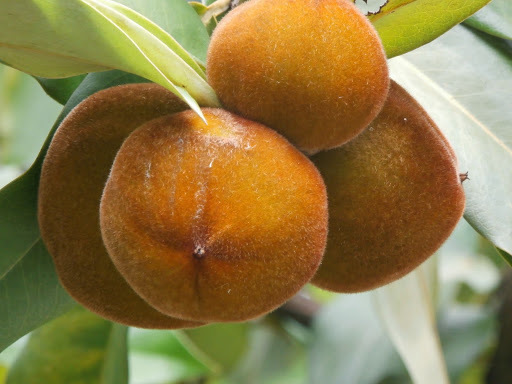
Butter Fruit
Diospyros blancoi
Diospyros blancoi, (synonym Diospyros discolor), commonly known as velvet apple, velvet persimmon, kamagong, or mabolo tree, is a tree of the genus Diospyros of ebony trees and persimmons. It produces edible fruit with a fine, velvety, reddish-brown fur-like covering. The fruit has a soft, creamy, pink flesh, with a taste and aroma comparable to peaches.
It is widely distributed and native to the Philippines, but it is also native to eastern and southern Taiwan. It has also been introduced to other parts of Southeast Asia, the Pacific Islands, South Asia, the Caribbean, Florida, and other tropical regions.
From the article Diospyros blancoi on Wikipedia (CC BY-SA), quoted section by section
How it is grown
It is a dioecious tropical tree that grows well in a diversity of soil, from sea level to 750 metres (2,400 ft) above sea level. Seed trees are normally planted 10–15 metres (30–45 ft) from each other; this one can be planted from 7.5–9 metres (25–30 ft) from each other. It needs a good distribution of rainfall through the year. Trees that were planted by seeds could take 6 or 7 years to give out fruit, but trees that were propagated by cuttings produce fruit in 3 or 4 years. It is a very productive tree. The fact that fruits vary greatly – in shape, color, hairiness and taste – suggests that there is a great deal of genetic variation in the plant. Seedless cultivars exist, and are highly favored since in the normal varieties the large seeds occupy a considerable volume of the fruit.
Wikipedia: “Cultivation”
Where it lives
Recorded sightings
—
geo-referenced records in GBIF, from museums, herbaria and field observers.
Drag the globe to turn it. Dots are where records exist, not a range map; darker means more records.
In the stacks
Searching the stacks…
Every page naming Diospyros blancoi in the Biodiversity Heritage Library →
This page is assembled live from iNaturalist, GBIF, Wikipedia, the Source Library and the Internet Archive. It is not yet part of the hand-edited codex. iNaturalist taxon 83582.