- Plants
- ›Vascular Plants
- ›flowering plants
- ›Dicots
- ›pinks, cactuses, and allies
- ›pink family
- ›Sclerantheae
- ›Cherleria
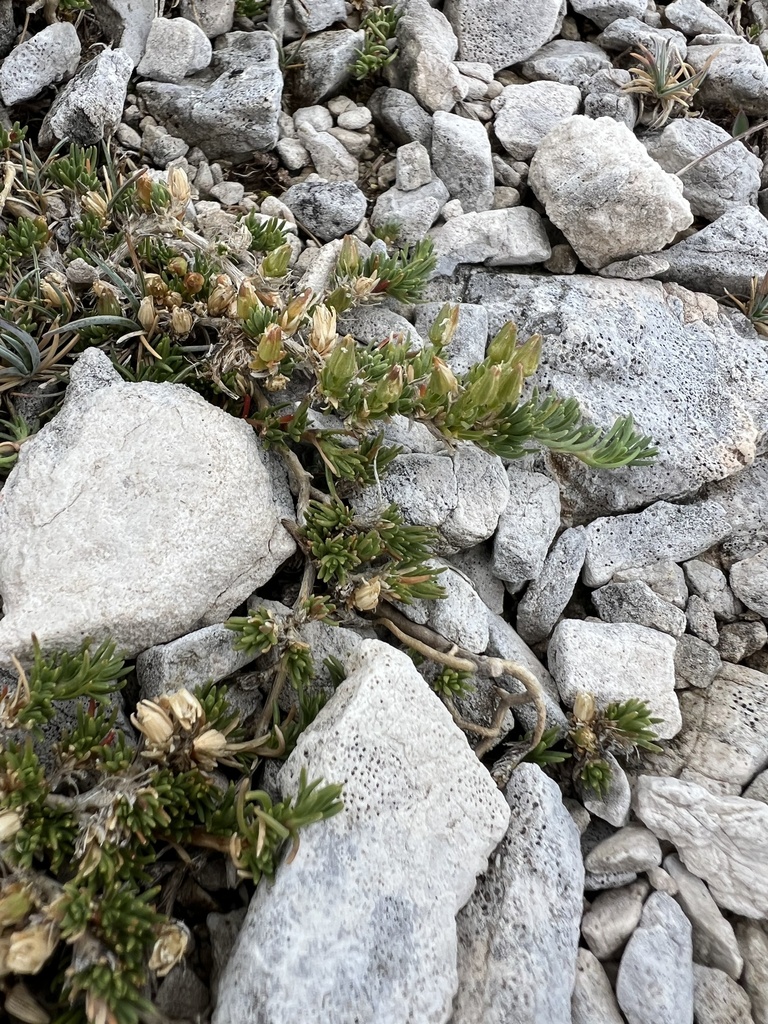
Cherleria handelii
Cherleria handelii, or Handei-Maceti's sandwort, is a perennial plant of the family Caryophyllaceae. It is a stenoendemic from the mountain Čvrsnica, Bosnia and Herzegovina.
From the article Cherleria handelii on Wikipedia (CC BY-SA), quoted section by section
Description
Cherleria handelii is a perennial plant subsided in the humus drilling, length up to about 15 (-20) cm. The stems are covered with dense leaves, which can be subsided or standing. Opposite are sitting, with sleeve, triangular to a barrel. At the bottom are a bit dull, with slightly rough and a little eyelashed edges. It blooms in June and July. Flowers are individual, with a large, cylindrical cup, which is at the base as well as cut down. Length is about 4-4.5 mm, naked or slightly hairy at the base. Petals cups are linear-oblong, about 4-4.5 mm long, and about 1.8 to 2 mm wide. At the top are rounded. In the rosary, the petals are oblong, essentially wedge-shaped, long up to about 5 mm, and about 1.8 to 2 mm wide. Exceed sepals in flowers are in the 10 stamen, and pistil has a 2-3 door (exceptionally more). Fruit is a quiver, cylindrical to egg-conical, about 4-4.5 mm long, diameter of 1.8–2 mm, with 3 (4) of the flap. Seeds are spherically-kidneys, width 1.2-1.5 mm and about 1-1.2 mm high.
== References ==
Where it lives
Recorded sightings
—
geo-referenced records in GBIF, from museums, herbaria and field observers.
Drag the globe to turn it. Dots are where records exist, not a range map; darker means more records.
In the stacks
Searching the stacks…
Every page naming Cherleria handelii in the Biodiversity Heritage Library →
This page is assembled live from iNaturalist, GBIF, Wikipedia, the Source Library and the Internet Archive. It is not yet part of the hand-edited codex. iNaturalist taxon 836817.