- Plants
- ›Vascular Plants
- ›flowering plants
- ›Dicots
- ›sandalwoods, mistletoes, and allies
- ›olax family
- ›Ximenia
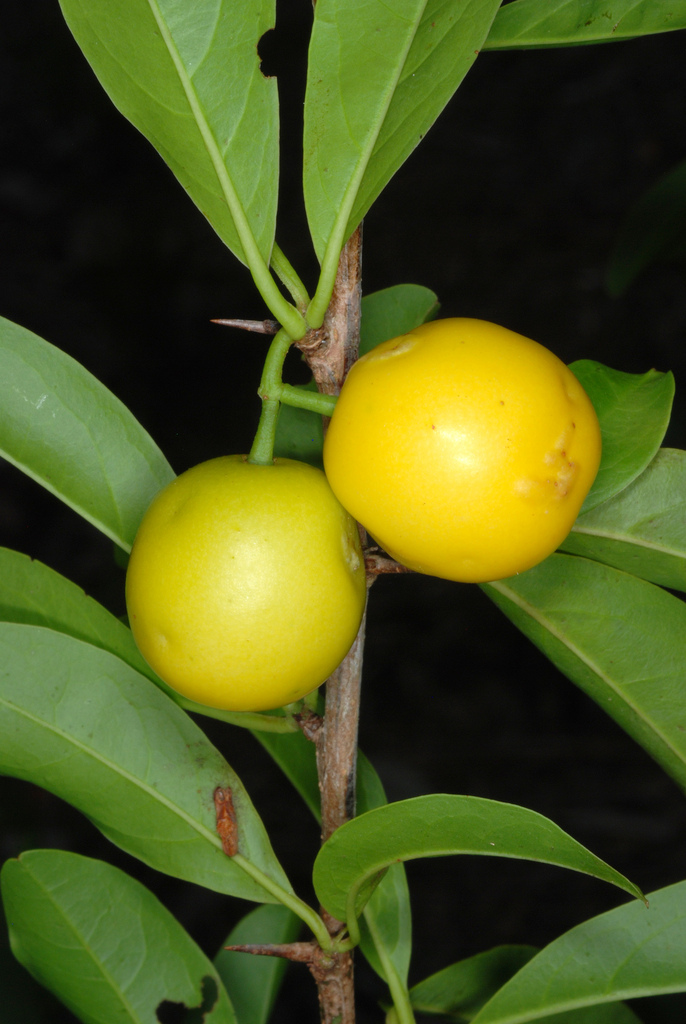
Hog plum
Ximenia americana
Ximenia americana, commonly known as tallow wood, hog plum, yellow plum, sea lemon, or pi'ut (Chamorro), is bush-forming shrub/small tree; a species from the Ximenia genus in the Olacaceae family. It is mainly found in the tropics, ranging from Africa, India and southeast Asia, to Australia, New Zealand, Pacific Islands, West Indies, Central, North and South America. It is especially common in Africa and South America. It is not domesticated so it is only found occurring in the wild.
They grow in areas with more than 500 mm of mean annual rainfall and up to heights of 2000 m. It is commonly found in a variety of diverse habitats ranging from dry woodlands, hilly areas to coastal bushlands, along riverbanks, and mangroves They are commonly found in poor and dry soil types. The plant has not been domesticated; as such, it only occurs in the wild.
From the article Ximenia americana on Wikipedia (CC BY-SA), quoted section by section
Range & habitat
It is found in many habitats, predominantly in semi-arid bushlands and in dry and moist woodlands, sandy open woodlands, dry hilly areas, coastal bushlands, countrysides, shrub savannahs, forest lands and along watercourses such as riverbanks and stony slopes. X. americana occurs in altitudes up to 2000 m (6562 ft) and where mean annual rainfall is more than 500 mm. It grows on many soil types such as clay soils, clay muddy, silt sandy; however, it is mostly observed growing on poor and dry soil. It can also absorb nutrients and water from other plant species through its roots, however, it does not use this method as its mode of survival.
Wikipedia: “Distribution and habitat”
What it does
Ximenia americana is a long-lived perennial and is found present in savannahs, one of their natural habitats, and are vital food sources for animals living in the same habitats, namely mammals like giraffes, who depend on the leaves of X. americana for its food. The leaves are also eaten by insects, such as butterflies, and their larvae, documented species being Axiocerses amanga (the bush scarlet), Stugeta bowkeri (the Bowker's sapphire) and Hypolycaena philippus (the purple-brown hairstreak). The vibrant colours of the fruit, which is oftentimes produced in large amounts during the early summer, attracts birds, such as bulbuls, starlings, and barbets, and other wildlife to feed on the fruit. The flowers are known attract many insect pollinators, namely bees. Documented bees include Agapostemon splendens (the brown-winged striped-sweat bee), Apis mellifera (the western honey bee), Augochloropsis sumptuosa, Coelioxys germana, Dialictus placidensis, Megachile mendica (the Flat-tailed Leaf-cutter Bee) and Melissodes communis (the common long-horned bee). Ximenia americana can be classified as a facultative hemiparasite, due to its tendency to live off the roots of other nearby host species, but not as a way of survival as it can perfectly grow without a host. Due to this it can grow better in soil where it can come into contact with the roots of other plants. …
Wikipedia: “Ecology”
At the table
Ximenia americana can be utilized as a food source, mainly its fruit, which can be eaten raw or pickled, and can be used to replace lemon in fish recipes, make juice, jams or intoxicating drinks; In South Africa, a kind of beer is made from the fruits. The kernel of the fruit can be made into oil, which is used in cooking as a substitute for butter or ghee. The nuts have a strong purgative effect, and should not be eaten in large amounts. In Asia, the young leaves are cooked as a vegetable. However, the leaves also contain cyanide and need to be thoroughly cooked, and should not be eaten in large amounts.
Wikipedia: “Food”
In medicine
Fatty acids and glycerides are abundantly available in X.americana. Further classes of chemical compounds found in X. americana includes alkaloids, anthraquinones, glycosides, flavonoids, glycosides, phenolic compounds, phlobatannins, quinones, saponins, tannins, and terpenoids. Leaves collected from X. americana in southern Niger were found to be rich in calcium, iron, magnesium, and manganese content but were also noted to be lacking protein. Linolenate was also detected in the leaves, along with high levels of palmitate. Vitamin C content varies according to maturity of the plant, with the green fruits having 74% more than the mature, yellow fruits. The seed of the fruit contains cyanide derivatives and high levels of riproximin were noted in the fruit kernels. The seed oil was observed to contain the compounds ximenic, linolenic, linoleic, and stearic acids along with smaller amounts of lumequic, ximenynic, arachidonic, erucic, and nervonic acids and a variety of other compounds. The volatile oil of the leaves were observed to be consisted of benzaldehyde (63.5%), hydroxybenzyl cyanide (13%) and isophorone (3.5%), the cyanide content contributes to the aforementioned almond-like smell of leaves.
Wikipedia: “Phytochemistry”
Toxicity
Leaves containing the cyanogenic glycoside sambunigrin at 100 ppm were noted to be fatal for the freshwater snail, Bulinus globus, the species responsible for causing the disease schistosomiasis. Researchers noted that X. americana extract had no deaths when the toxic effects of the extract of the plant for 14 days, however, after an oral administration of 2000 mg.kg−1, forced breathing and analgesia in the animals were noted. Another study was conducted on the effects of the liquid extracts of the root, stem and leaves of X. americana on the blood and the liver, and damage to the cells of the liver were noted.
How it is grown
There have been no recorded cases of the domestication of X. americana. However, it is noted that Ximenia americana can easily propagated by planting fresh seeds in a mixture of 5 parts soil and 1 part compost. Germination is usually observed 14 to 30 days after the seed has been planted. The plant grows about 0.5 m (1.6 ft) every year, a moderate growth rate. It can grow on loamy, clay soil, and other types of poor and dry soil and is adaptable to changes in soil pH. It is drought-resistant, making it a good source of food during dry periods. It is also tolerant of mild flooding, that occur during storms or floods, for short periods of time. It is also mildly tolerant of salty soil types and salt sprays and winds. Due to the semiparasitic roots, it grows well around other plants and is best grown next a host like oak.
Wikipedia: “Cultivation”
In human culture
The species is also used as a border and boundary, if it is cultivated as a hedge plant properly. The plant can also be used for decoration purposes as it has attractive flowers and foliage.
Wikipedia: “Horticulture”
Where it lives
Recorded sightings
—
geo-referenced records in GBIF, from museums, herbaria and field observers.
Drag the globe to turn it. Dots are where records exist, not a range map; darker means more records.
In the stacks
Searching the stacks…
Every page naming Ximenia americana in the Biodiversity Heritage Library →
This page is assembled live from iNaturalist, GBIF, Wikipedia, the Source Library and the Internet Archive. It is not yet part of the hand-edited codex. iNaturalist taxon 83832.