- Animals
- ›Arthropods
- ›Hexapods
- ›Insects
- ›Winged and Once-winged Insects
- ›Beetles
- ›Water, Rove, Scarab, Long-horned, Leaf, and Snout Beetles
- ›Scarabaeiform Beetles
- ›Scarabs, Stag Beetles, and Allies
- ›Scarabs
- ›Dung Beetles
- ›Phanaeini
- ›Phanaeus
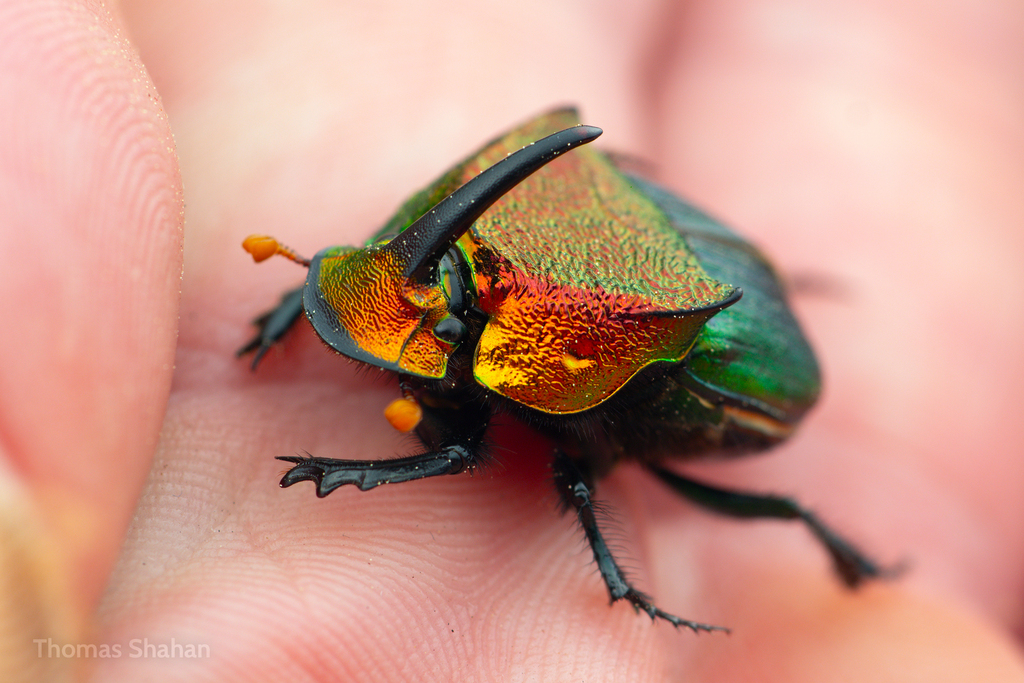
Rainbow Scarab
Phanaeus vindex
Phanaeus vindex, also known as a rainbow scarab (like other members in its genus), is a North American species of true dung beetle in the family Scarabaeidae. It is found in eastern and central United States (Florida and New England to Arizona and Wyoming) and northern Mexico. It is the most widespread species of Phanaeus in the United States and it has a wide habitat tolerance. It may hybridize with the generally less common P. difformis.
From the article Phanaeus vindex on Wikipedia (CC BY-SA), quoted section by section
Description
P. vindex adults are hard-bodied beetles which range from approximately 11-22 millimeters (0.4-0.9 inches) in length. They are relatively bulky and oblong. These beetles are sexually dimorphic; the males can be identified by their iridescent elytra and a large horn on their heads while females have slightly less vibrant shells and lack horns. Females also have different numbers of segments on their abdomen than males. Additionally, the ends of male abdomens raise above the elytra, however, in females, they do not. On top of this, the abdomen is distinctly colored in both sexes. Like most Phanaeus species, male rainbow scarabs can be observed in either a major morph with large horns and bodies, or a minor morph, with significantly reduced horn and body size.
At the table
Because P. vindex is a member of the Scarabaeinae sub-family, they are considered to be “true dung beetles” and feed exclusively on fecal excrement through all stages of their life cycle. While they do prefer to feed on dung from pasture animals, rainbow scarabs do sometimes feed on wild animal feces in more forestal areas. Research has shown that rainbow scarabs have certain preferences when selecting feces to feed on; they are most attracted to excrement that is considered “fragrant” or produced by organisms that have very diverse diets. They tend to consume dung from omnivores such as pigs and cows and will sometimes select herbivore dung, but they are least attracted to dung produced by carnivorous animals. P. vindex is afforded a very wide range of feces in their diet as a result of being able to occupy various habitats and soil types across seasons. Typically, however, these beetles do prefer clay soils, in contrast with other scarab beetles which may be more prevalent in sandy habitats. Larvae of all dung beetles have biting mouthparts to help consume the feces, but when dung beetles in the Scarabaeidae family reach their adult stage, they develop specialized mouthparts in addition to the biting portions. …
Wikipedia: “Food resources”
Listen
Looking for field recordings…
Where it lives
Recorded sightings
—
geo-referenced records in GBIF, from museums, herbaria and field observers.
Drag the globe to turn it. Dots are where records exist, not a range map; darker means more records.
In the stacks
Searching the stacks…
Every page naming Phanaeus vindex in the Biodiversity Heritage Library →
This page is assembled live from iNaturalist, GBIF, Wikipedia, the Source Library and the Internet Archive. It is not yet part of the hand-edited codex. iNaturalist taxon 83929.