- Animals
- ›Arthropods
- ›Hexapods
- ›Insects
- ›Winged and Once-winged Insects
- ›Flies
- ›Brachyceran Flies
- ›Cyclorrhaphan Flies
- ›Schizophoran Flies
- ›Acalyptrate Flies
- ›Diopsoidea

Stalk-eyed Flies
Diopsidae
Stalk-eyed flies are insects of the fly family Diopsidae. The family is distinguished from most other flies by most members of the family bearing eyestalks: projections from the sides of the head with the eyes at the end. Some fly species from other families such as Drosophilidae, Platystomatidae, Richardiidae, and Tephritidae have similar heads, but the unique character of the Diopsidae is that their antennae are also located on the stalk, rather than in the middle of the head as in all other flies. Stalked eyes are present in all members of the subfamily Diopsinae, but are absent in the Centrioncinae, which retain unstalked eyes similar to those of other flies. The stalked eyes are usually sexually dimorphic, with eyestalks present but shorter in females.
The stalk-eyed flies are up to a centimeter long, and they feed on both decaying plants and animals. Their unique morphology has inspired research into how the attribute may have arisen through forces of sexual selection and natural selection. Studies of the behavior of the Diopsidae have yielded important insights into the development of sexual ornamentation, the genetic factors that maintain such a morphological feature, sexual selection, and the handicap principle.
4 branches of this family, most-observed first

Diopsinae
subfamilyDiopsinae
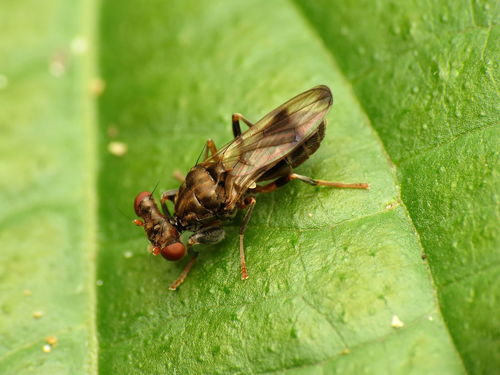
Sphyracephalinae
subfamilySphyracephalinae
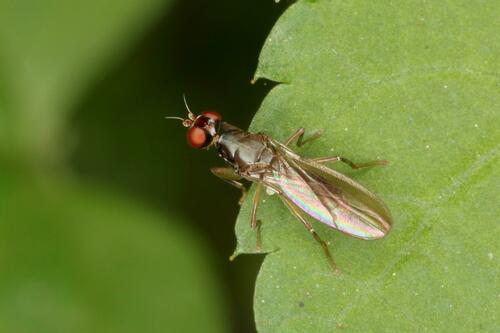
Afromontane Forest Flies
subfamilyCentrioncinae
Pseudodiopsis
genusPseudodiopsis
Where it lives
Recorded sightings
—
geo-referenced records in GBIF, from museums, herbaria and field observers.
Drag the globe to turn it. Dots are where records exist, not a range map; darker means more records.
In the stacks
Searching the stacks…
Every page naming Diopsidae in the Biodiversity Heritage Library →
This page is assembled live from iNaturalist, GBIF, Wikipedia, the Source Library and the Internet Archive. It is not yet part of the hand-edited codex. iNaturalist taxon 83944.