- Plants
- ›Vascular Plants
- ›flowering plants
- ›Dicots
- ›saxifrages, stonecrops, and allies
- ›stonecrop family
- ›Sempervivoideae
- ›Telephieae
- ›Hylotelephium
- ›Hylotelephium telephium
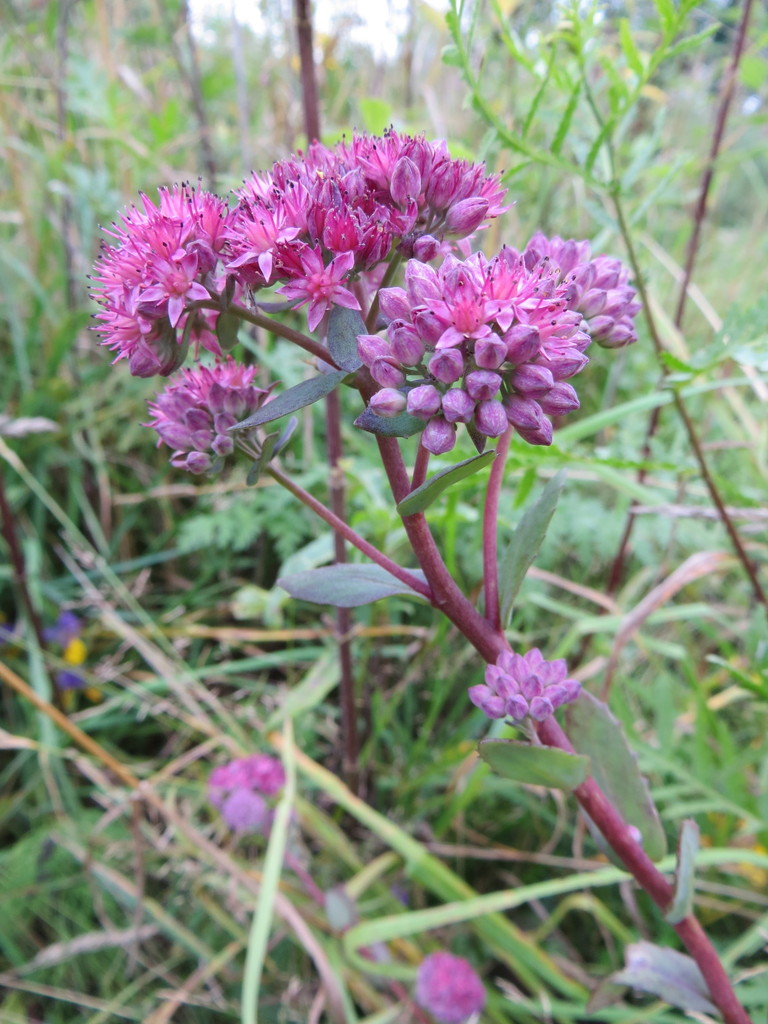
Orpine
Hylotelephium telephium
Hylotelephium telephium (synonym Sedum telephium), known as orpine, livelong, frog's-stomach, harping Johnny, life-everlasting, live-forever, midsummer-men, Orphan John, witch's moneybags, and garden stonecrop is a succulent perennial plant of the family Crassulaceae native to Eurasia. The flowers are held in dense heads and can be reddish or yellowish-white. A number of cultivars, often with purplish leaves, are grown in gardens as well as hybrids between this species and the related Hylotelephium spectabile (iceplant), especially the popular 'Herbstfreude' ('Autumn Joy'). Occasionally garden plants may escape and naturalise as has happened in parts of North America.
From the article Hylotelephium telephium on Wikipedia (CC BY-SA), quoted section by section
Range & habitat
The species is endemic from Europe to Asia, but has been widely introduced elsewhere, particularly N America. It can be found growing in fields, around hedges, hills, and on gravelly or calcareous soils. In the UK, it is found in woodland and near hedges.
Wikipedia: “Distribution and habitat”
At the table
The very young leaves can be eaten raw, and both the young leaves and firm tubers can be cooked. The plant has been used medicinally, being used by the Romans to treat wounds, and in later times to treat internal ulcers. It has also been used for love-divination, as the stems and leaves can store water, when picked, hence common name livelong. They were hung in a room where a girl was to be married to a boy. If the stems grew together, this 'sign' would mean that the marriage would be blessed and she would be happy. Alternatively, if they grew apart, the marriage prospects looked bad, and if a stem died, this would portent death.
Wikipedia: “Uses”
Where it lives
Recorded sightings
—
geo-referenced records in GBIF, from museums, herbaria and field observers.
Drag the globe to turn it. Dots are where records exist, not a range map; darker means more records.
In the old herbals & bestiaries


In the stacks
Searching the stacks…
Every page naming Hylotelephium telephium in the Biodiversity Heritage Library →
This page is assembled live from iNaturalist, GBIF, Wikipedia, the Source Library and the Internet Archive. It is not yet part of the hand-edited codex. iNaturalist taxon 84031.