- Plants
- ›Vascular Plants
- ›flowering plants
- ›Dicots
- ›myrtles, evening primroses, and allies
- ›myrtle family
- ›Myrtoideae
- ›Chamelaucieae
- ›Chamelauciinae
- ›Verticordia
- ›Eperephes
- ›Pennuligera
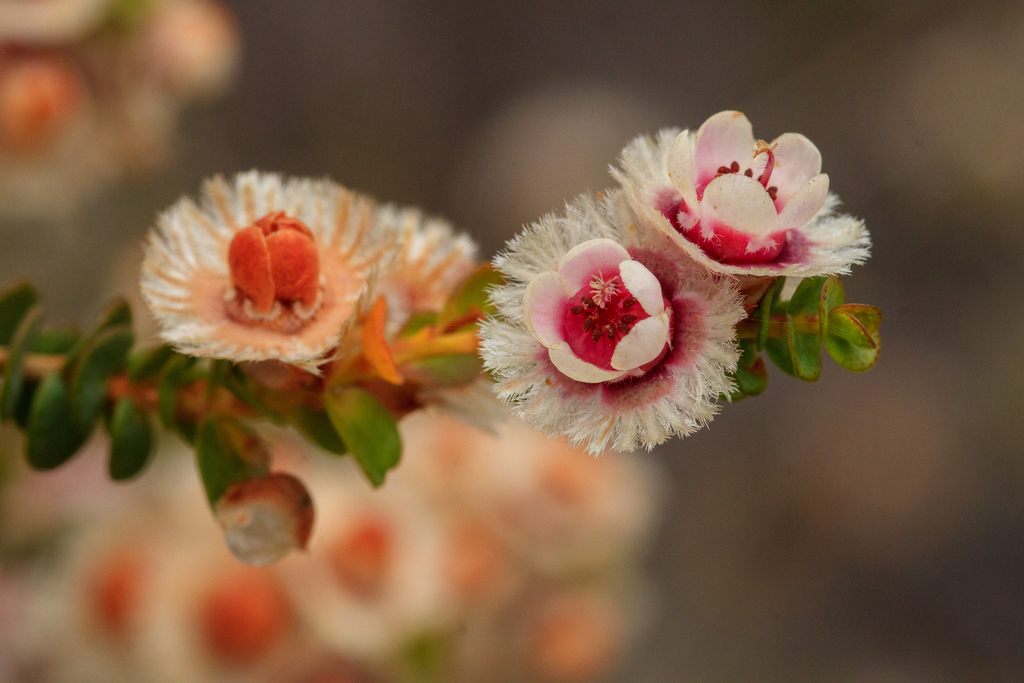
Verticordia fragrans
Verticordia fragrans, commonly known as hollyhock verticordia, is a species of flowering plant in the myrtle family, Myrtaceae and is endemic to the south-west of Western Australia. It is an openly branched shrub with egg-shaped leaves and spikes of sweetly scented, pink and white flowers in spring and early summer.
From the article Verticordia fragrans on Wikipedia (CC BY-SA), quoted section by section
Description
Verticordia fragrans is a shrub which grows to a height of 0.45–3 m (1–10 ft) and a width of 0.45–1 m (1–3 ft) and has a single, openly branched stem at its base. The leaves are thin, egg-shaped to elliptic or almost round in shape, 1.5–4 mm (0.06–0.2 in) long. The flowers are sweetly scented, arranged in spreading spike-like groups, each flower on a stalk about 1.5–3 mm (0.06–0.1 in) long. The sepals are pink, rarely white, 3.5–4 mm (0.14–0.16 in) long and have 6 to 9 white feathery lobes. The petals are erect, deep to pale pink or rarely white, 4.0–4.5 mm (0.16–0.18 in) long, about 3 mm (0.1 in) wide with a few short hairs around the edge. The style is 5 mm (0.2 in), curved near the top with a few hairs near the tip. Flowering time is from October to November or December.
Range & habitat
This verticordia grows in sand, sometimes with or over clay, loam or sandstone, often with other verticordia species in woodland or shrubland. It is found near Eneabba and Coomallo in the Geraldton Sandplains biogeographic region.
Wikipedia: “Distribution and habitat”
How it is grown
It is usually propagated from cuttings and is easy to grow in full sun or part shade. It is both drought and frost tolerant and has grown well in Sydney, near the sea as well as inland in Western Australia.
== References ==
Wikipedia: “Use in horticulture”
Where it lives
Recorded sightings
—
geo-referenced records in GBIF, from museums, herbaria and field observers.
Drag the globe to turn it. Dots are where records exist, not a range map; darker means more records.
In the stacks
Searching the stacks…
Every page naming Verticordia fragrans in the Biodiversity Heritage Library →
This page is assembled live from iNaturalist, GBIF, Wikipedia, the Source Library and the Internet Archive. It is not yet part of the hand-edited codex. iNaturalist taxon 841468.