- Plants
- ›Vascular Plants
- ›flowering plants
- ›Dicots
- ›myrtles, evening primroses, and allies
- ›myrtle family
- ›Myrtoideae
- ›Chamelaucieae
- ›Chamelauciinae
- ›Verticordia
- ›Chrysoma
- ›Sigalantha
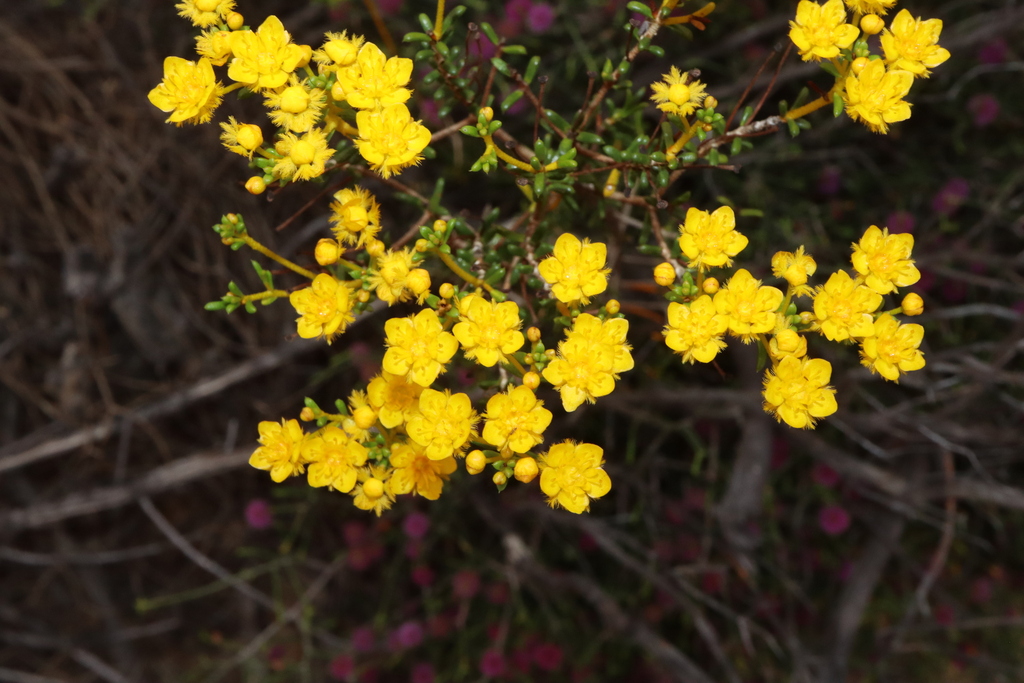
Verticordia integra
Verticordia integra, commonly known as plastic verticordia, is a flowering plant in the myrtle family, Myrtaceae and is endemic to the south-west of Western Australia. It is a shrub with only a few branches, with very thick oblong to egg-shaped leaves and heads of shiny golden-coloured flowers in late spring.
From the article Verticordia integra on Wikipedia (CC BY-SA), quoted section by section
Description
Verticordia integra is an open, sparsely-branched shrub which grows to 30–75 cm (10–30 in) high and 20–50 cm (8–20 in) wide. Its leaves are oblong to egg-shaped, 2–7 mm (0.08–0.3 in) long and have a round end but with a short point at the tip. Leaves near the flowers are similar in shape but shorter. The flowers are usually scented and are arranged in rounded, corymb-like groups on the ends of the branches on erect stalks 7–12 mm (0.3–0.5 in) long with the lower flowers having longer stalks. The floral cup is a flattened hemisphere, less than 1.0 mm (0.04 in) long, rough and glabrous. The sepals are gold-coloured, about 3 mm (0.1 in) long, widely spreading and have 4 to 6 lobes which have long, spreading hairs. The petals are shiny gold-coloured, 3–4 mm (0.1–0.2 in) long and erect, egg-shaped to almost round and dished with a smooth edge. The style is straight or slightly curved, about 2.5 mm (0.1 in) long and glabrous. Flowering mostly occurs from October to November.
Range & habitat
This verticordia usually grows in association with other species of verticordia in sand with lateritic gravel, loam or clay in heath. It mainly occurs in the area between Lake Biddy, Lake Magenta, Lake King and Ravensthorpe in the Esperance Plains and Mallee biogeographic regions.
Wikipedia: “Distribution and habitat”
How it is grown
This verticordia has been difficult to propagate and establish in the garden but when successful produces a bushier plant than wild specimens. It has been propagated from cuttings but establishing them in the garden has been difficult.
== References ==
Wikipedia: “Use in horticulture”
Where it lives
Recorded sightings
—
geo-referenced records in GBIF, from museums, herbaria and field observers.
Drag the globe to turn it. Dots are where records exist, not a range map; darker means more records.
In the stacks
Searching the stacks…
Every page naming Verticordia integra in the Biodiversity Heritage Library →
This page is assembled live from iNaturalist, GBIF, Wikipedia, the Source Library and the Internet Archive. It is not yet part of the hand-edited codex. iNaturalist taxon 841481.