- Plants
- ›Vascular Plants
- ›flowering plants
- ›Dicots
- ›myrtles, evening primroses, and allies
- ›myrtle family
- ›Myrtoideae
- ›Chamelaucieae
- ›Chamelauciinae
- ›Verticordia
- ›Eperephes
- ›Pennuligera
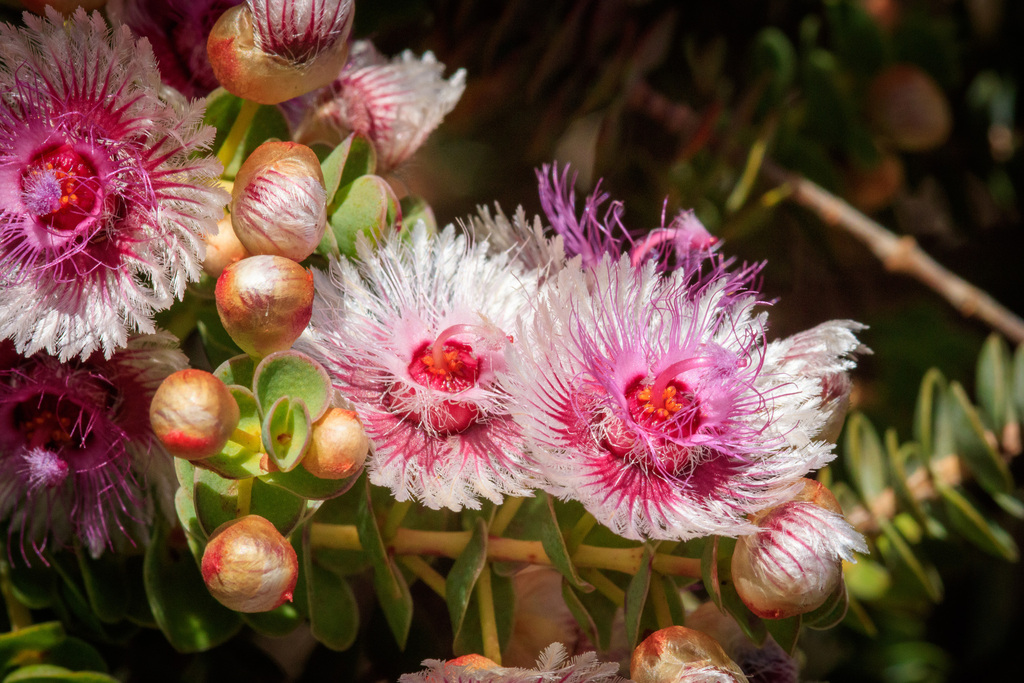
Verticordia oculata
Verticordia oculata is a flowering plant in the myrtle family, Myrtaceae and is endemic to Western Australia. It is a sprawling woody shrub with large, circular leaves with white edges and silver-white flowers with a dark centre of lilac and purple, the largest flowers of the genus Verticordia. The botanist Ferdinand von Mueller reportedly became entranced by its floral display when he visited the northern sandplains area in 1877, later describing the shrub as the 'princess of Australian flora'.
From the article Verticordia oculata on Wikipedia (CC BY-SA), quoted section by section
Description
Verticordia oculata is a shrub which grows to a height of between 20 and 70 cm (0.7 and 2 ft) and sprawls to a width of 0.3–1.0 m (1–3 ft). It has a lignotuber, from which several or many main stems emerge. The leaves are almost circular in shape, 4–11 mm (0.2–0.4 in) in diameter with a distinct white margin, lack a stalk and attach directly to the stem. The flowers are 20–25 mm (0.8–1 in) in diameter and are grouped in a spreading arrangement at the upper parts of the stem on stalks 7–11 mm (0.3–0.4 in) long. The sepals are 9–10 mm (0.35–0.39 in) long and have 12-14 deeply divided, feather-like, silver-white lobes and are lilac to purple at the base. The petals are 7–8 mm (0.3–0.3 in) long, more or less circular in shape with 15 to 18 long, finger-like lobes and are lilac-pink to purple. The colouration of the flower parts contribute to its resemblance to an eye. Flowering occurs between October and December.
Range & habitat
Verticordia oculata is found growing with several other species of the genus, in heaths and shrublands, on white, red, and yellow sand. It occurs on sandplains and ridges in the Avon Wheatbelt, Carnarvon, Geraldton Sandplains and Yalgoo biogeographic regions. It has a distribution range north of the Principality of Hutt River to a locality west of the Billabong Roadhouse. Specimens have been recorded near the coast and inland to Yuna.
Wikipedia: “Distribution and habitat”
How it is grown
This small shrub has been described as "spectacularly beautiful" and both it and the hybrid Verticordia 'Wemms find' have horticultural potential. Its branching habit, pale leaves and large flowers are especially attractive but it is not well known in cultivation outside Western Australia, where some examples have grown for more than 14 years. It can be propagated from cuttings but when grown on its own roots, tends to suffer from fungal attack, especially in humid areas such as Sydney. Established plants grown in Western Australia have shown to be frost resistant and have tolerated heavy summer rainfall.
== References ==
Wikipedia: “Use in horticulture”
Where it lives
Recorded sightings
—
geo-referenced records in GBIF, from museums, herbaria and field observers.
Drag the globe to turn it. Dots are where records exist, not a range map; darker means more records.
In the stacks
Searching the stacks…
Every page naming Verticordia oculata in the Biodiversity Heritage Library →
This page is assembled live from iNaturalist, GBIF, Wikipedia, the Source Library and the Internet Archive. It is not yet part of the hand-edited codex. iNaturalist taxon 841496.