- Plants
- ›Vascular Plants
- ›flowering plants
- ›Dicots
- ›myrtles, evening primroses, and allies
- ›myrtle family
- ›Myrtoideae
- ›Chamelaucieae
- ›Chamelauciinae
- ›Verticordia
- ›Chrysoma
- ›Sigalantha
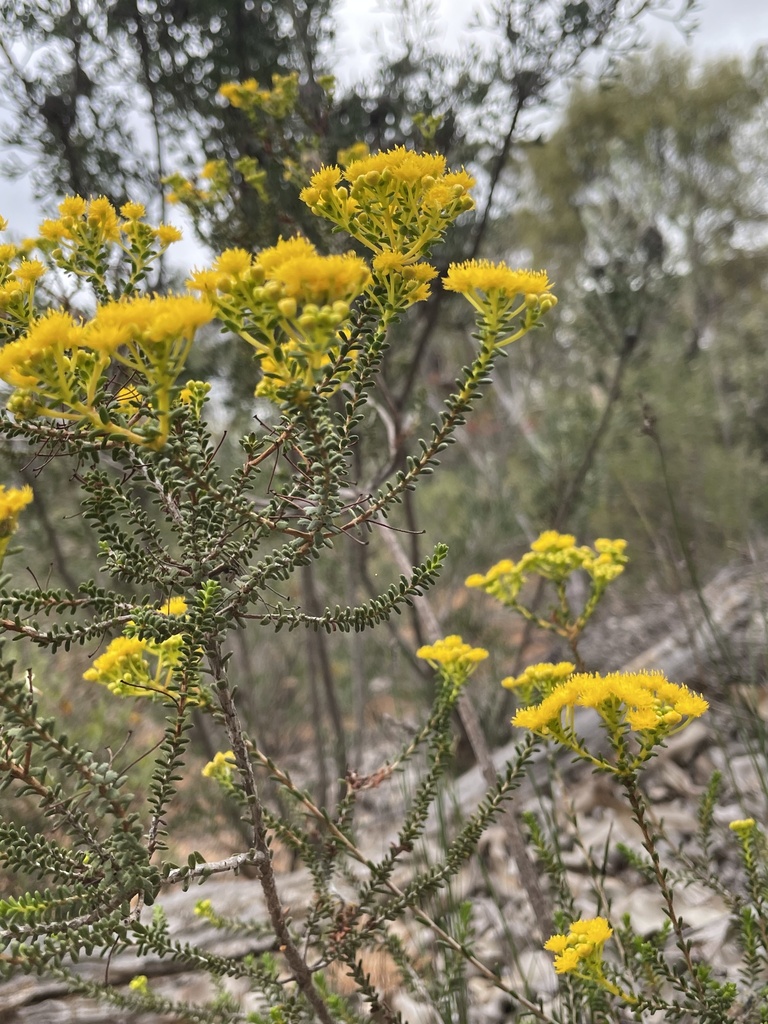
Verticordia serrata
Verticordia serrata is a flowering plant in the myrtle family, Myrtaceae and is endemic to the south-west of Western Australia. It is a spindly or openly branched shrub with hairy, egg-shaped leaves and flowers which are golden at first, then fade to a greyish colour.
From the article Verticordia serrata on Wikipedia (CC BY-SA), quoted section by section
Description
Verticordia serrata is an openly branched shrub which grows to a height of 1.5 m (5 ft) and which usually has one main branch. Its leaves are either elliptic to egg-shaped and 2.5–6 mm (0.1–0.2 in) long or linear in shape and 6–20 mm (0.2–0.8 in) long, depending on variety, but always have hairy eges. The flowers are usually scented and are arranged in corymb-like groups on erect stalks from 3–8 mm (0.1–0.3 in) long with the longest stalks on the lowest flowers in each group. The floral cup is 0.5–1.0 mm (0.02–0.04 in) long, warty and glabrous. The sepals spread widely, are golden-yellow, turning greyish with age, 2.5–3.5 mm (0.098–0.14 in) long, with 6 to 8 hairy lobes. The petals are a similar colour to the sepals, 2.5–4 mm (0.1–0.2 in) long and egg-shaped with a toothed margin. The style is 2–4 mm (0.08–0.2 in) long, straight and glabrous. Flowering time differs, depending on the variety.
Range & habitat
This verticordia occurs in the south-west of Western Australia, each variety with a different range. The most widespread is var. serrata which occurs from near Perth, inland as far as Koonadgin and as far east in coastal areas as Ravensthorpe. All grow in sand, often with gravel, loam or clay in shrubland and woodland, often with other species of verticordia.
Wikipedia: “Distribution and habitat”
How it is grown
All three varieties can be propagated from cuttings, but var. linearis is the easiest to strike. All are described as "ornamental" and "attractive" and also sometimes slow-growing, appear to be hardy when established.
== References ==
Wikipedia: “Use in horticulture”
Where it lives
Recorded sightings
—
geo-referenced records in GBIF, from museums, herbaria and field observers.
Drag the globe to turn it. Dots are where records exist, not a range map; darker means more records.
In the stacks
Searching the stacks…
Every page naming Verticordia serrata in the Biodiversity Heritage Library →
This page is assembled live from iNaturalist, GBIF, Wikipedia, the Source Library and the Internet Archive. It is not yet part of the hand-edited codex. iNaturalist taxon 841512.