- Plants
- ›Vascular Plants
- ›flowering plants
- ›Dicots
- ›myrtles, evening primroses, and allies
- ›myrtle family
- ›Myrtoideae
- ›Chamelaucieae
- ›Chamelauciinae
- ›Verticordia
- ›Eperephes
- ›Verticordella
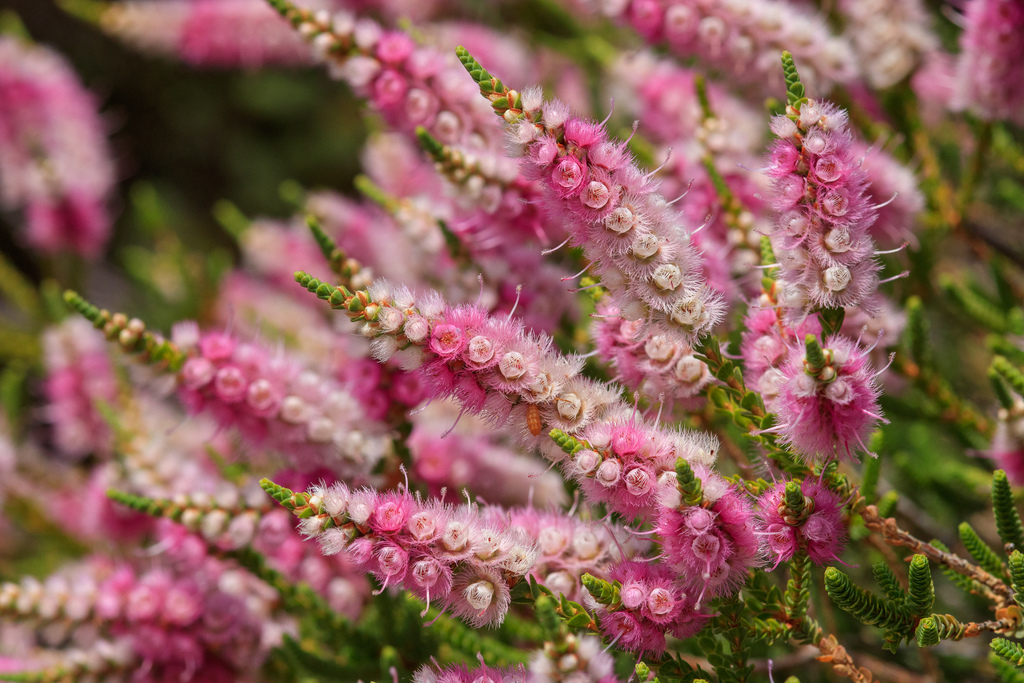
Verticordia spicata
Verticordia spicata, commonly known as spiked featherflower, is a species of flowering plant in the myrtle family, Myrtaceae and is endemic to the south-west of Western Australia. It is usually a dense, bushy shrub with small leaves pressed against the stem and spikes of pink flowers from late spring to early summer.
From the article Verticordia spicata on Wikipedia (CC BY-SA), quoted section by section
Description
Verticordia spicata is an upright to spreading shrub 0.3–1 m (1–3 ft), sometimes 2 m (7 ft) tall with one main stem at its base. The leaves are densely arranged along the branches, mostly closely clasping the stem. The leaves are broadly egg-shaped, 1.5–3.5 mm (0.06–0.1 in) with prominent oil glands and have narrow, translucent and slightly hairy margins. The flowers are scented and arranged in spike-like groups on the upper part of the branching stems, each flower on a stalk less than 0.2 mm (0.008 in) long. The floral cup is top-shaped, 2 mm (0.08 in) long, glabrous with two green appendages, 1.9 mm (0.07 in) long. The sepals are pale pink to mauve, spreading, 3–5.5 mm (0.1–0.2 in) long, with 6 or 7 feathery lobes and two ear-like appendages on the sides. The petals are similar in colour to the sepals, 3–4.5 mm (0.1–0.2 in) long and erect with long filaments on their ends. The style is 4–7 mm (0.16–0.28 in) long, curved and hairy near the tip. Flowering time is from October to January.
Range & habitat
Spiked featherflower occurs between the Cooloomia Nature Reserve near the Murchison River Kalbarri National Park, Northampton and Mullewa in the Avon Wheatbelt, Carnarvon, Geraldton Sandplains and Yalgoobiogeographic regions. Scaly-leaved featherflower is confined to the eastern part of the range, between Three Springs and Morawa. Both subspecies grow in sandy soil, often over granite or sandstone in heath or shrubland.
Wikipedia: “Distribution and habitat”
How it is grown
Propagation of both species has proven to be difficult, especially of subspecies squamosa. Subspecies spicata has been grown from cuttings, seed and by grafting onto Darwinia citriodora rootstock. Mature shrubs have been ornamental and sometimes survived for 14 years.
== References ==
Wikipedia: “Use in horticulture”
Where it lives
Recorded sightings
—
geo-referenced records in GBIF, from museums, herbaria and field observers.
Drag the globe to turn it. Dots are where records exist, not a range map; darker means more records.
In the stacks
Searching the stacks…
Every page naming Verticordia spicata in the Biodiversity Heritage Library →
This page is assembled live from iNaturalist, GBIF, Wikipedia, the Source Library and the Internet Archive. It is not yet part of the hand-edited codex. iNaturalist taxon 841514.