- Plants
- ›Vascular Plants
- ›flowering plants
- ›Dicots
- ›myrtles, evening primroses, and allies
- ›myrtle family
- ›Myrtoideae
- ›Chamelaucieae
- ›Chamelauciinae
- ›Darwinia
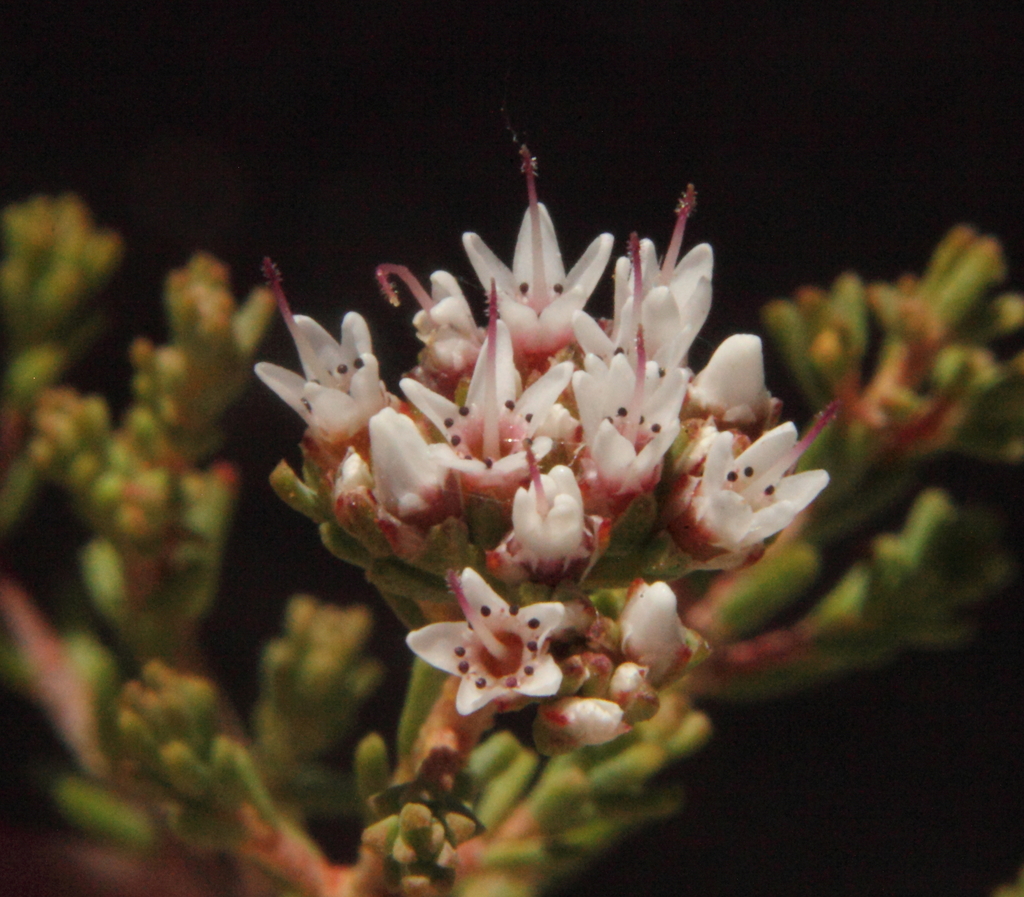
Darwinia capitellata
Darwinia capitellata is a plant in the myrtle family Myrtaceae and is endemic to the south-west of Western Australia. It is a bushy, many-branched shrub, very similar to Darwinia diosmoides but differs in the arrangement of its flowers, its more branched habit, prominent oil glands on the younger stems and its thinner, paper-like bracteoles. It was first discovered as a separate species when specimens of it were found to have a larger chromosome number than specimens of D. diosmoides.
From the article Darwinia capitellata on Wikipedia (CC BY-SA), quoted section by section
Description
Darwinia capitellata is a many-branched shrub growing to 1.0 metre (3 ft) high with its leaves crowded near the ends of the branches. The younger branches have prominent oil glands. The leaves have distinct oil glands, a distinct stalk and are 2.5–4.5 millimetres (0.1–0.2 in) long and 0.5–1.0 millimetre (0.02–0.04 in) wide. The flowers are arranged near the ends of the branches in heads that are more corymb-like than those of other species of Darwinia. The two bracteoles around each flower are 2.3–4.0 millimetres (0.09–0.2 in) long, 0.5–1.0 millimetre (0.02–0.04 in) wide, thin and papery and fall off as the flower matures. The petals are egg-shaped, white 1.8–2.3 millimetres (0.07–0.09 in) long and enclose the 10 stamens, staminodes and the lower part of the style. The style which protrudes from the rest of the flower is 4–6 millimetres (0.16–0.24 in) long and has a band of hairs near its tip. Flowering occurs between August and November and is followed by the fruit which is a non-fleshy nut containing a seed 1 millimetre (0.04 in) long.
Range & habitat
This darwinia grows on sandplains, sometimes on sandstone rock between Kalbarri National Park, Perenjori and Sandstone in the Avon Wheatbelt, Geraldton Sandplains, Mallee, Murchison and Yalgoo biogeographic regions.
Wikipedia: “Distribution and habitat”
Where it lives
Recorded sightings
—
geo-referenced records in GBIF, from museums, herbaria and field observers.
Drag the globe to turn it. Dots are where records exist, not a range map; darker means more records.
In the stacks
Searching the stacks…
Every page naming Darwinia capitellata in the Biodiversity Heritage Library →
This page is assembled live from iNaturalist, GBIF, Wikipedia, the Source Library and the Internet Archive. It is not yet part of the hand-edited codex. iNaturalist taxon 841535.