- Plants
- ›Vascular Plants
- ›flowering plants
- ›Dicots
- ›myrtles, evening primroses, and allies
- ›myrtle family
- ›Myrtoideae
- ›Chamelaucieae
- ›Chamelauciinae
- ›Darwinia
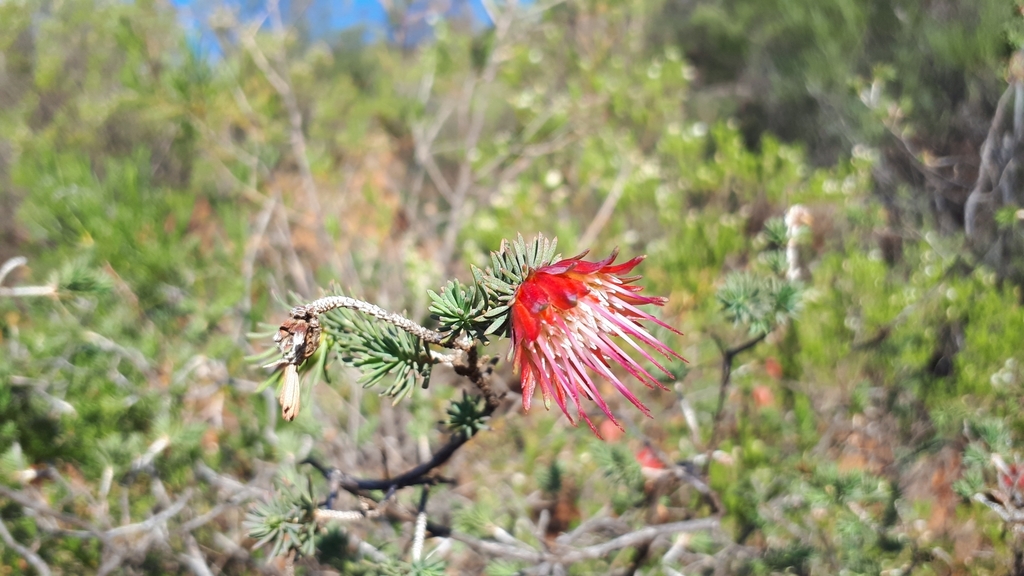
Darwinia masonii
Darwinia masonii, commonly known as Mason's darwinia, is a plant in the myrtle family Myrtaceae and is endemic to Western Australia.
From the article Darwinia masonii on Wikipedia (CC BY-SA), quoted section by section
Description
Darwinia masonii is an erect shrub typically growing to a height of 1–3 m (3.3–9.8 ft). It has closely crowded and narrow grey-green leaves that are approximately 1 cm (0.39 in) in length and almost triangular in cross section. The inflorescence consists of several small, pendant, tubular red flowers approximately 3 cm (1.2 in) in diameter and 5 mm (0.20 in) long. The flowers are surrounded by spreading pinkish pendulous bracts at the ends of small branchlets. The bracts have a prominent midrib and are wider at the base and narrower toward the apex. The style is about 1.5 cm (0.59 in) long. It blooms usually between April and November.
Range & habitat
Darwinia masonii has a restricted distribution, endemic to a small area in the Mt Gibson Ranges in the Wheatbelt region of Western Australia. This species is found generally on upper hillsides and ridges above 330 m (1,100 ft) on shallow clay soils over laterite, ironstone, granite or near creeks.
Wikipedia: “Distribution and habitat”
Where it lives
Recorded sightings
—
geo-referenced records in GBIF, from museums, herbaria and field observers.
Drag the globe to turn it. Dots are where records exist, not a range map; darker means more records.
In the stacks
Searching the stacks…
Every page naming Darwinia masonii in the Biodiversity Heritage Library →
This page is assembled live from iNaturalist, GBIF, Wikipedia, the Source Library and the Internet Archive. It is not yet part of the hand-edited codex. iNaturalist taxon 841552.