- Plants
- ›Vascular Plants
- ›flowering plants
- ›Dicots
- ›myrtles, evening primroses, and allies
- ›myrtle family
- ›Myrtoideae
- ›Chamelaucieae
- ›Chamelauciinae
- ›Darwinia
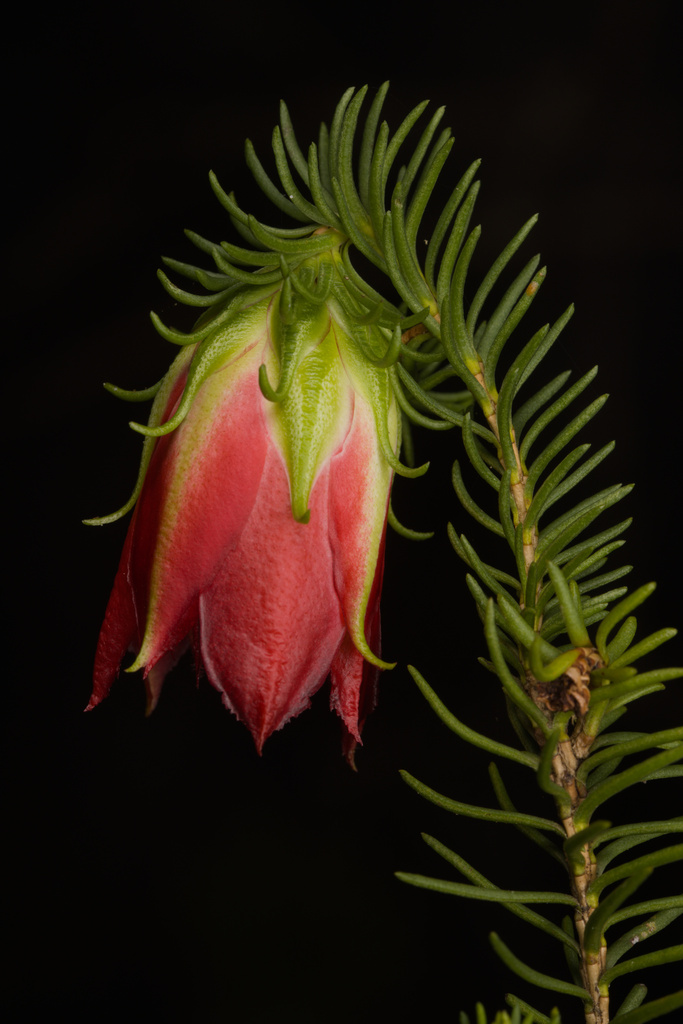
Gillam's Bell
Darwinia oxylepis
Darwinia oxylepis, commonly known as Gillham's bell, is a plant in the myrtle family Myrtaceae. It grows as a dense, upright shrub 1.0–1.5 m (3.3–4.9 ft) high, and produces large numbers of red inflorescences prominently displayed on the ends of the branchlets in spring. It is one of a group of Darwinias including D. leiostyla, D. macrostegia, D. meeboldii, D. collina and D. squarrosa collectively known as mountain bells. The species is found in only a few seasonally moist gullies near the lower slopes of the Stirling Range National Park and nearby Porongurup National Park and is therefore classified as endangered.
From the article Darwinia oxylepis on Wikipedia (CC BY-SA), quoted section by section
Description
Gillham's bell is a small, dense, upright shrub to about 1.5 metres high, with erect branches and short branchlets. Its leaves are about 10 mm long by about 1 mm wide and are almost cylindrical or triangular in cross section. Bell-shaped, flower-like inflorescences appear from August to November. These are clusters of about 10 drooping, nectar-rich flowers surrounded by bright red petal-like bracts up to 30 mm long.
Range & habitat
This darwinia grows in stony, peaty sand in rocky gullies that are wet in winter. There are only four known populations of D. oxylepis, all of them in national parks (Stirling Range and Porongurup). They grow in areas known to be significantly affected by Phytophthora cinnamomi fungus to which they are vulnerable. They are also in areas that are prone to bushfire. The species is killed by fire and regenerates from seed stored in the soil but it takes up to four years before new plants produce seed. More frequent fire events may therefore cause loss of populations. The plants also grow in areas frequented by tourists and are at risk from trampling and unauthorised picking of plant parts.
Wikipedia: “Distribution and habitat”
How it is grown
As with others in the genus, D. oxylepis is not well known in cultivation. It is difficult to grow from seed but relatively easy to grow from cuttings, although generally short-lived in the garden. It has been grafted onto the hardier eastern Australian D. citriodora, and this is the preferred method of propagation.
== References ==
Wikipedia: “Propagation”
Where it lives
Recorded sightings
—
geo-referenced records in GBIF, from museums, herbaria and field observers.
Drag the globe to turn it. Dots are where records exist, not a range map; darker means more records.
In the stacks
Searching the stacks…
Every page naming Darwinia oxylepis in the Biodiversity Heritage Library →
This page is assembled live from iNaturalist, GBIF, Wikipedia, the Source Library and the Internet Archive. It is not yet part of the hand-edited codex. iNaturalist taxon 841557.