- Plants
- ›Vascular Plants
- ›flowering plants
- ›Dicots
- ›myrtles, evening primroses, and allies
- ›myrtle family
- ›Myrtoideae
- ›Chamelaucieae
- ›Chamelauciinae
- ›Darwinia
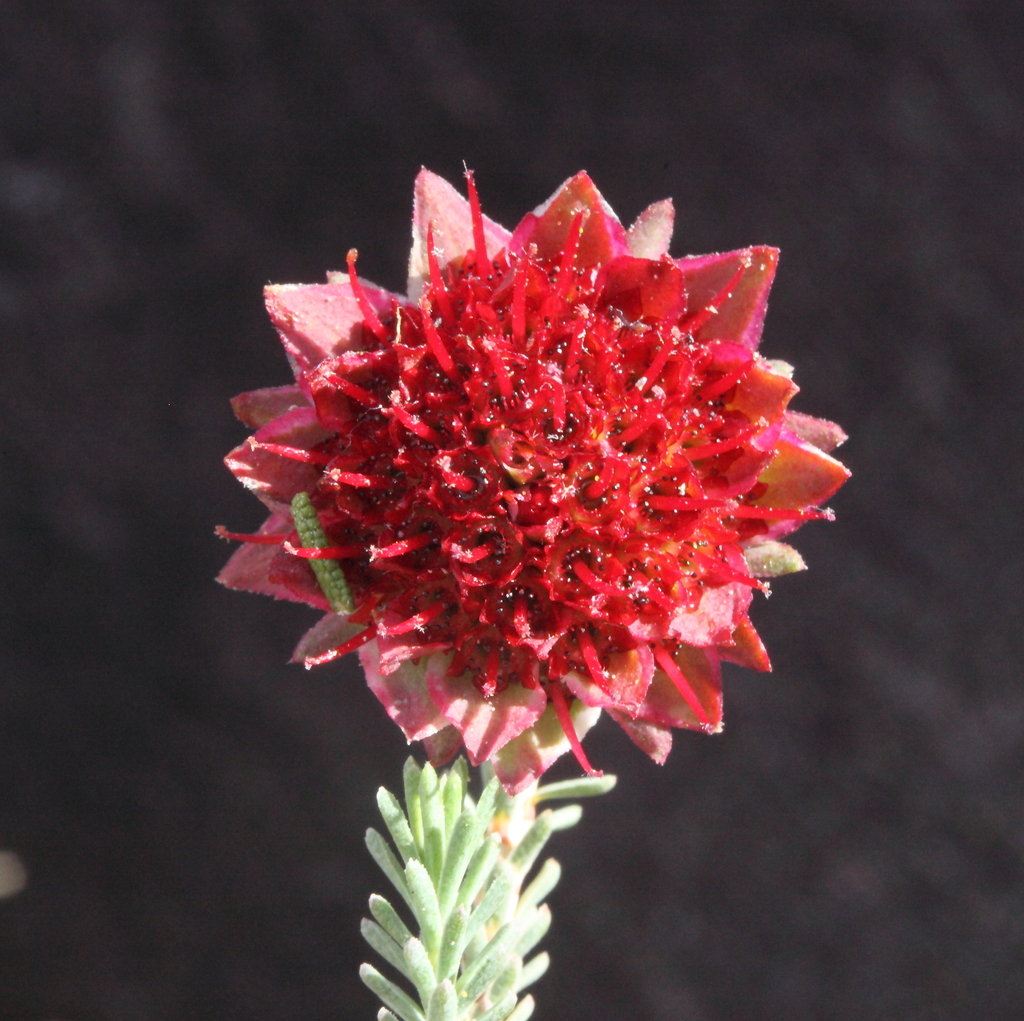
Darwinia purpurea
Darwinia purpurea, commonly known as the rose darwinia, is a species of flowering plant in the family Myrtaceae and is endemic to the southwest of Western Australia. It is a spreading shrub with linear leaves and dense heads of red or yellow flowers surrounded by many overlapping involucral bracts.
From the article Darwinia purpurea on Wikipedia (CC BY-SA), quoted section by section
Description
Darwinia purpurea is a spreading shrub that typically grows to height of 10–50 cm (3.9–19.7 in) and has many branches. Its leaves are linear, 2–4 mm (0.079–0.157 in) long, the upper surface flat and the lower surface convex. The flowers are arranged in dense, hemispherical heads surrounded by a large number of overlapping egg-shaped or spatula-shaped involucral bracts that are slightly longer than the flowers. The sepal tube is about 4 mm (0.16 in) long with small, scale-like lobes, the petals about 2 mm (0.079 in) long. Flowering occurs from July to December.
Range & habitat
Rose darwinia is often found on undulating plains and amongst granite outcrops in the Avon Wheatbelt, Coolgardie, Geraldton Sandplains and Yalgoo of south-western Western Australia, where it grows in sandy or lateritic soils.
== References ==
Wikipedia: “Distribution and habitat”
Where it lives
Recorded sightings
—
geo-referenced records in GBIF, from museums, herbaria and field observers.
Drag the globe to turn it. Dots are where records exist, not a range map; darker means more records.
In the stacks
Searching the stacks…
Every page naming Darwinia purpurea in the Biodiversity Heritage Library →
This page is assembled live from iNaturalist, GBIF, Wikipedia, the Source Library and the Internet Archive. It is not yet part of the hand-edited codex. iNaturalist taxon 841565.