- Animals
- ›Chordates
- ›Vertebrates
- ›Cartilaginous Fishes
- ›Chimaeras
- ›Chimaeras
- ›Shortnose Chimaeras
- ›Hydrolagus
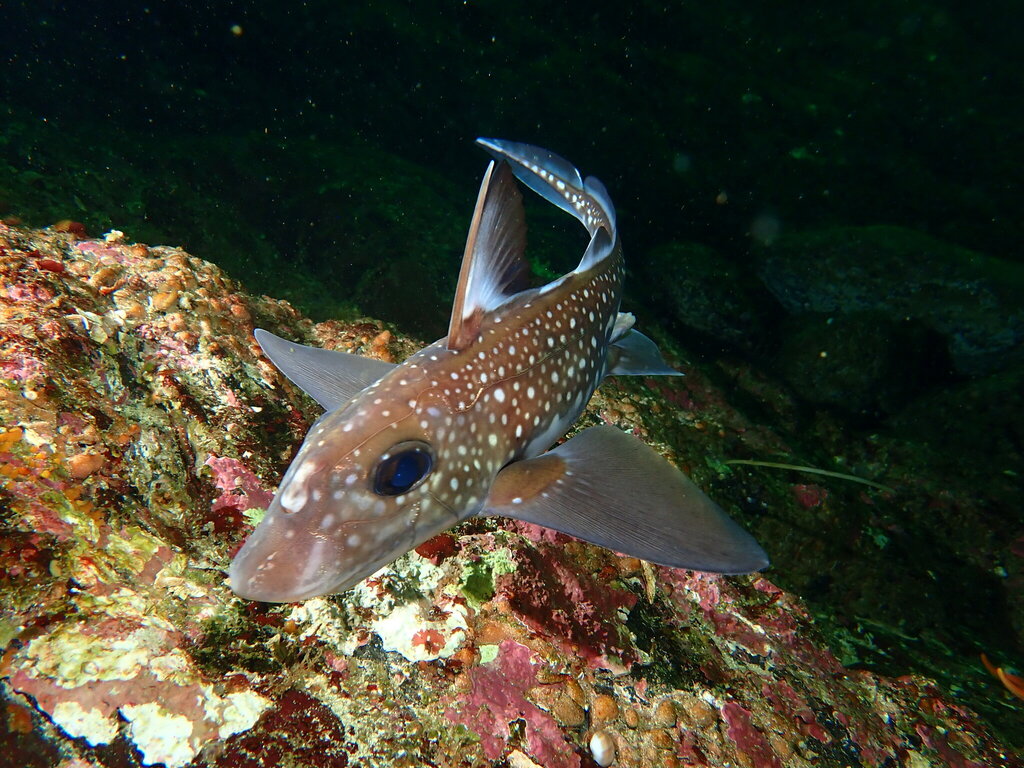
Spotted Ratfish
Hydrolagus colliei
The spotted ratfish (Hydrolagus colliei) is a chimaera found in the north-eastern Pacific Ocean. Often seen by divers at night in the Pacific Northwest, this cartilaginous fish gets its characteristic name from a pointed rat-like tail. The ratfish lays leathery egg cases on the bottom of muddy or sandy areas, which are often mistaken by divers as something inanimate. While mainly a deep-water species, it occurs at shallower depths in the northern part of its range. The generic name, Hydrolagus, comes from the Greek words ὕδωρ, meaning water, and λαγώς/λαγῶς, meaning hare, and the specific name honors Alexander Collie, who was a ship's surgeon and early naturalist who dissected the first specimen to be described during the voyage of HMS Blossom in the Pacific from 1825-28. The spotted ratfish is common in much of its range, not typically eaten by humans, and is not commercially caught.
From the article Spotted ratfish on Wikipedia (CC BY-SA), quoted section by section
Description
The spotted ratfish has a very distinct appearance compared to unrelated fish species. The female is up to 97 cm (38 in) long, much bigger than the male. These fish have a smooth and scaleless skin that is a silvery-bronze color, often with sparkling shades of gold, blue, and green. The speckled white spots along their backs contribute to their name. Dark edges outline both the caudal and dorsal fins, whereas the pectoral fins have a transparent outline. Their pectoral fins are large and triangular, and extend straight out from the sides of their bodies like airplane wings. They have a grooved venomous spine located at the leading edge of their dorsal fin and connected to a venom gland at its base, which is used in defense. It does not present a serious danger to humans, but can cause painful wounds and has been known to kill harbor seals that ate spotted ratfish (caused by the spine penetrating vital tissue in the stomach or esophagus after the ratfish was swallowed). The tail of the ratfish constitutes almost half of its overall length and closely resembles a pointed, rat-like tail. The body of this fish is supported by cartilage rather than bone. It has a duckbill-shaped snout and a rabbit-like face. The mouth is small and contains one pair of forward-directed, incisor-shaped teeth in the bottom jaw and two pairs in the top jaw. …
Range & habitat
The spotted ratfish can be found in the northeastern Pacific Ocean, ranging from Alaska to Baja California, with an isolated population in the Gulf of California. They are abundant in much of their range. They be found most commonly off the Pacific Northwest. The range of depths in which this fish is found extends from 0 to 913 m (0 to 2,995 ft) below sea level, but it is most common between 50 and 400 m (160 and 1,310 ft). Spotted ratfish typically live closer to the shore in the northern part of their range than in the southern, but it is also found as shallow as 30 m (98 ft) off California. Spotted ratfish tend to move closer to shallow water during the spring and autumn, then to deeper water in summer and winter. For most of the year, they prefer temperatures between 7.2 and 8.9 °C (45 and 48 °F), but seasonally they do move into slightly warmer water. They can most commonly be found living near the sea floor in sandy, muddy, or rocky reef environments. Unlike most of its relatives, which are entirely restricted to deep waters, the spotted ratfish has been held in public aquaria. It has also been bred in such aquaria, where two of the main issues are the requirements of low light and low temperature (generally kept at 8–12 °C or 46–54 °F).
Wikipedia: “Distribution and habitat”
What it does
The spotted ratfish swims slowly above the seafloor in search of food. Location of food is done by smell. Their usual hunting period is at night, when they move to shallow water to feed. They are particularly drawn to crunchy foods such as crabs and clams. Besides these, the spotted ratfish also feeds on shrimp, worms, small fish, small crustaceans, and sea stars. Species known to prey on the spotted ratfish include soupfin sharks, dogfish sharks, Pacific halibut, pinnipeds, and pigeon guillemots.
Wikipedia: “Diet”
Where it lives
Recorded sightings
—
geo-referenced records in GBIF, from museums, herbaria and field observers.
Drag the globe to turn it. Dots are where records exist, not a range map; darker means more records.
In the stacks
Searching the stacks…
Every page naming Hydrolagus colliei in the Biodiversity Heritage Library →
This page is assembled live from iNaturalist, GBIF, Wikipedia, the Source Library and the Internet Archive. It is not yet part of the hand-edited codex. iNaturalist taxon 84182.