- Plants
- ›Vascular Plants
- ›flowering plants
- ›Dicots
- ›Roses, Elms, Figs, and Allies
- ›rose family
- ›brambles, roses, strawberries, and allies
- ›Brambles
- ›Rubus
- ›Idaeobatus
- ›Idaei
- ›Nivei
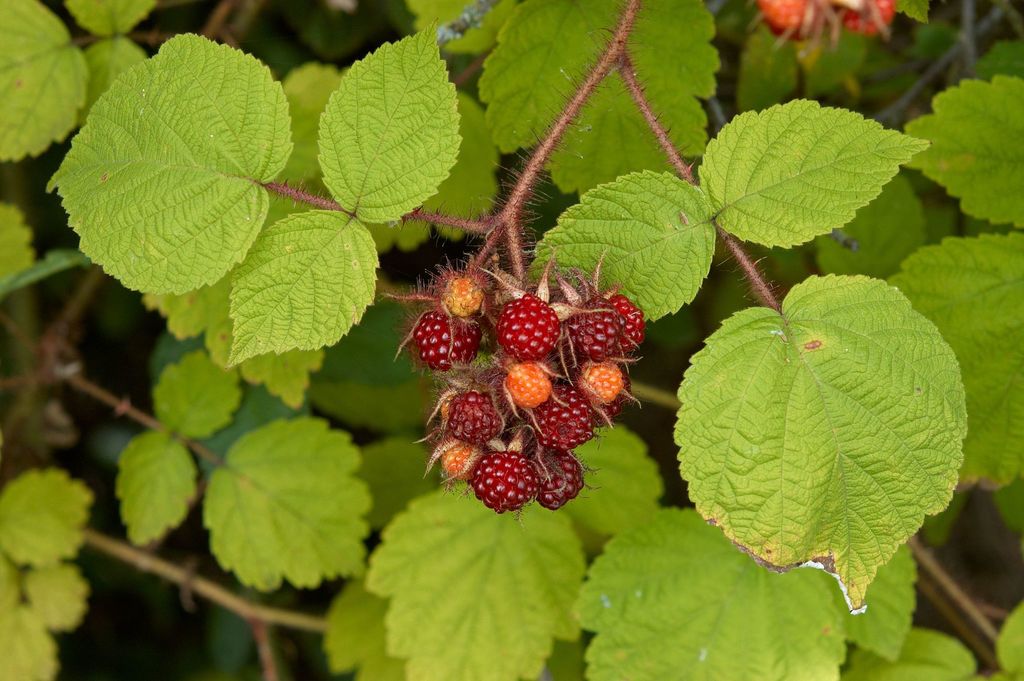
wineberry
Rubus phoenicolasius
Rubus phoenicolasius (Japanese wineberry, wine raspberry, wineberry or dewberry) is an Asian species of raspberry (Rubus subgenus Idaeobatus) in the rose family.
The species was introduced to Europe and North America as an ornamental plant and for its potential in breeding hybrid raspberries. It has subsequently escaped from cultivation and become naturalized in parts of Europe and North America.
From the article Rubus phoenicolasius on Wikipedia (CC BY-SA), quoted section by section
Description
The species is a perennial plant which bears biennial stems ("canes") from the perennial root system. In its first year, a new stem ("primocane") grows vigorously to its full height of 1–3 metres (3+1⁄2–10 ft), unbranched, and bearing large pinnate leaves with three or five leaflets; The leaves appear in sets of three, where the two side leaves are small, and the center leaf is large. In its second year, the stem ("floricane") does not grow taller, but produces several side shoots, which bear smaller leaves always with three leaflets; the leaves are white underneath. The plant's branches, stems and leaves are covered in spines. The leaves are green on top, and white on the bottom because of a dense layer of woolly hairs. Typically beginning in the plant's second year, the flowers are produced in late spring on short, very bristly racemes on the tips of the side shoots. Each flower is 6–10 millimetres (1⁄4–1⁄2 in) in diameter with five purplish red to pink petals and a bristly calyx. The fruit is orange or red, and have on average of a 1 cm diameter, edible, produced in summer or early autumn; in botanical terminology and like all members of Rubus, it is not a berry at all but an aggregate fruit of numerous drupelets around a central core. Ripening occurs from early summer. …
Range & habitat
The species is native to eastern Asia (China, Japan, and Korea) and was introduced to Europe and North America as an ornamental plant and for its potential in breeding hybrid raspberries. It subsequently escaped from cultivation and became naturalized in parts of Europe and North America. Wineberries can be found in many habitats, such as forest, fields, stream banks, and wetland edges, as well as open woods.
Wikipedia: “Distribution and habitat”
What it does
Wineberries grow vigorously and can form extensive, dense thickets that displace many native species. The first years of growth for wineberries are longer (approximately 32%) than many other black and red raspberries. Wineberries are a host to several viruses, such as raspberry yellow spot that can affect native species of raspberry. Wineberry vine growth may be controlled variously, such as by biological mechanisms increasing susceptibility to diseases, or mechanical effects by digging, excavating or repeatedly cutting back the plant until it dies. Concentrations of herbicides mixed to the manufacturers specifications can be applied to the leaves to kill the plants. The wineberry is listed as a noxious weed by both Connecticut and New York where its possession and sale are prohibited by law.
Wikipedia: “Ecology”
At the table
Wineberries grow in the wild in many parts of the United States, primarily the Appalachian Mountains. They are common along the edges of fields and roadsides, and still are used as breeding stock for raspberry cultivars. They are edible, with no poisonous look-a-likes in North America. Other plants that may be mistaken as wineberries include red raspberry, salmonberry, black raspberry, and blackberry, all of which are edible. Sweet and tart with a raspberry-like flavor, wineberries can be eaten raw, or used similarly to raspberries to make pastries, such as pie or other sweet treats.
Wikipedia: “Uses”
In human culture
The red hairs of the fruit give the species its scientific name, from the Latin phoenicus, meaning red.
Wikipedia: “Etymology”
Where it lives
Recorded sightings
—
geo-referenced records in GBIF, from museums, herbaria and field observers.
Drag the globe to turn it. Dots are where records exist, not a range map; darker means more records.
In the stacks
Searching the stacks…
Every page naming Rubus phoenicolasius in the Biodiversity Heritage Library →
This page is assembled live from iNaturalist, GBIF, Wikipedia, the Source Library and the Internet Archive. It is not yet part of the hand-edited codex. iNaturalist taxon 84227.