- Plants
- ›Vascular Plants
- ›flowering plants
- ›Dicots
- ›Mints, Plantains, Olives, and Allies
- ›Mint Family
- ›Nepetoideae
- ›Mentheae
- ›balms, mints, and thymes
- ›Clinopodium
- ›Clinopodium
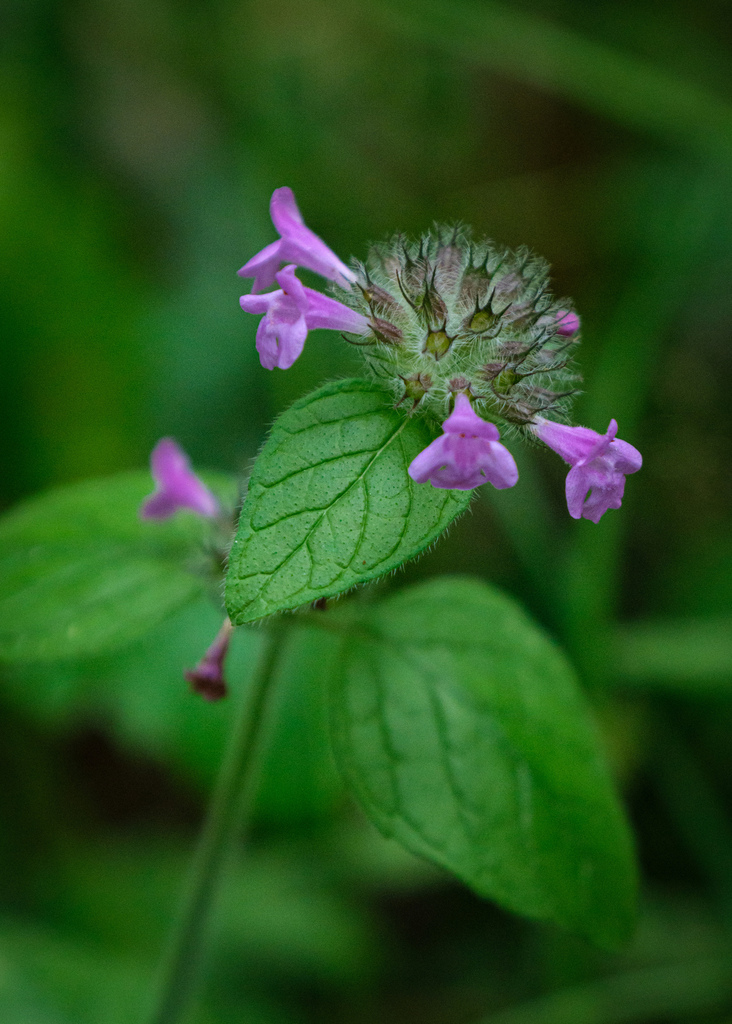
Wild Basil
Clinopodium vulgare
Clinopodium vulgare, or the wild basil (not to be confused with the basils of the genus Ocimum), is a species of flowering plant in the family Lamiaceae.
From the article Clinopodium vulgare on Wikipedia (CC BY-SA), quoted section by section
Description
Wild basil is a perennial rhizomatous herb with square, upright, hairy stems and opposite pairs of leaves. The leaves are hairy, ovate or lanceolate in shape, and have short or no stalks, wedge-shaped bases and bluntly-toothed margins. The inflorescence is a terminal spike consisting of several loose whorls of clusters of flowers growing in the axils of the leaves. Each flower has a short stalk, five sepals about 10 mm (0.39 in) long and five petals 12 to 15 mm (0.47 to 0.59 in) in length which are fused into a tube. The flowers are pink, violet or purple and have two lips. Each has four stamens, a long style and fused carpels.
Range & habitat
Wild basil occurs in suitable locations in most of Europe, western and central Asia, North America and North Africa. Its typical habitat is dry grassland and heathland, usually on limestone or chalky soils. Though its distribution is patchy it is widespread and not threatened in the UK.
Wikipedia: “Distribution”
At the table
The leaves of wild basil are used as an aromatic herb in the preparation of food dishes and to make a herbal tea. They can also be used in the preparation of both a brown and a yellow dye. This plant has traditionally been used as an astringent, a cardiac stimulant, an expectorant, to reduce flatulence and to increase perspiration. It has been used traditionally in Bulgaria for the healing of wounds and has been shown to have anti-bacterial properties.
Wikipedia: “Uses”
Where it lives
Recorded sightings
—
geo-referenced records in GBIF, from museums, herbaria and field observers.
Drag the globe to turn it. Dots are where records exist, not a range map; darker means more records.
In the old herbals & bestiaries

Notable Commentaries on the History of Plants
Leonhart Fuchs · 1542 · p.930

Notable Commentaries on the History of Plants
Leonhart Fuchs · 1549 · p.928

Commentaries on the Six Books of Dioscorides on Medical Matter
Pietro Andrea Mattioli · 1563 · p.607

Florum et coronariarum historia
Rembert Dodoens · 1568 · p.281

Six Groups of the History of Plants
Rembert Dodoens · 1583 · p.299

History of Rare Plants
Carolus Clusius · 1601 · p.366

Herbarium Portatile, Oder Behendes Kräuter- und Gewächs-Buch: Darinn nicht allein 1363. so wol Einheimische als Außländndische Kräuter mit Lateinisch und Deutscher Benennung abgebildet, sondern auch die meisten, so in der Medicin gebräuchlich, kürtzlich erkläret werden
Panckow, Thomas · 1656 · p.208
In the stacks
Searching the stacks…
Every page naming Clinopodium vulgare in the Biodiversity Heritage Library →
This page is assembled live from iNaturalist, GBIF, Wikipedia, the Source Library and the Internet Archive. It is not yet part of the hand-edited codex. iNaturalist taxon 84281.