- Plants
- ›Vascular Plants
- ›flowering plants
- ›Dicots
- ›Sunflowers, Bellflowers, Fanflowers, and Allies
- ›bellflower family
- ›bellflower subfamily
- ›Campanula
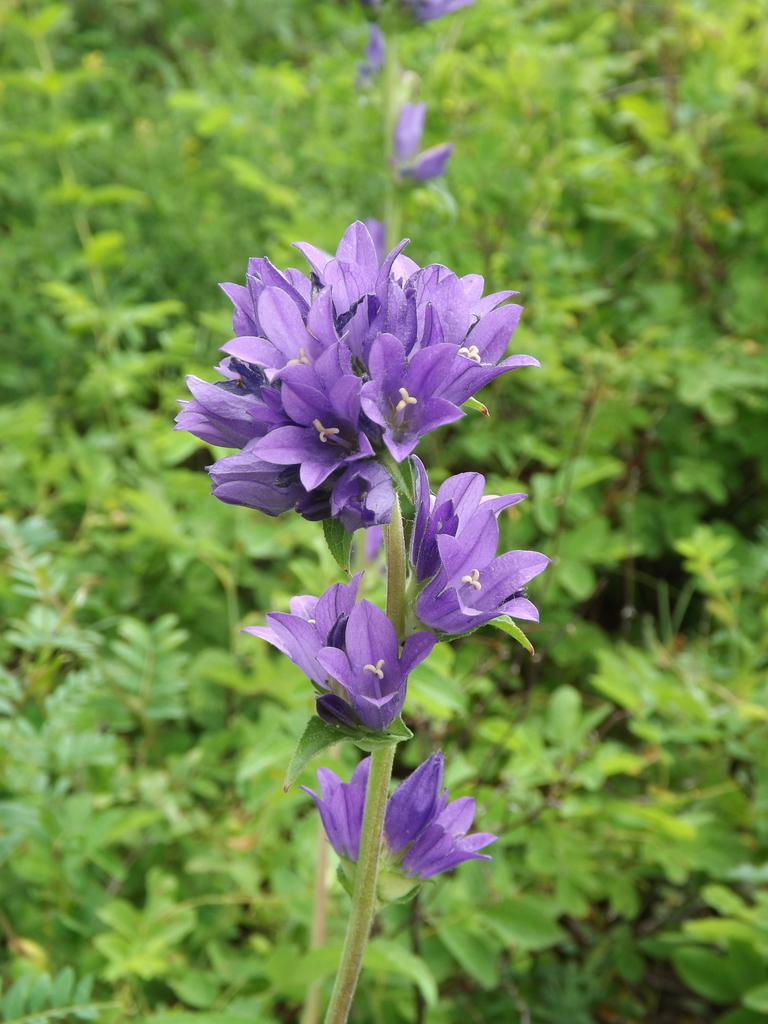
clustered bellflower
Campanula glomerata
Campanula glomerata, known by the common names clustered bellflower or Dane's blood, is a species of flowering plant in the genus Campanula, belonging to the family Campanulaceae. It is the county flower of Rutland, England.
From the article Campanula glomerata on Wikipedia (CC BY-SA), quoted section by section
Description
Campanula glomerata is a perennial herbaceous plant growing to a height of 20–60 centimetres (7.9–23.6 in), with a maximum of 90 centimetres (35 in). The stem is simple, erect and shortly pubescent, basal leaves are petiolated, oval-lanceolate and lightly heart-shaped (cordate), while cauline leaves are lanceolate, sessile and amplexicaul. The inflorescence is formed by 15-20 sessile, actinomorphic and hermaphrodite single flowers of about 2 to 3 cm. They are in terminal racemes or in the axils of upper leaves, surrounded by an involucre of bracts. The corolla is campanulate and pubescent with five dark violet-blue or purplish-blue petals. Flowering period is from June to September.
Range & habitat
The species is native to the North Temperate Zone of Eurasia, from Britain to Japan. In Europe it is present almost everywhere except the extreme north. In North America the plant is naturalized. This plant can be found in forests or dry grasslands, in scrub and open woodland, in grassy but not too wet places, in the edges of woods and along the margins of roads and trails. It prefers calcareous soils, at an altitude up to 1,500 m (4,921 ft) above sea level.
Wikipedia: “Distribution and habitat”
How it is grown
The plant is widely cultivated in gardens, with flowers in a range of colours including white, pink, blue and purple. Numerous cultivars have been developed for garden use, including 'Joan Elliott' (with large violet flowers) and the white-flowered 'Schneekrone'. The vigorous cultivar 'Superba', growing to 60 cm (24 in), with rich blue flowers, has gained the Royal Horticultural Society's Award of Garden Merit. The pale purple cluster-flowered 'Caroline' has also won the award.
Wikipedia: “Cultivation”
In human culture
The genus Latin name (Campanula), meaning small bell, refers to the bell-shape of the flower, while the specific name (glomerata) refers to the tight grouping of the flowers at the top of the stem.
Wikipedia: “Etymology”
Where it lives
Recorded sightings
—
geo-referenced records in GBIF, from museums, herbaria and field observers.
Drag the globe to turn it. Dots are where records exist, not a range map; darker means more records.
In the stacks
Searching the stacks…
Every page naming Campanula glomerata in the Biodiversity Heritage Library →
This page is assembled live from iNaturalist, GBIF, Wikipedia, the Source Library and the Internet Archive. It is not yet part of the hand-edited codex. iNaturalist taxon 84349.