- Plants
- ›Vascular Plants
- ›flowering plants
- ›Dicots
- ›saxifrages, stonecrops, and allies
- ›stonecrop family
- ›Sempervivoideae
- ›Umbilicieae
- ›Rhodiola
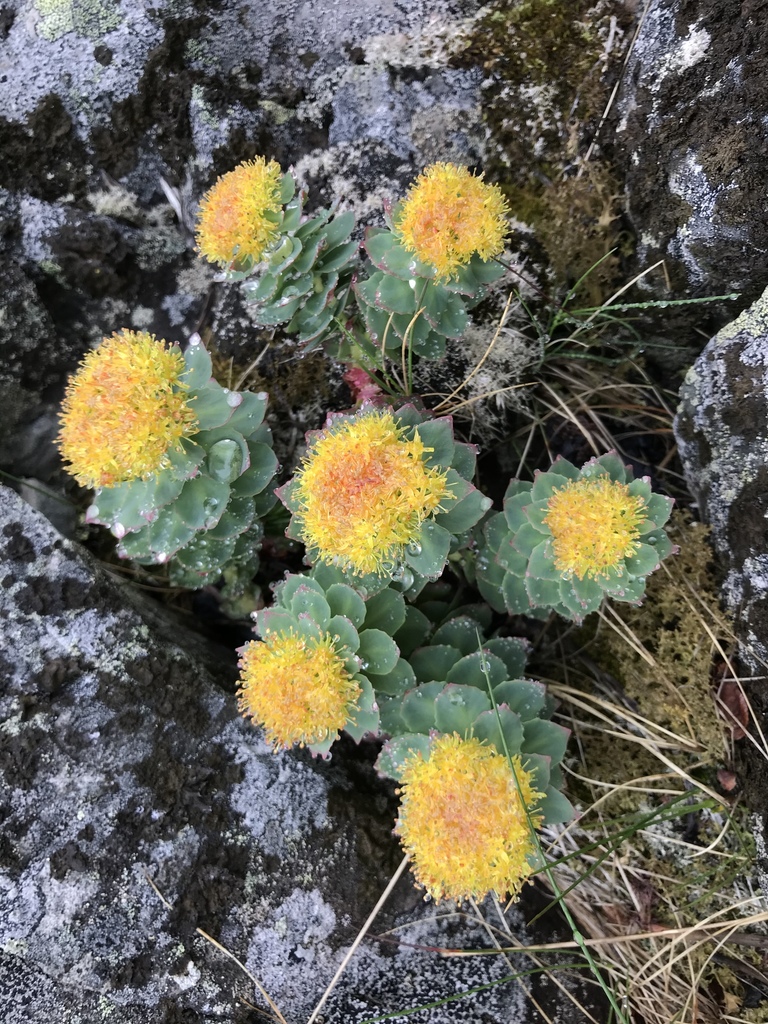
Roseroot
Rhodiola rosea
Rhodiola rosea (commonly golden root, rose root, roseroot, Aaron's rod, Arctic root, king's crown, lignum rhodium, orpin rose) is a perennial flowering plant in the family Crassulaceae. It grows naturally in wild Arctic regions of Europe (including Britain), Asia, and North America (New Brunswick, Newfoundland and Labrador, Nova Scotia, Quebec; Alaska, Maine, New York, North Carolina, Pennsylvania, Vermont), and can be propagated as a groundcover.
Although Rhodiola rosea has been used in traditional medicine, there is no high-quality clinical evidence of its effectiveness to treat any disease. The United States Food and Drug Administration has issued several warnings to manufacturers of R. rosea based dietary supplements for making false health claims about safety and efficacy.
From the article Rhodiola rosea on Wikipedia (CC BY-SA), quoted section by section
Description
Rhodiola rosea is from 5 to 40 centimetres (2.0 to 15.7 in) tall, fleshy, and has several stems growing from a short, scaly rootstock. Flowers have 4 sepals and 4 petals, yellow to greenish yellow in color sometimes tipped with red, about 1 to 3.5 millimetres (0.039 to 0.138 in) long, and blooming in summer. Several shoots growing from the same thick root may reach 5 to 35 centimetres (2.0 to 13.8 in) in height. R. rosea is dioecious – having separate female and male plants.
Taxonomy. Rhodiola rosea was first described by Pedanius Dioscorides in De Materia Medica. Many North American plants formerly included in R. rosea are now treated separately as Rhodiola integrifolia and Rhodiola rhodantha.
Chemical constituents. About 140 chemical compounds are in the subterranean portions of R. rosea. Rhodiola roots contain phenols, rosavin, rosin, rosarin, organic acids, terpenoids, phenolic acids and their derivatives, flavonoids, anthraquinones, alkaloids, tyrosol, and salidroside. The chemical composition of the essential oil from R. rosea root growing in different countries varies. For example, rosavin, rosarin, and rosin at their highest concentration according to many tests can be found only in R. …
Range & habitat
Rhodiola rosea grows in cold regions of the world, including much of the Arctic, the mountains of Central Asia, scattered in eastern North America and mountainous parts of Europe. It grows on sea cliffs and on mountains at high altitude.
Wikipedia: “Distribution”
At the table
The leaves and shoots can be eaten raw, having a bitter flavor. They can also be cooked like spinach or are sometimes added to salads. An extract is sometimes added as a flavoring in vodkas.
Wikipedia: “Culinary use”
Where it lives
Recorded sightings
—
geo-referenced records in GBIF, from museums, herbaria and field observers.
Drag the globe to turn it. Dots are where records exist, not a range map; darker means more records.
In the old herbals & bestiaries

Book of Herbs
Hieronymus Bock (Tragus) · 1546 · p.722

Commentaries on the Six Books of Dioscorides on Medical Matter
Pietro Andrea Mattioli · 1563 · p.617

Notable Commentaries on the History of Plants
Leonhart Fuchs · 1542 · p.699

Notable Commentaries on the History of Plants
Leonhart Fuchs · 1549 · p.697

On the Names of Plants
Hieronymus Bock (Tragus) · 1552 · p.985

History of Plants in Four Books
Valerius Cordus · 1561 · p.295

Discourses on the Six Books of Dioscorides
Dioscorides; Pietro Andrea Mattioli (comm.) · 1568 · p.1261

History of Rare Plants
Carolus Clusius · 1601 · p.441

Rariorum Plantarum Historia (with Fungorum Historia)
Carolus Clusius · 1601 · p.447
In the stacks
Searching the stacks…
Every page naming Rhodiola rosea in the Biodiversity Heritage Library →
This page is assembled live from iNaturalist, GBIF, Wikipedia, the Source Library and the Internet Archive. It is not yet part of the hand-edited codex. iNaturalist taxon 84436.