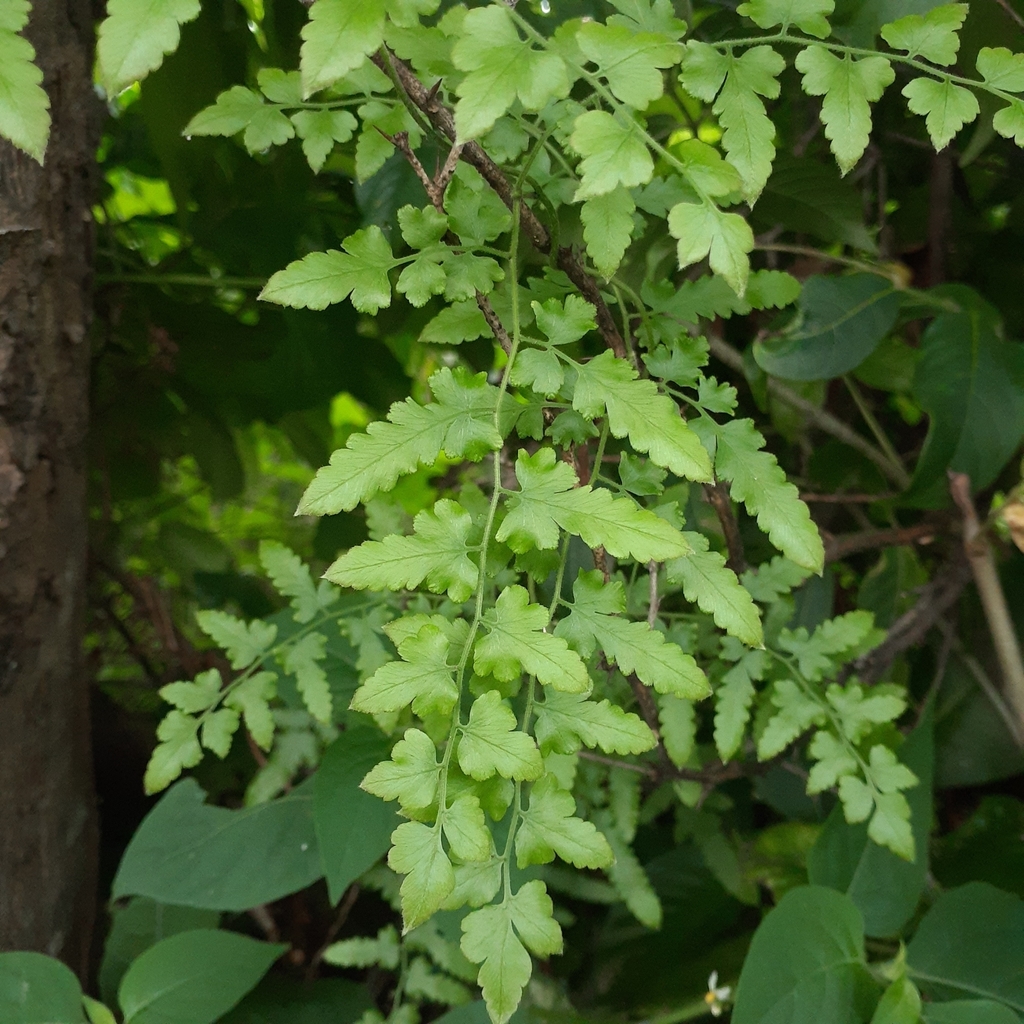
monarch climbing fern
Lygodium venustum
Lygodium venustum, with no widely used common name other than climbing fern, which is applicable to all species of the genus Lygodium, is a fern native to tropical parts the Americas.
From the article Lygodium venustum on Wikipedia (CC BY-SA), quoted section by section
Description
With Lygodium venustum and other Lygodium species, what appears to be a twining stem with several compound leaves, or fronds, actually is just one big leaf, with the apparent stem being the leaf's twining rachis. The actual stem is a rhizome growing below ground or at the ground's surface. Keeping this unusual growth pattern in mind, here are other key features of Lygodium venustum:
The subterranean rhizome reaches up to 2 mm (1⁄16 in) in diameter and bears brown hairs. The leaf's rachis is straw-colored, wiry, twining, variously hairy and with indeterminate growth. Leaves may become 3-4 times pinnately compound. The first-order leaflets, or pinnae, produce two side subdivisions, or "pinnules." The pinna's central lobe is much the largest, up to 10 cm (4 in) long and 1.4 cm (1⁄2 in) wide. Margins are finely toothed. Spores are produced on cylindrical lobes about 1 mm (1⁄32 in) wide growing at the margins of the leaf's ultimate divisions, the "fertile pinnae." Each lobe bears two rows of sporangia, one row on each side of a midvein, with each sporangium covered by yellow, pocket-like flaps of tissue serving as "indusia." The flaps bear white hairs up to 0.5 mm (1⁄64 in) long.
Leaf development. A plant's first juvenile leaves grow only up to about 20 cm (8 in) long and may be deeply cut longitudinally. …
Range & habitat
Lygodium venustum occurs from the southern half of Mexico and the Greater Antilles south through Central America and in South America as far south as Peru, Bolivia, Brazil and northern Argentina.
Wikipedia: “Distribution”
What it does
Because of the potentially long life span of leaves of Lygodium venustum, the species is considered a successful pioneer species in disturbed vegetation, as well as a competitive weed in Mexican vanilla plantations. In Argentina, dark brown spots on leaves of Lygodium venustum were found to be caused by the fungal disease organism Pestalotiopsis maculans.
Wikipedia: “Ecology”
In medicine
In Mexico, Lygodium venustum is taken orally to treat snake bites and scorpion stings. The root and leaves can be ground and a tea made, or else the paste can be applied to the affected part. Sometimes it also is taken as an infusion for problems of the gastrointestinal tract such as diarrhea, or just nausea.
Wikipedia: “In traditional medicine”
In human culture
The genus name Lygodium is based on the Greek lygodes, meaning "flexible," referring to the twining rachises of leaves of the species. The species name venustum is the accusative, singular form of the Latin venustus, meaning "attractive, charming, graceful" etc.
== References ==
Wikipedia: “Etymology”
Where it lives
Recorded sightings
—
geo-referenced records in GBIF, from museums, herbaria and field observers.
Drag the globe to turn it. Dots are where records exist, not a range map; darker means more records.
In the stacks
Searching the stacks…
Every page naming Lygodium venustum in the Biodiversity Heritage Library →
This page is assembled live from iNaturalist, GBIF, Wikipedia, the Source Library and the Internet Archive. It is not yet part of the hand-edited codex. iNaturalist taxon 84798.