- Plants
- ›Vascular Plants
- ›flowering plants
- ›Dicots
- ›pinks, cactuses, and allies
- ›pink family
- ›Caryophylloideae
- ›Caryophylleae
- ›Dianthus
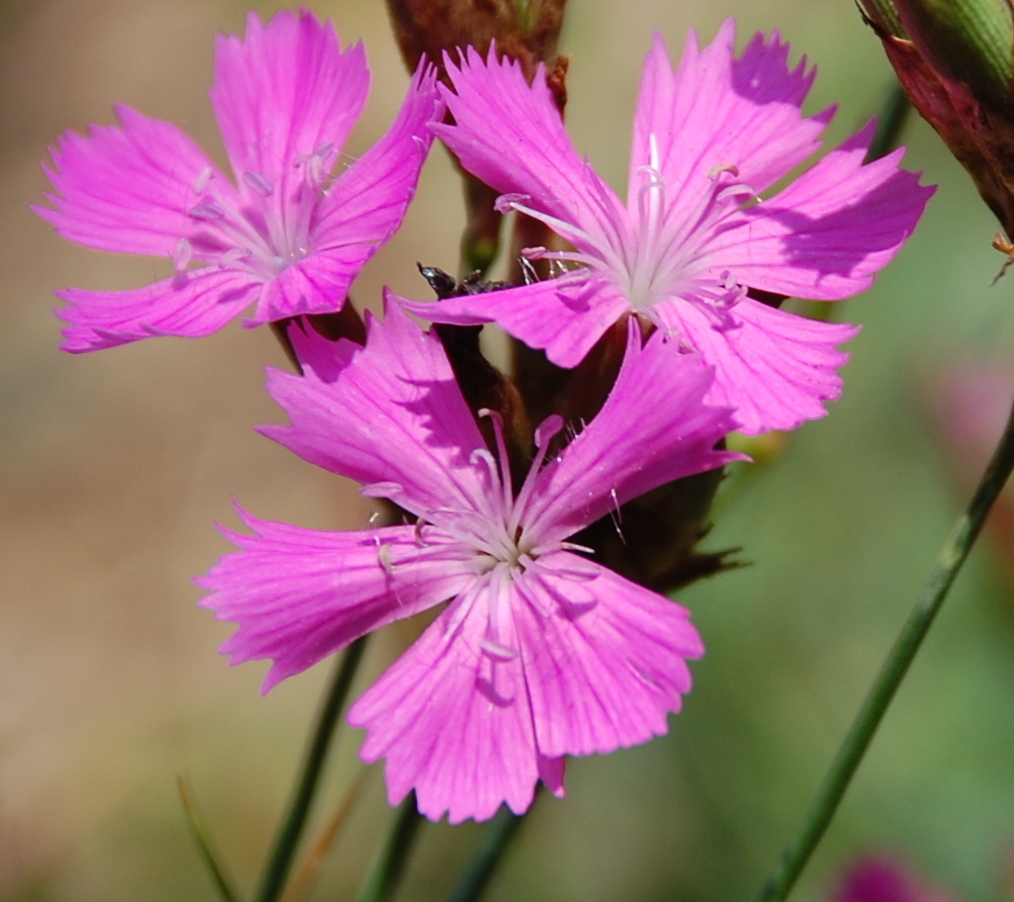
Carthusian Pink
Dianthus carthusianorum
Dianthus carthusianorum (Caryophyllaceae), commonly known as Carthusian pink or Clusterhead pink, belongs to the genus Dianthus and is native to Europe. It is a variable herbaceous perennial plant growing to 60 cm (24 in) tall.
From the article Dianthus carthusianorum on Wikipedia (CC BY-SA), quoted section by section
Description
Plants usually grow in small dense clusters with many stems, some of which are sterile. Stems are erect, unbranched or sometimes branched at the base. Leaf blades are linear, to spatulate and 3-7 cm long occasionally reaching length of 13 cm. They are green to slightly glaucous greyish-green and possess glabrous margins. The lower part of the leaf wraps around the stem and is described as leaf sheath, which is 8-18 mm long and 3-8 times as long as the stem diameter.
Flowers are grouped into dense, head-like clusters, which is why this species is also known as Clusterhead pink. These inflorescences usually contain 4-15 flowers, which are further surrounded by bracts which can be green and leaf-like or brown, dry and papery. Bracts end in an arista/awn. Sepals are fused to form the calyx tube characteristic for many Caryophyllaceae, it is 10-15 mm long, hairless, marked by 40-45 longitudinal ribs and at the top divided into 3-4 mm long oval lobes. The five clawed petals can be deep pink, to scarlet or purple; have tufts of tiny hairs towards their base and tooth-like projections on the outward facing part. After flowering 8-10 mm long fruits are forming as capsule which release many 1.6-2 mm long seeds after maturation. Chromosome numbers are 2n = 30 and 2n = 60.
Range & habitat
Dianthus carthusianorum is native to Europe, with a distribution range from central/northern Spain and Italy in the south; to southern Denmark, Germany and Poland in the north and to Bulgaria, Romania and Ukraine in the east. It is considered to be introduced in Sweden, Great Britain, Turkey and the US. Plants are occurring between June and October in dry, grassy habitats at altitudes of up to 2,500 m (8,200 ft) often in mountains.
Wikipedia: “Distribution”
Where it lives
Recorded sightings
—
geo-referenced records in GBIF, from museums, herbaria and field observers.
Drag the globe to turn it. Dots are where records exist, not a range map; darker means more records.
In the stacks
Searching the stacks…
Every page naming Dianthus carthusianorum in the Biodiversity Heritage Library →
This page is assembled live from iNaturalist, GBIF, Wikipedia, the Source Library and the Internet Archive. It is not yet part of the hand-edited codex. iNaturalist taxon 84960.